Can everyone agree that politicians are servants for the people, elected by the people ... can all parties agree on that point? OK, let's move on ... so if there is a WAVE, be it Chinese, rural, Indian, Iban, retards, gays, mixed parentage, single mums ... any kind of WAVE la ... that voted against your PARTY ...
WHY DO YOU AS A LEADER/SERVANT/PARTY FOR THE PEOPLE ... IMMEDIATELY QUESTION THE LOYALTY, QUESTION THE DECISION, CLAIMS THAT THE PEOPLE PART OF THE WAVE WERE UNGRATEFUL???
If your party/leader/members were really servants for the people .... the first thing that should come to your mind is .. WHERE DID WE GO WRONG!!! ... and not point fingers at your citizens!!!
When you accuse, it shows where your heart, motivations and intentions are ...
Why don't you be a servant of the people as all politicians should be, and ask the party themselves "DI MANA KAH KITA DAH MENGECEWAKAN RAKYAT ... menjadikan keadaan begini .... kenapa ada sekelompok rakyat yang berfikir demikian"
(Where did we go wrong, where did we fail our people that caused this group of people to vote against us)
Wednesday, May 08, 2013


Tuesday, May 07, 2013
Lots Of Questions, No Answers

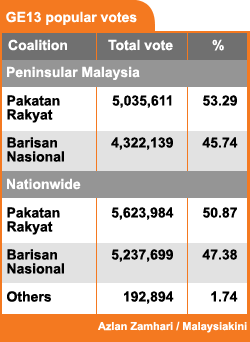
The chart above is why so many questions have risen ....
Bridget Welsh also has her view on the situation below.
Disturbing questions surrounding GE13 polling
By Bridget Welsh | 12:05PM May 7, 2013
Malaysiakini
Malaysiakini
 GE13 SPECIAL The GE13 results are in and the BN has managed to hold only power, winning by a 22-seat majority. This result is the worst performance for BN in Malaysia’s history.
For the first time, the incumbent government has lost the popular vote nationally (in 2008, it was only on the peninsula). The BN coalition has still managed to hold onto power. This piece, in a series analysing the election results, looks at the concerns raised regarding the electoral process and the potential impact these issues may have had on the final results.
In analysing the fairness of any polls, one asks whether the irregularities in the process could have affected the final outcome. Were the problems enough to change which coalition would have formed government? These issues will be debated and assessed in the days and weeks ahead. Let me share some preliminary observations that suggest that in this election, some things appear not to be quite right.
Integrity of electoral roll
This was the longest wait for an election, and both sides were extremely active in registering new voters, especially in the urban areas where the party machinery was well honed.
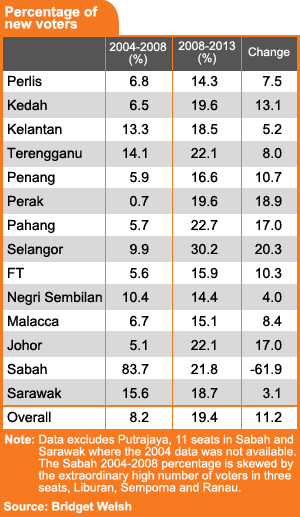
Even factoring in the more robust voter registration efforts, changes in electoral procedures to register people where they live rather than where they are from, population demographics, and possible housing developments in different seats, the increased numbers in the electoral roll are significantly not in line with historical patterns of voter registration. This out-of-line pattern is in every state, except Negeri Sembilan.
Even factoring in the more robust voter registration efforts, changes in electoral procedures to register people where they live rather than where they are from, population demographics, and possible housing developments in different seats, the increased numbers in the electoral roll are significantly not in line with historical patterns of voter registration. This out-of-line pattern is in every state, except Negeri Sembilan.
The figure that stands out in voter increase occurred from 2004 to 2008 in Sabah. The questions about the electoral roll in Sabah have been long standing, and are the subject of the ongoing Royal Commission of Inquiry into Immigrants.
These increases from 2004 through 2008 are by any measure – huge – in places such as Liburan, where caretaker Chief Minister Musa Aman state seat is located, in Semporna, the seat of Shafie Apdal and in Ranau currently held by Ewok Ebin.
Yet, after 2008, while the numbers have dropped, there is still on average 21% new voters in Sabah seats, a high number not in line with demographic trends. Migration appears to continue be a factor shaping voter numbers in Sabah in this GE13, despite calls to tighten the flows.
We also find that new voters have flooded states like Selangor, Pahang, Terengganu and Johor in GE13. The average increase in voters nationally between 2004 and 2008 was 8.2%. In the run-up to GE13, the voters registered doubled to 19.4%. The national and statewide averages however obscure the differences among different seats within states. It is clear that some seats have been special recipients of new voters.
Much has been made of the 28% of new voters in Lembah Pantai. This seat is actually on the low side compared to others. Consider the whopping 61.5% increase in Tapah, recently re-won by BN, or Subang with 52% new voters, won by Pakatan with a larger majority this election but shaped heavily by Pakatan’s registration of new voters.
A total of 90 seats, or 41% of all parliamentary seats, have more than 25% new voters. Many of these were in races with tight contests in 2008, and continued to have tight contests in GE13. The new voters has advantaged the opposition in urban areas, but benefitted the BN in rural and semi-rural areas or in states where the machinery of the opposition is comparatively weak, such as Johor.
Such races also won by BN that had large number of voters include Cameron Highlands (20%), Pasir Gudang (39%) and Tebrau (45%) in Johor. While some of the increase in the latter two seats might be explained in part by development, bizarrely there are sharp increases in voting populations in the remote interior state of Pensiangan (33%) and remote coastal seat of Kota Marudu (32%) in Sabah. These abnormal high increases raise questions.
 The placement of new voters is even more intriguing when studying the actual polling stations results. Many new voters are concentrated in more less populated areas within constituencies, often in rural and semi-rural seats.
This is where the questions over the large number of unexplained voters grouped in bunches in places like Bachok (21% new voters and won by PAS with less than 1% margin) and Bukit Gantang (29% of new voters and won by PAS with 2% margin) come in.
It appears that the localised remote placements of new voters may have had an impact. For example, the placement of 3,600 new voters in a remote Felda schemes occurred in Segamat, which was won by the BN with a 1,217 majority. The voting in this Felda scheme was over 90%, with one stream at 99%. In 2004, the voter turnout in this area was much lower.
This spike pattern of voter turnout in particular polling stations was found in Terengganu in 2004, when the BN wrested back the state, and questions were raised at that time as well.
Spike patterns out of line
This GE13 spike in voter turnout at the local level is being witnessed in specific places across the country. With the national level of turnout at 80%, the spike patterns that are well out of line with historic patterns of voting behaviour raise questions, even accounting for the overall rise in participation and voter turnout.
Another pattern in the placement of new voters beyond tight races involves prominent leaders getting large shares of new voters, such as Najib Razak’s own seat Pekan with 38% new voters, or Rompin represented by Jamaluddin Jarjis at 29% new voters. It remains unclear why these largely rural constituencies would have such large voter increases.
Generally out-migration areas such as Perak and Pahang receiving large numbers of new voters does not conform with population patterns. Why are places with people leaving to work outside get sharp increases in voters?
The lack of clear transparent explanations on why voters are registered in some areas in such high numbers this election, compared to past patterns in these areas, understandably raises questions.
Many seats that were lost by the opposition or were in tight races have large number of new voters, including, including Tanah Merah (24%) and Balik Pulau (25%), although in some cases the opposition picked up or retained seats with large voter increases in these seats, such as Kota Raja (47%) and Kuala Nerus (25%), among others.
This issue of voter registration and voter turnout levels needs further study, with more information on who are these new voters and their pattern of voting. The fact is that the polling station results will show the spikes at the local level and careful study will tell us statistically the impact of these new voters on electoral outcomes.
The Electoral Commission (EC) and electoral administration as a whole are facing a real trust deficit. A reliable electoral roll is essential for any fair elections. Repeatedly questions have been raised about the veracity of many new voters.
Election watchdog Merap and others have time and again drawn to the questions of electoral roll integrity. Before the polls, these matters were essentially ignored or dismissed. To date, the scope of phantom voters and questionable placement was not fully known. Now the results themselves will show the impact at the local level.
This is why the sharing of all results through the Borang 14 is essential in order to make a systematic and thorough assessment. Preliminary reviews of results are already raising red flags as they have shaped the outcomes at both the parliamentary and state levels.
Early and postal voting
Queries about the early and postal voting have also emerged. Here the question is about double voting, with individuals having the opportunity to vote twice. Postal voting numbers increased in this election. Historically, there have always been questions about the veracity of postal voting, with reports questioning that this voting is secret and others arguing over the accuracy of the results.
There have been improvements in recent years over postal voting involving polling agent access to this process in many locations. Yet, even with these improvements, questions about whether postal voting is fair and accurate remain.
In this election, further questions emerged over the numbers and placement of these postal voters in different constituencies. Many tight races, such as Sibu, had increases in postal voters. In some cases, the list of names of new postal voters were reportedly not provided openly.
Early voting, an estimated 240,000 people, is also a new addition for this election and being queried. Early voting includes many Malaysians within Malaysia, such as the wives of army officers and journalists who can vote before polls.
There was not a clear distribution of the list of early voters provided nationally, and in some cases even individual candidates were not able to access the names of who were the postal and early voters.
No clear explanation was given to why some constituencies received early voters and others did not. Importantly, this information was not properly shared so that it could be verified. Furthermore, there were unexplained instances when the numbers of early and postal voters increased. In Lembai Pantai, for example, the number stated was 200, but 600 showed up. How did this happen?
Given the reality that the indelible ink was in many cases not indelible, the possibility of double voting exists. On voting day there are numerous reports of individuals finding out that someone had voted fraudulently using their name, leading to concerns also about electoral disenfranchisement.
There were also reports of non-Malaysians being transported to the polling stations by buses and even flown in, some of these believed to be phantom voters. The scale and impact of these on the results is not yet clear, but given the combination of a non-transparent early and postal voting process in various locations and non-indelible ink issues on election day, and sightings of non-Malaysians in contentious seats, troubling questions are being raised.
The close results make these issues and questions more salient. A total of 72 of seats (or 32%) were won by less than 10% margins of turnout. Twenty percent of seats, 44 seats, were won with less than a 5% margin. The closeness of these races could easily have come down to a few voters. These razor-thin margin seats were won by both sides, but given the questions raised about the process of voting in these close seats, they need to be carefully reviewed.
To date, the total number of seats affected by either non-transparent new voter increases and early voting allocations and unexplained incidents of disenfranchisement appears to be more than the actual margin of victory for the BN. These reports need to be properly vetted and verified, but fundamental questions remained.
A spoilt-vote victory
Finally, this brings up the questions on the election night itself. There are queries surrounding the recounts and spoilt votes. How many recounts which overturned the results at the last moment were there? In Perak, for example, three state seats – three is a famous number in Perak – Alor Pongsu, Manjoi and Pangkor results were overturned at the last minute. Questions were also raised at Kamunting as well.
The need for transparency at the final count is essential for a fair election. When the EC asks people to leave and there are new ballot boxes seen outside of a polling station, as was reported in Lembah Pantai, there are questions. It is not fully clear what exactly happened with the recounts in Perak and elsewhere – as there were numerous recounts nationally this election – but the climate of distrust that has permeated the assessment of the election process raises doubts.
In the days ahead, a better sense of the numbers and recounts will emerge. With reports of sudden changes in the voting results such as Bentong and Labis, questions are being raised. Many people cannot understand how a result that was statistically a large margin ahead could be overturned. These need to be clarified, particularly in Bentong where the margin was larger.
Part of the problem is that in some cases, the number of spoilt votes exceeded the actual majority in places where recounts took place. Here are some of the seats at the parliamentary level where this happened: Kuala Selangor, Cameron Highlands, Bachok, Bentong, Sungai Besar, Kota Merudu and Baram won by the BN and Sepang and Kuala Nerus won by the opposition. Another seat with high spoilt votes is Segamat, at 950.
What distinguishes these close recounts from the famous cases of Lim Kit Siang and Karpal Singh losing in 1999 with more spoilt votes than the majority, is the process of the administration of the indelible ink in this election – before marking the ballot paper – thus staining the papers and contributing to higher spoilt votes.
This pattern of higher spoilt votes than actual margins of victory was also replicated at the state level as well in many areas, where only a few seats mattered for who should win state power. The process of administering the ink appears to have had an impact on the results in some areas.
It is important to be careful when reviewing the election results and not rush to judgement about what happened and why. It is also important to see the election holistically. The focus here has not touched on the use of money in the campaign, which was rampant, labeled ‘bombing’ in Sabah, or the mainstream media reporting.
The aim has been to raise the preliminary questions revealed in the results and the impact actual numbers of voters associated with the election. As the evaluation of the election moves forward, the call to answer these questions will only increase and intensify. Further study and analysis is essential.
Nevertheless, from the non-indelible ink and spikes in voter turnout to being not allowed to vote, concerns with the electoral process itself are not sitting right with many in the public, and this is not just supporters on one side or another. Transparent and truthful answers are both needed and welcomed.
__
DR BRIDGET WELSH is associate professor of political science at Singapore Management University. She is travelling around Malaysia to provide her GE13 analyses exclusively to Malaysiakini. Bridget can be reached at bwelsh@smu.edu.sg.
DR BRIDGET WELSH is associate professor of political science at Singapore Management University. She is travelling around Malaysia to provide her GE13 analyses exclusively to Malaysiakini. Bridget can be reached at bwelsh@smu.edu.sg.
Currency Realignment Battles
The amount of liquidity swishing in the global economy, it is unlikely to see any equity led correction in the forseeable future. Cyprus was but a blip, maybe if the same thing happened to Spain or Italy would we see anything resembling a major correction. No one seems to be ready to take back the liquidity from the financial system, not anytime soon.
The rising tide has brought up most equity markets, however, some hefty action may be seen in currency realignment battles. Why? Since most major economies are setting interest rates close to zero, that is as good as it gets to try to pump up the economy. What is left is a corresponding decline in purchasing power which lifts competitive advantage to further boost their economies.
Japan has thrown a spanner into the works by being aggressive in printing money following decades of inertia. When that happens, it negates the weaker Euro and US dollar, which may curb their economic intentions.

Safe havens such as yen, Swiss, the loonie and Aussie currencies may have seen funds leaving their shores as the need for safe havens seems to be dissipating. That could be because the US economy's recovery seem to have a bit more legs in it, plus Asia and Latin America are holding well. China seems to have navigated its excessive speculation in property and stock markets well enough by driving it down without a hard landing. China still has to grapple with State companies debt levels and some inroads seem to have been made there.
So, how should the currency wars play out. Soros was rumoured to have been shorting the Aussie dollar but the rumoured size of $1bn is not going to move markets. I would still short the Aussie dollar, not on betting on interest moves, but on usual holders of high interest rate papers in NZ and Aussie bonds (i.e. Japanese) to liquidate to move back to Japan as thing are rosier there.
Overvalued currencies are there for many reasons: mainly because they were largely unscathed from the 2008 crisis and a solid local economy.
The most undervalued major currency has to be the HKD. Its economy is not tied to the US but the currency is. What you get is smart investors would just keep piling into HK dollar assets until it is so frothy that they cannot take it anymore but will change it to a different basket weighted currency of yen, yuan, dollar and euro. The HKD is so artificially weak which is good for the local economy, tourism and MICE related events. I guess they will wait till things boil over in property and stocks before they have the political will to act.

For the rest of the year, these are my shorts and longs:
SHORTS - Aussie dollar, NZ dollar, Canadian loonie, Japanese yen
LONGS - Malaysian ringgit, Indonesia rupiah, Thai baht, HKD, Taiwan dollar, Chinese yuan
The rising tide has brought up most equity markets, however, some hefty action may be seen in currency realignment battles. Why? Since most major economies are setting interest rates close to zero, that is as good as it gets to try to pump up the economy. What is left is a corresponding decline in purchasing power which lifts competitive advantage to further boost their economies.
Japan has thrown a spanner into the works by being aggressive in printing money following decades of inertia. When that happens, it negates the weaker Euro and US dollar, which may curb their economic intentions.
Safe havens such as yen, Swiss, the loonie and Aussie currencies may have seen funds leaving their shores as the need for safe havens seems to be dissipating. That could be because the US economy's recovery seem to have a bit more legs in it, plus Asia and Latin America are holding well. China seems to have navigated its excessive speculation in property and stock markets well enough by driving it down without a hard landing. China still has to grapple with State companies debt levels and some inroads seem to have been made there.
So, how should the currency wars play out. Soros was rumoured to have been shorting the Aussie dollar but the rumoured size of $1bn is not going to move markets. I would still short the Aussie dollar, not on betting on interest moves, but on usual holders of high interest rate papers in NZ and Aussie bonds (i.e. Japanese) to liquidate to move back to Japan as thing are rosier there.
Overvalued currencies are there for many reasons: mainly because they were largely unscathed from the 2008 crisis and a solid local economy.
The most undervalued major currency has to be the HKD. Its economy is not tied to the US but the currency is. What you get is smart investors would just keep piling into HK dollar assets until it is so frothy that they cannot take it anymore but will change it to a different basket weighted currency of yen, yuan, dollar and euro. The HKD is so artificially weak which is good for the local economy, tourism and MICE related events. I guess they will wait till things boil over in property and stocks before they have the political will to act.
For the rest of the year, these are my shorts and longs:
SHORTS - Aussie dollar, NZ dollar, Canadian loonie, Japanese yen
LONGS - Malaysian ringgit, Indonesia rupiah, Thai baht, HKD, Taiwan dollar, Chinese yuan
Friday, April 26, 2013
@myburgerlab
You cannot pay me to come to a place to do a food review. If I write about it, it has to be very good or very bad. This has been ongoing for nearly a year and at the urgings of many friends, I finally made it. Its located at the edges of Paramount Garden, imagine going from SS2 to Paramount Garden, its about 50-100m from the wet market.
Closed on Mondays, opens from 5pm-10.30pm ... you cannot miss it if you come around 5 or 6 cause the queue snakes all the way to about 20-30 people. Best time to go is around 9.30pm as parking is easy.

Mine smelled so good, I had to eat it while driving back. Average age of patrons is below 25 for sure. Loved the concept and considering they do not use pork, these are exceptional burgers.
Charcoal bun: 9.5/10, not doughy, light and yummy
Beef patty: 9.5/10, juicy and well seasoned, seared well on the outside
Choices: mind boggling but almost everything is very good, the portobello plus melted cheese are to die for
Secret menu: the Elvis, peanut butter with jam, heavenly ... even though Elvis had his with crispy bacon as well
Chip: 8/10, a bit too much seasoning but still very good
Do not takeaway the burgers as its not so good after 20 minutes, too soggy and you really want a freshly grilled warm burger. Now, please have a decent coffee machine please....

I think many angel investors will be talking to the owners, and I hope they are well advised because you should not see this inside a mall. It will be fantastic as a suburban outlet, should keep it that way as there is an important collegian feel to the place, long benches and simple yet artistic elegance. Open near student colleges, thats your bread and butter. Its a cooler hangout place as more younger people prefer not to hang out at mamaks anymore.
Do not do franchise, it will kill the product. They also did one thing well, the staffing, for a small place, you will see 8 people cramped inside a well oiled kitchen, plus another 6-8 staff hanging around the place as server, more like GROs really, they will explain the menu and advise accordingly should you need that.
Best burger ever ... for just around RM20, it sure is by a mile. Do something, and do it really well, don't be tempted to offer too many other stuff. If only Ninja Joe pork burger outlets had the same management - replace the bun, hold the lettuce (it wets the burger too much), and stay away from the malls.
They can serve 400-600 burgers a day. On a napkin I can calculate that they will make between RM35,000-45,000 net a month. But if you go to a mall, you will end up paying your margins to the mall owners and lose much of the "essence of the place". Go for low hanging fruit first, try not to take any money from angel investors first - go and open at Subang SS15 area and another around Solaris Mont Kiara as Publika is way too crowded.
Do that well, then only go bigger because by then you would have room to have "sourcing power", "central kitchen for distribution of ingredients and sauces", and critical mass for staff training and culture immersion. Grow organically, involve loyal staff who represents your brand, plant them to grow much like Christians plant churches.
If you go overseas, I can suggest a side by side concept, one that serves pork burgers as well.

No.14, Jalan 21/22 Seapark
46300 PJ Selangor
Business hours: 5pm - 10.30pm (Closed on Monday)

Closed on Mondays, opens from 5pm-10.30pm ... you cannot miss it if you come around 5 or 6 cause the queue snakes all the way to about 20-30 people. Best time to go is around 9.30pm as parking is easy.
Mine smelled so good, I had to eat it while driving back. Average age of patrons is below 25 for sure. Loved the concept and considering they do not use pork, these are exceptional burgers.
Charcoal bun: 9.5/10, not doughy, light and yummy
Beef patty: 9.5/10, juicy and well seasoned, seared well on the outside
Choices: mind boggling but almost everything is very good, the portobello plus melted cheese are to die for
Secret menu: the Elvis, peanut butter with jam, heavenly ... even though Elvis had his with crispy bacon as well
Chip: 8/10, a bit too much seasoning but still very good
Do not takeaway the burgers as its not so good after 20 minutes, too soggy and you really want a freshly grilled warm burger. Now, please have a decent coffee machine please....
I think many angel investors will be talking to the owners, and I hope they are well advised because you should not see this inside a mall. It will be fantastic as a suburban outlet, should keep it that way as there is an important collegian feel to the place, long benches and simple yet artistic elegance. Open near student colleges, thats your bread and butter. Its a cooler hangout place as more younger people prefer not to hang out at mamaks anymore.
Do not do franchise, it will kill the product. They also did one thing well, the staffing, for a small place, you will see 8 people cramped inside a well oiled kitchen, plus another 6-8 staff hanging around the place as server, more like GROs really, they will explain the menu and advise accordingly should you need that.
Best burger ever ... for just around RM20, it sure is by a mile. Do something, and do it really well, don't be tempted to offer too many other stuff. If only Ninja Joe pork burger outlets had the same management - replace the bun, hold the lettuce (it wets the burger too much), and stay away from the malls.
They can serve 400-600 burgers a day. On a napkin I can calculate that they will make between RM35,000-45,000 net a month. But if you go to a mall, you will end up paying your margins to the mall owners and lose much of the "essence of the place". Go for low hanging fruit first, try not to take any money from angel investors first - go and open at Subang SS15 area and another around Solaris Mont Kiara as Publika is way too crowded.
Do that well, then only go bigger because by then you would have room to have "sourcing power", "central kitchen for distribution of ingredients and sauces", and critical mass for staff training and culture immersion. Grow organically, involve loyal staff who represents your brand, plant them to grow much like Christians plant churches.
If you go overseas, I can suggest a side by side concept, one that serves pork burgers as well.
No.14, Jalan 21/22 Seapark
46300 PJ Selangor
Business hours: 5pm - 10.30pm (Closed on Monday)
Saturday, April 13, 2013
2 Year Old Brilliant Artist
He is quite brilliant, look at some of his paintings, its not just some kid doodling paint .... there is a clarity of composition, there is structure in colour scheme selection. What is art? It is art, when it speaks to you.
------------------------------------------------------

His work is described as art in its purest form, untouched by life's pollutants and representative of what is important and beautiful. What makes it particularly special is it was created by a two-year-old … and it's been sold for $12,000.
Vinnie Marcis, who has high functioning autism, was 14-months-old when his mother Summa Shing first realised he had a gift.

"My grandfather, who is an art teacher, commented on how wonderful the works were," she said.
Advertisement
It was not only the family who were amazed by his talent, little Vinnie caught the attention of local art gallery owner and curator Troy Williams.
Mr Williams said he discovered Vinnie's ability when a friend told him to look at his paintings on Facebook.
"I didn't realise Vinnie was only two-years-old when I was looking at his works," said Mr Williams, who has seen the toddler in action.
"I liked what I saw and basically decided that I would like to represent the artist and do a show.''
He exhibited his work at C Gallery in Brisbane's Fortitude Valley last week, a show Mr Williams said was very successful.
"He's only got nine paintings left out of 30," he said.
"Also there was a little extra money made from donations at the bar, which was donated to the AEIOU Foundation [for children with autism]. People were astounded that the works were done by a two-year-old because they have so much maturity, composition and fluidity throughout."
Ms Shing has since provided an update on the show, reporting the works sold for about $12,000 in total, with 10 per cent of the profits donated to the AEIOU Foundation.
She said she felt Vinnie was aware of his achievement.
"He seemed to really turn it on that night and has been painting more than usual since," she said.
Read more: http://www.smh.com.au/entertainment/art-and-design/toddler-young-at-art-but-showing-a-maturity-to-turn-a-profit-20130411-2hog6.html#ixzz2QAibDlwL


Tuesday, April 09, 2013
Thatcherism
Why was Margaret Thatcher relevant or important to us? For many younger Brits, they may not realise it but the jobs and opportunities they have now are largely due to Thatcher. Why do I say that? Did you know what Britain was like in the 70s-80s... the unions had the rule of the day ... many were led by similar union leaders who wreaked havoc in Australia in the early 70s. It was getting to the stage where almost every week there was a new union striking for higher wages.

In her infinite wisdom and courage, she had the balls to not be part of the European Union, and stayed with the British pound. In her heart she probably knew the E.U. was a recipe for disaster ... and she was very right ... Funny how seemingly no one seems to be willing to attribute her achievements. Somehow I think it would be so different if Margaret was a man ... I think the accolades would have been enormous. Let us all check our biases .....
It was very difficult for any politician to deal with such threats and ransom-like tactics by the unions. It was her inner belief in having free markets that led her to be thorough in her reforms. She had the political integrity and political will to push things through even though knowing there will be bouts of resentment and adjustment for the real economy. But Thatcher, did, she told the people that she will get rid of them, and that the people would need to suffer for a while. They whacked the unreasonable unions out and had to endure some disruption in services but things just went skyrocketing after that.
That paved the way for the financial liberalisation for London to be the new financial center. The policies of Thatcher were smart and strategic to get UK where it is now. The young people now take their jobs for granted, not knowing how much hardship Thatcher had to go through, not to mention the male-egocentric naysayers in House of Commons and the street.
It was a job that would have taken a woman twice the might to get it done, buit she did it and she did it because she is a woman. Our Mahathir took a huge license from her political strategy to make it his own in the 90s - don't lie Dr. M, it was blatant and for all to see.
She deregulated the financial sector, privatised many state-owned companies, and took on the then-powerful trade unions. The resulting spike in unemployment accompanied by protests and inner-city riots tested her early leadership, but the 1982 Falklands war cemented her popularity, and she won two more general elections before her ‘poll tax’ proved a bridge too far.
If you followed her pursuits, she was an incredible debater, an excellent speech maker, a remarkable political strategist ... a person who can govern with a strong sense of capitalism and pragmatism. Many on the socialistic bent may disagree with her policies, and I do at times, but overall she was magnificent as a person and a politician.
Sometimes it takes a woman to do a man's job.
RIP, Mrs Thatcher.
In her infinite wisdom and courage, she had the balls to not be part of the European Union, and stayed with the British pound. In her heart she probably knew the E.U. was a recipe for disaster ... and she was very right ... Funny how seemingly no one seems to be willing to attribute her achievements. Somehow I think it would be so different if Margaret was a man ... I think the accolades would have been enormous. Let us all check our biases .....
It was very difficult for any politician to deal with such threats and ransom-like tactics by the unions. It was her inner belief in having free markets that led her to be thorough in her reforms. She had the political integrity and political will to push things through even though knowing there will be bouts of resentment and adjustment for the real economy. But Thatcher, did, she told the people that she will get rid of them, and that the people would need to suffer for a while. They whacked the unreasonable unions out and had to endure some disruption in services but things just went skyrocketing after that.
That paved the way for the financial liberalisation for London to be the new financial center. The policies of Thatcher were smart and strategic to get UK where it is now. The young people now take their jobs for granted, not knowing how much hardship Thatcher had to go through, not to mention the male-egocentric naysayers in House of Commons and the street.
It was a job that would have taken a woman twice the might to get it done, buit she did it and she did it because she is a woman. Our Mahathir took a huge license from her political strategy to make it his own in the 90s - don't lie Dr. M, it was blatant and for all to see.
She deregulated the financial sector, privatised many state-owned companies, and took on the then-powerful trade unions. The resulting spike in unemployment accompanied by protests and inner-city riots tested her early leadership, but the 1982 Falklands war cemented her popularity, and she won two more general elections before her ‘poll tax’ proved a bridge too far.
Lady Thatcher also played a key role in the end of the Cold War, leading the West’s embrace of reformist Soviet leader Mikhail Gorbachev.
If you followed her pursuits, she was an incredible debater, an excellent speech maker, a remarkable political strategist ... a person who can govern with a strong sense of capitalism and pragmatism. Many on the socialistic bent may disagree with her policies, and I do at times, but overall she was magnificent as a person and a politician.
Sometimes it takes a woman to do a man's job.
RIP, Mrs Thatcher.
Tuesday, March 26, 2013
Must Watch Movies
Amid the tension surrounding the elections and the uncertain market conditions owing because of that, let's look at something else to take our minds to something different. For the last 3 months or so, there have not been any worthy English films to talk about, probably because the Oscar race is over and other blockbusters are awaiting the summer release. However, I have found 3 magnificent Canto/Mando films, highly entertaining to boot. Must watch.
The first is the sleeper hit from China, Lost In Thailand. Its a kind of Planes, Trains and Automobiles (Steve Martin, John Candy) meet The Hangover. It was so successful, it has grossed more than US$200m in China alone. It has also caused the number of Chinese tourists to Thailand to jump manifold. It tells of two executives from a venture capital firm seeking the signature of their boss who has gone for a sabbatical at one of the monastery in Thailand for a critical deal. Its very funny in any language.

The Cold War, brilliant in the same style as Infernal Affairs, only this time the crooks have abducted a police patrol van with the 5 police officers inside and ransoming the entire police force. Although Aaron Kwok looks a bit too young to be cast as a very very senior police officer, it was a mild thing. The story line is captivating but its the personalities in the police force that takes center stage. As the top officer is overseas, the next 2 most senior fought for the right to oversee the "rescue/ransom" - Tony Leung Kar Fai was brilliant, trying to gain control of the operations as his son is one of the 5 kidnapped officers. While Aaron is not really a detective but rose from the ranks of administration and strategy. You feel for all the main characters. Gripping stuff.

The final one has to be the bravest comedy produced from HK. Its called Vulgaria, and the entire movie is filled with profanities in Cantonese, but very funnily done. Top notch actors delivering the crudest lines with a hard to believe story line, but somehow it all works. The profanities are not deliberate because in reality its how normal HK people speak. There are too many laugh out loud scenes, most are too crude to describe here. Must be conversant in Cantonese to watch this one.

The first is the sleeper hit from China, Lost In Thailand. Its a kind of Planes, Trains and Automobiles (Steve Martin, John Candy) meet The Hangover. It was so successful, it has grossed more than US$200m in China alone. It has also caused the number of Chinese tourists to Thailand to jump manifold. It tells of two executives from a venture capital firm seeking the signature of their boss who has gone for a sabbatical at one of the monastery in Thailand for a critical deal. Its very funny in any language.
The Cold War, brilliant in the same style as Infernal Affairs, only this time the crooks have abducted a police patrol van with the 5 police officers inside and ransoming the entire police force. Although Aaron Kwok looks a bit too young to be cast as a very very senior police officer, it was a mild thing. The story line is captivating but its the personalities in the police force that takes center stage. As the top officer is overseas, the next 2 most senior fought for the right to oversee the "rescue/ransom" - Tony Leung Kar Fai was brilliant, trying to gain control of the operations as his son is one of the 5 kidnapped officers. While Aaron is not really a detective but rose from the ranks of administration and strategy. You feel for all the main characters. Gripping stuff.
The final one has to be the bravest comedy produced from HK. Its called Vulgaria, and the entire movie is filled with profanities in Cantonese, but very funnily done. Top notch actors delivering the crudest lines with a hard to believe story line, but somehow it all works. The profanities are not deliberate because in reality its how normal HK people speak. There are too many laugh out loud scenes, most are too crude to describe here. Must be conversant in Cantonese to watch this one.
Monday, March 25, 2013
Let's All Adopt This - How Car Drivers Say Thank You
There are very few cases of road rage in Japan. See how car drivers say thank you in Japan. If you let another car into your lane, the other driver will press the hazard lights and let it blink a couple of times to say thank you. So cool ... yet I think it will go a long way to de-stress those around us and lets make a step to try and change the Malaysian driving culture bit by bit.
Important To View: Can The Pakatan Manifesto Stands The Math Test
The simplest way to attack the Pakatan Manifesto is to say that it will not work, that there is not enough money to fund all that. Tony Pua, a learned person of business and strategist, explains why the Pakatan Manifesto is not a pipe dream. Excellent presentation and convincing too.
Thursday, March 21, 2013
Jon Hamm's Penis Banned From Mad Men
Mad Men is a very good series, but the producers are having a hard time with Jon Hamm's little general, as men during those days wear much tighter trousers, so much so that his cowabunga had to be photoshopped out of posters..etc... What a wonderful positive PR problem to have.


When a man walks into a room, he brings his whole penis with him. A fleshy appendage, no less primitive than the prehensile tail we lost when we evolved, yet no less important than the heart that keeps us pumping. It makes a man feel whole. It drives a man. It’s the stick that chases the carrot. And when it hangs off of Jon Hamm, it causes problems simply because it stands up for itself.
Conflicts between the Mad Men crew and Jon Hamm’s increasingly demanding companion, Little Dick Whitman, have apparently become so prevalent, the show’s producers have “politely” asked the notoriously freewheeling star to stifle his penis with a layer of restrictive underwear, after Hamm’s penis became too distractingly headstrong. “This season takes place in the 1960s, where the pants are very tight and leave little to the imagination,” an insider "source" explains to the New York Daily News. And while, yes, the entire series has so far taken place in the 1960s, either the closer trouser cuts of Carnaby Street have begun to encroach upon Mad Men, or Jon Hamm’s penis has similarly begun to experiment with the styles of the era, and its insistence on copying Bob Dylan’s fly-away hair and Cuban boots have made Hamm’s penis all the more disruptive.
In addition to being banned from the set, Jon Hamm’s penis has also been Photoshopped out of promotional booklets and advertisements, with NYDN’s source laughing, “Imagine how distracting that would be on the side of a bus or building.” Hamm’s representative, however, doesn’t find anything amusing about his client’s enormous, impudent genitals being scrubbed from city buses so as not to cause traffic accidents. “It is ridiculous and not really funny at all. I’d appreciate you taking the high road and not resorting to something childish like this that’s been blogged about 1,000 times,” they said, clearly not familiar with the Internet.
On a related note, Matthew Weiner is still allowed free rein. "Around here there can only be one Weiner in charge," he said, hopefully.
Tuesday, March 19, 2013
Where Is Cyprus?
To most of us, we do not even know the locations of Cyprus, maybe even the fact that it was admitted into the European Union as well. How can something so small be so significant? How can it drag markets down so much? In hindsight, the weaker markets gave the lawmakers a big signal. Its not so much that they can whack the depositors in Cypriot banks, they are scared that such tough and unreasonable measures may be employed at other difficult countries such as Spain or Italy.
What is likely to happen: the Cypriot lawmakers will vote down the rule. This will anger the ECB and may pave the way for Cyprus exit. I mean, seriously, in the whole scheme of things, its only $7bn. You may actually see a minor bank run at places such as Italy and Spain as well, which may bring back the ECB, IMF and EU finance ministers to the discussion room. Likelihood, the tax will only apply to deposits above 100,000 euros ... paving the way to tax the rich but not the poorer citizens - that may be acceptable, the shortfall can easily be made up by the trioka.

(excerpts from Bloomberg & NYT)
A plan to rescue the tiny European country of Cyprus, assembled overnight in Brussels, has left financial regulators, German politicians, panicked Cypriot leaders and a disgruntled Kremlin with a bailout package that has outraged virtually all the parties. Russia was angry it was left out of talks to aid Cyprus, where it has billions in banks. Aha, you see, Cypriot banks was seen as a haven for a lot of riche Russians to stash their millions and billions.
As markets tumbled and the Cypriot Parliament fell into turmoil. It now looks likely that the Cypriot lawmakers will vote down the measures.
Officials scrambled to explain what went wrong and how best to control the damage of completely irrational decision to make bank depositors liable for part of the bailout. The deal flopped so badly that finance ministers who came up with it shortly before dawn on Saturday were on the phone to each other Monday night talking about ways to revise it. Whatever the outcome, the dispute is a vivid demonstration of why Europe, which until recently was congratulating itself on having weathered the worst of the financial storm, has trouble making decisions with so many different interests represented at the table.

Politics, both domestic and international, get in the way of economics and make it difficult for wealthy countries to line up behind a plan to help the smallest ones. The northern European nations have grown so weary of bailouts for their southern neighbors that they were intent on exacting a hefty contribution from their latest supplicant. Germany in particular, with parliamentary elections looming in September, was set on driving a hard bargain.
A wild card in this instance were the Russians, who have deposited billions in Cypriot banks, extended a $3.25 billion line of credit to Nicosia in 2011 and were in negotiations to help out Cyprus once again. Cypriot leaders apparently were so concerned with keeping their wealthy offshore Russian customers happy that they pushed their own citizens to pay even more than some of the lenders were demanding.
The Russians reacted angrily to a so-called stability tax on deposits in Cyprus, and at being left out of the negotiations. On Monday, Russia’s minister of finance, Anton Siluanov, warned that Russia might not extend the existing credit line because the Europeans had not consulted authorities in Moscow about the deposit levy plan. On Sunday, one Russian official was reported by the Interfax news agency as advising Russians to withdraw funds from Cyprus, saying the banking system was untrustworthy.
The all-night discussions began Friday and ran for 10 hours, ending shortly before dawn on Saturday. Cyprus needed to come up with billions of dollars to help cover the costs of the bailout of the country’s financial sector, or its European allies said they would leave it to face the prospect of collapse alone.
Each of the major stakeholders, which included the International Monetary Fund, the European Central Bank and euro zone finance ministers, entered the room with a conflicting goal. Protecting the small-time saver was at the top of no one’s list. The result was a compromise solution everyone is now unhappy with, officials say, one that stands to cost ordinary Cypriot depositors 6.75 percent of their savings.
The Germans and their northern European allies wanted to exact a maximum contribution from Cyprus to ensure the deal could pass their recalcitrant, bailout-weary parliaments at home. A confidential report by the German foreign intelligence agency, known by its German initials as the B.N.D., was making the rounds, one that painted the island as a haven for money-laundering. The stigma attached to helping the Cypriots — and the political cost in an election year — was rising rapidly.

The I.M.F. was dead set on keeping the debt at what its number-crunchers considered a sustainable level. The Cypriots, meanwhile, wanted to spread the pain around.
The European Central Bank also had reservations about levying higher taxes, but the Germans wanted $9.2 billion from depositors, officials said. That was an enormous contribution for a country the size of Cyprus.
Cypriot lawmakers is likely now to shoot down an unprecedented levy on bank deposits, risking the island’s membership in the euro. Cypriot President Nicos Anastasiades warned German Chancellor Angela Merkel in a call yesterday that he may not be able to win passage, said a Cypriot government official.
Finance chiefs from the 17-member euro area late yesterday urged Cyprus to spare small-scale savers, while keeping unchanged the size of their demand on account holders. While Cyprus accounts for less than half a percent of the euro economy, the fight over the bank tax risks triggering new turmoil in the financial crisis that began in 2009 in Greece.
A complete rejection of the measure would forego European assistance and could lead to a sovereign default, or even an exit from the currency union. What we have seen in the last few days is a very serious blunder by European governments that essentially are blackmailing the government of Cyprus to confiscate the money that belongs rightfully to depositors.
Once banks on the island reopen, the country could see more than 7 billion euros in outflows, or about 10 percent of the total, Central Bank Governor Panicos Demetriades told a parliamentary committee.
Anastasiades was rebuffed in a call to German Chancellor Angela Merkel yesterday. Merkel told him that he can only negotiate a rescue with the so-called troika, which comprises the European Commission, the ECB and the International Monetary Fund, according to a German government official.
The bank levy and additional tax measures reduced the overall rescue package to 10 billion euros from about 17 billion euros to meet the IMF’s demand for debt sustainability and German politicians’ skepticism over financial transfers.
German Finance Minister Wolfgang Schaeuble said there was no other option if the troika wanted to keep the price tag for the bailout at 10 billion euros. Naturally, the Cypriot president tried to find a way around it, but there was none, and that the levy doesn’t violate deposit guarantees, because such protections are “only as good as a state’s solvency.
Russian President Vladimir Putin called the tax “unfair, unprofessional and dangerous,” according to a statement posted on the Kremlin website. Russian companies and individuals have $31 billion of deposits in Cyprus, according to Moody’s.

What is likely to happen: the Cypriot lawmakers will vote down the rule. This will anger the ECB and may pave the way for Cyprus exit. I mean, seriously, in the whole scheme of things, its only $7bn. You may actually see a minor bank run at places such as Italy and Spain as well, which may bring back the ECB, IMF and EU finance ministers to the discussion room. Likelihood, the tax will only apply to deposits above 100,000 euros ... paving the way to tax the rich but not the poorer citizens - that may be acceptable, the shortfall can easily be made up by the trioka.

Global markets were rattled slightly. However as more news on the backlash by so many parties, it is likely that the rule has to be changed significantly to gain acceptance, and more importantly restore confidence in the ECB's recovery and restoration plan. Cyprus ia small issue, no one will risk pushing the silly rule through at the risk of major fallouts in bigger EU nations. Last thing they need in Italy and Spain is a bank run.
(excerpts from Bloomberg & NYT)
A plan to rescue the tiny European country of Cyprus, assembled overnight in Brussels, has left financial regulators, German politicians, panicked Cypriot leaders and a disgruntled Kremlin with a bailout package that has outraged virtually all the parties. Russia was angry it was left out of talks to aid Cyprus, where it has billions in banks. Aha, you see, Cypriot banks was seen as a haven for a lot of riche Russians to stash their millions and billions.
As markets tumbled and the Cypriot Parliament fell into turmoil. It now looks likely that the Cypriot lawmakers will vote down the measures.
Officials scrambled to explain what went wrong and how best to control the damage of completely irrational decision to make bank depositors liable for part of the bailout. The deal flopped so badly that finance ministers who came up with it shortly before dawn on Saturday were on the phone to each other Monday night talking about ways to revise it. Whatever the outcome, the dispute is a vivid demonstration of why Europe, which until recently was congratulating itself on having weathered the worst of the financial storm, has trouble making decisions with so many different interests represented at the table.

Politics, both domestic and international, get in the way of economics and make it difficult for wealthy countries to line up behind a plan to help the smallest ones. The northern European nations have grown so weary of bailouts for their southern neighbors that they were intent on exacting a hefty contribution from their latest supplicant. Germany in particular, with parliamentary elections looming in September, was set on driving a hard bargain.
A wild card in this instance were the Russians, who have deposited billions in Cypriot banks, extended a $3.25 billion line of credit to Nicosia in 2011 and were in negotiations to help out Cyprus once again. Cypriot leaders apparently were so concerned with keeping their wealthy offshore Russian customers happy that they pushed their own citizens to pay even more than some of the lenders were demanding.
The Russians reacted angrily to a so-called stability tax on deposits in Cyprus, and at being left out of the negotiations. On Monday, Russia’s minister of finance, Anton Siluanov, warned that Russia might not extend the existing credit line because the Europeans had not consulted authorities in Moscow about the deposit levy plan. On Sunday, one Russian official was reported by the Interfax news agency as advising Russians to withdraw funds from Cyprus, saying the banking system was untrustworthy.
The all-night discussions began Friday and ran for 10 hours, ending shortly before dawn on Saturday. Cyprus needed to come up with billions of dollars to help cover the costs of the bailout of the country’s financial sector, or its European allies said they would leave it to face the prospect of collapse alone.
Each of the major stakeholders, which included the International Monetary Fund, the European Central Bank and euro zone finance ministers, entered the room with a conflicting goal. Protecting the small-time saver was at the top of no one’s list. The result was a compromise solution everyone is now unhappy with, officials say, one that stands to cost ordinary Cypriot depositors 6.75 percent of their savings.
The Germans and their northern European allies wanted to exact a maximum contribution from Cyprus to ensure the deal could pass their recalcitrant, bailout-weary parliaments at home. A confidential report by the German foreign intelligence agency, known by its German initials as the B.N.D., was making the rounds, one that painted the island as a haven for money-laundering. The stigma attached to helping the Cypriots — and the political cost in an election year — was rising rapidly.

The I.M.F. was dead set on keeping the debt at what its number-crunchers considered a sustainable level. The Cypriots, meanwhile, wanted to spread the pain around.
The European Central Bank also had reservations about levying higher taxes, but the Germans wanted $9.2 billion from depositors, officials said. That was an enormous contribution for a country the size of Cyprus.
Cypriot lawmakers is likely now to shoot down an unprecedented levy on bank deposits, risking the island’s membership in the euro. Cypriot President Nicos Anastasiades warned German Chancellor Angela Merkel in a call yesterday that he may not be able to win passage, said a Cypriot government official.
Finance chiefs from the 17-member euro area late yesterday urged Cyprus to spare small-scale savers, while keeping unchanged the size of their demand on account holders. While Cyprus accounts for less than half a percent of the euro economy, the fight over the bank tax risks triggering new turmoil in the financial crisis that began in 2009 in Greece.
A complete rejection of the measure would forego European assistance and could lead to a sovereign default, or even an exit from the currency union. What we have seen in the last few days is a very serious blunder by European governments that essentially are blackmailing the government of Cyprus to confiscate the money that belongs rightfully to depositors.
Once banks on the island reopen, the country could see more than 7 billion euros in outflows, or about 10 percent of the total, Central Bank Governor Panicos Demetriades told a parliamentary committee.
Anastasiades was rebuffed in a call to German Chancellor Angela Merkel yesterday. Merkel told him that he can only negotiate a rescue with the so-called troika, which comprises the European Commission, the ECB and the International Monetary Fund, according to a German government official.
The bank levy and additional tax measures reduced the overall rescue package to 10 billion euros from about 17 billion euros to meet the IMF’s demand for debt sustainability and German politicians’ skepticism over financial transfers.
German Finance Minister Wolfgang Schaeuble said there was no other option if the troika wanted to keep the price tag for the bailout at 10 billion euros. Naturally, the Cypriot president tried to find a way around it, but there was none, and that the levy doesn’t violate deposit guarantees, because such protections are “only as good as a state’s solvency.
Russian President Vladimir Putin called the tax “unfair, unprofessional and dangerous,” according to a statement posted on the Kremlin website. Russian companies and individuals have $31 billion of deposits in Cyprus, according to Moody’s.

Tuesday, March 05, 2013
HIV - Important Developments
Many are trying not to jump to too many conclusions too soon, but we could possibly see significant developments in curing babies of AIDS soon. That should be a first step towards finding cures for adult patients.
By RON WINSLOW (Wall Street Journal)
The report that a 2½-year- old Mississippi baby appears to be cured of HIV, the virus that causes AIDS, has provoked intense interest, excitement and some skepticism among AIDS researchers and the community at large.
The toddler's case, if confirmed in further research, could have important implications for treatment of more than 300,000 babies born with the virus each year—mostly in the developing world.
The baby is the second person ever documented to be cured of the virus during the 32-year global AIDS epidemic. The first, a man named Timothy Brown and known as the Berlin patient, was cured as an adult as a result of a bone-marrow transplant he received to treat his leukemia.
Here are answers to some questions raised by the report, which was disclosed Sunday and formally presented Monday at the annual Conference on Retroviruses and Opportunistic Infections in Atlanta.

WSJ's Ron Winslow reports on the unprecedented cure of the HIV virus in a two-year-old girl in Mississippi and its potential impact on broader treatments. Photo: Getty Images.
Q. Beyond the report of the cure itself, what stands out about this case?
A. Two important details are these: The baby was started on a more aggressive regimen than normal—and within 31 hours of birth—well before test results that confirmed the HIV infection were available. Generally, doctors start with a lower dose and wait for confirmation of infection before starting such an intense regimen, something that can take four to six weeks. Researchers believe the rapid, aggressive treatment likely led to curing the child of the virus.
Second, the mother decided to take the baby off therapy, something a doctor would almost never do. When the baby was brought back for care after a hiatus of at least five months, standard tests were unable to detect any virus. "I fully expected to see that the child's viral load had gone up quite high," said Hannah Gay, the doctor at University of Mississippi Medical Center who started the baby on the intense regimen.
Q. This is just one case. Will this treatment strategy cure more babies?
A. Much more research is required to validate the finding before it could become part of standard treatment. Deborah Persaud, the researcher at Johns Hopkins Children's Center who is the lead author of the cure report, said further studies are now being planned to test the intense, very early treatment regimen in more infants. In addition, the baby will continue to be monitored for her HIV status.
If the findings hold up, the approach could significantly alter developing-world treatment of babies born with HIV, perhaps playing a major role in the global health community's goal of halting HIV infection of newborns. "This news gives us great hope that a cure for HIV in children is possible and could bring us one step closer to an AIDS-free generation," UNAIDS Executive Director Michel Sidibé said in a statement.
Q. What are the implications for people already diagnosed with HIV or who have progressed to developing AIDS?
A. It isn't clear how the new case applies to people with established infections. Such infections are characterized by "viral reservoirs" where HIV lurks in immune-system cells, hidden from treatment and ready to roar back when treatment stops. The latent reservoirs persist for years and are the major barrier to an overall cure of HIV and AIDS.
In the case of the baby, researchers believe the early treatment likely prevented the establishment of the reservoirs, which typically can form very quickly after exposure to HIV.
Q. So was the baby infected or was the infection prevented by the treatment?
A. Some researchers question whether the baby was truly infected. Cells in the baby "may have been infected—there was virus around," said Steven Deeks, an AIDS researcher at University of California at San Francisco. "But the cells being infected weren't the type that become long-lived reservoirs."
The key issue in prevention is reversing the effect of the latent reservoirs, Dr. Deeks said. "What is probably happening [in the Mississippi case] is that latency is being prevented, not reversed."
Q. Why do researchers think the baby was infected with HIV?
A. The baby tested positive for the virus based on five separate tests, including two taken within 31 hours after birth. After treatment began, levels of the virus gradually declined. At one month, the virus couldn't be detected by commonly used tests, an expected result based on the therapy she was given.
Anthony Fauci, director of the National Institute for Allergy and Infectious Diseases, said, "They did the right things in their study." The findings are a "proof of concept" that very early treatment—before the viral reservoirs are established and before the immune system is damaged—could cure babies of the infection.
In any event, if the strategy is proven effective in additional studies, it likely wouldn't matter whether the infections were being prevented or just rooted out before they became established in the reservoirs, researchers said. Babies would still become free of infection.
Q. How would the strategy fit into current efforts to prevent infections among newborns?
A. The well-established approach is to treat infected pregnant women with antiretroviral therapy during pregnancy and during birth. That reduces the rate of mother-to-child transmission to under 2% from a range of 15% to 45%, according to the World Health Organization.
That's why WHO, UNAIDS and other public-health organizations have made providing pregnant mothers in the developing world with access to antiretroviral drugs the primary strategy in preventing mother-to-child transmission.
"We still need to focus on prevention," said University of Mississippi's Dr. Gay. "Prevention works and prevention is the best form of cure."
Sunday, March 03, 2013
Asset Class Returns As At End February 2013
As the table is based in USD, a stronger dollar last month clipped returns of foreign stocks and bonds from a U.S. currency perspective. U.S. equities and bonds, by contrast, posted respectable gains in February, although the domestic pop wasn't enough to offset the drag from foreign markets in U.S. dollar terms for a globally diversified portfolio. As a result, the Global Market Index (GMI) slipped 0.1% last month, although GMI is still up a handsome 2.4% for the year so far through February's close.
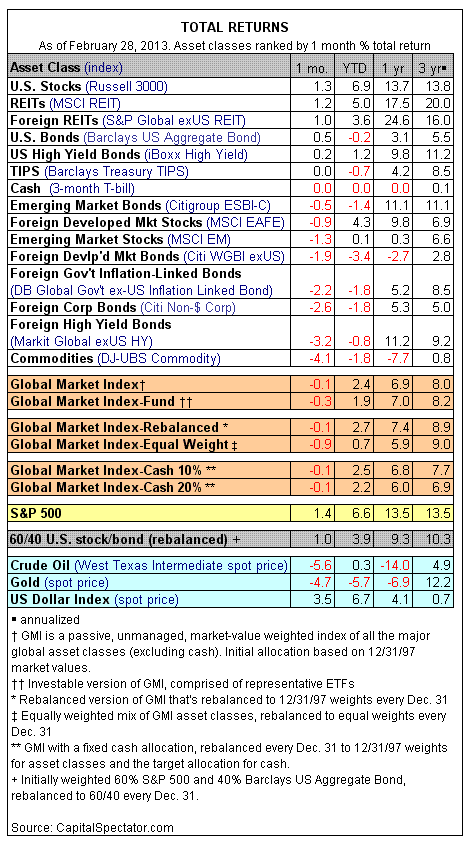
The big loser last month was commodities, which shed more than 4% overall. Meanwhile, REITs continue to rise, adding 1.2% in the U.S. market and gaining 1.0% on an offshore basis. Over the past year, REITs generally are in the performance lead among the major asset classes. Foreign REITs in particular are higher by a strong 24.6% through the end of February 2013. REITs has been on a tear for most of the past 12 months, a strong indication of the recovery in commercial properties - the fact that money is leaving the sidelines and venturing into stocks and properties in the US is a strong trend for a buoyant market in 2013.
By comparison, bonds, US and foreign have been muted, again a show of money exiting bonds. You would think that considering a market rally in equities based on liquidity (thanks to all central banks printing press) would have seen an effect in commodities, the reverse is happening. That is not a good thing as it may mean that the current equity rally is largely a bubble as it is not translating into real activity (i.e. pickup in commodities buying for end products or consumption). A better explanation would that there has been so much excess capacity and inventory for commodities that they will only pick up by June July methinks, same for the precious oil.
Subscribe to:
Posts (Atom)