Showing posts with label Citibank. Show all posts

Monday, March 02, 2009

Citi Is Scrambling To Survive


The near bank nationalisation of Citgroup sent its shares spiraling downwards. Didn't Roubini advocate bank nationalisation? Was the move bad? The government's term sheet proposed the conversion of
Citi preferred stock into common at a price of $3.25. The face value of Citi preferred stock is $25, implying 7.69 shares of common to be received per preferred share (at $3.25). If all the preferreds convert, the common shareholders will see a 75% dilution. What that means is that assuming earnings go back to what it was 5 years ago, the EPS would have to see a similar 75% dilution in real EPS just by the sheer amount of new common shares. So, if you think Citi was going back to $40 like in the old days - similar earnings 5 years ago would only make the current Citi share to reach $10, and that is a wildly optimistic view now. Citi should be locked under $5 for the next few years.

Following the announcement, Citigroup traded at around $1.60 on Friday, a preferred share holder would effectively had an an implied value of $12.30 of common stock per preferred share. Citi preferreds traded down to a low price of $4.5 early in the day, after closing at $5.50 Friday, however they quickly inverted and hit a high of $9.25 as people realized the potential arbitrage, before closing for the day at $8.05 on volume of 46.5 million shares. This was an excellent arb opportunity whereby you can short 7.69 shares of common for every share of preferred purchased. This arb is worth nearly 50% return. I do believe that the government's move was "positive" for Citi. However there are some unknowns still in the conversion amount, and added to that the arb opportunity caused persistent selling in the second half of the day.

The uncertainty also affect the arb in addition to shaking down the share price. There was a footnote in the Citi illustrative example of how preferred to common conversion would take place, where Citi noted that the government will provide separate treatment for private and public preferred shareholders: "Ownership assumes conversion of publicly issued preferred stock is done at a significant premium to market, while the U.S. Government's and privately placed preferred are done at par." Which is to say the rest of the preferred stock's conversion rate is still unconfirmed.

The arbs are now hoping that the premium for their publicly purchased preferred shares will be lower than the "guaranteed" 50% return they would pocket if they executed the trade at the end of the day, as otherwise they face massive losses on the conversion. If not, the whole arb trade will collapse and you will see massive short covering in Citgroup shares.

The government's move is good as it will give effective control to the government, hence the bank would be more than likely to be biting the bullet on some of the niggling issues which many troubled banks have been neglecting to do - sell down the toxic assets; work closer with private equity and hedge funds to take some of the toxic assets off the books. The other good from the move is that Citi will save from having to pay dividends/interest on the preferred stocks that have been converted. Don't laugh, that is worth some $10bn over the next few years, which is as good as receiving a capital injection of $10bn to Citi.

The other reason for the sell down is the amount new to be converted stock that is coming onto the market for Citi by the preferreds. The key to raising confidence in Citi was to massively increase its tangible common equity, a measure of capital that shows the value attributable to common shareholders. TCE doesn't include securities such as preferred shares. Citi's TCE prior to the new move was at a shaky 1.5%, now it should go above 4.3%. Citi still has to convince Singapore's GIC and Abu Dhabi I.A. to convert their preferreds - a move not palatable to them but in the end they will have little choice really. Expect Citi shares to swing wildly over the next few days but I expect reality to sink back in and go back above $2, some short covering to come in as well.
[citi]

p/s photo: Marion Caunter

Saturday, January 31, 2009

Why Citibank Might Not Be Around ... Soon


Why pick on Citibank? Didn't they agree to break up the company already? Well, one can argue that the biggest toxic assets reside in Citigroup, Lehman Brothers and Merrill Lynch. We all know Lehman was hung out to dry. Merrill's woes are now part of Bank of America's problems. BoA may or may not be able to digest Merrill's positions. Both Citi and BoA have been given tons of money by the US government. Will it be sufficient? In the past 12 months, taxpayers, sovereign wealth funds and private investors have sunk $1 trillion into failing U.S. and British financial institutions, while central banks have slashed their cost of funds to nothing and their collateral standards even lower.

It looks likely that the hole is simply too big to fill even by governments. Bank losses from the write-offs of bad loans and busted derivatives tally up to $1.5 trillion so far. In addition, $5 trillion to $10 trillion worth of off-balance-sheet businesses such as structured investment vehicles - leveraged lending vehicles used by big banks are being forced back to banks' balance sheets by regulators. Rules require banks to keep a base of real shareholder capital amounting to 10% of those funds. So banks need to find up to $1 trillion within the next year to meet that objective.That is in addition to all that has been injected into banks so far.

Add the $1.5 trillion in losses to $1 trillion in needed new reserves, and you can see that banks need as much as $2.5 trillion in new capital to remain solvent under current rules. Consider that the entire world banking system had only $2 trillion in shareholder capital in 2007, before everything blew up. Therefore, the entire system is simply insolvent, as liabilities are greater than assets. Governments aren't forcing banks to admit this, but investors are, and that is why big banks' shares are only a fraction of their value this year compared to their highs in 2008.

Governments, meanwhile, are trying desperately to help banks plug the gap, but they're coming up short. When you add the $500 billion from sovereign wealth funds to the $500 billion from the first tranche of the Troubled Assets Relief Program, it's only $1 trillion. That's already been provided. So that leaves a gap of $500 billion to $1.5 trillion. That's why Trichet said that banks don't need to keep 10% capital reserves.

Is this all priced in? Well, insolvent banks is why credit is not flowing, besides being a confidence issue as well. Even BoA and JP Morgan Chase are continuing to drop despite being on firmer ground. Investors have already factored in the likely outcomes. Nationalise (take over) Citibank, and force a merger with either BoA or JP Morgan Chase. Nationalisation means that banks would have to issue equity to the government, a process that wiped out current shareholders. Yes, that would mean most bank stocks would go to zero. If banks are insolvent, the most attractive asset they have is the brand. To leave them hanging around means they won't be able to do any lending, just like zombie firms. The new administration will have to bite the bullet on this. When this happen, it will be viewed as a positive, not a negative, as we will be on our way to cleaning up the zombies.

To be clear, when I say that Citibank and/or BoA might not be around soon, it basically means that they will be absorbed into another entity, not that they will disappear or that their jobs will disappear. The best that the big banks can hope for is that the 'bad bank' idea takes root - but they will have to ask for another $1.5 trillion to fund the 'bad bank', if that takes flight, then Citigroup, BoA and the rest can sell the toxic assets to the 'bad bank' ... then they can still survive, if the 'bad bank' idea fails... its nationalisation , baby...

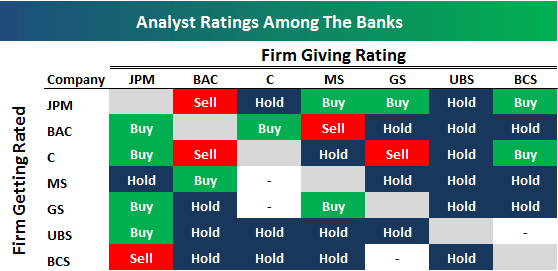
JP Morgan (JPM), Citi (C), Bank of America (BAC), Morgan Stanley (MS), Goldman (GS) and UBS. Analyst ratings on fellow banks as at 28 January 2009. Knowing analysts' ratings, a SELL is a big sell, a HOLD means its a SELL as well.

This will not just be in the US but will affect a few of the top banks in Europe as well. The idea of a bad bank is basically an alarm bell to all that TARP as it is will be insufficient to bailout the big banks. We now cringe at the size of the TARP and Obama's stimulus package, well how about another $1.5 trillion for the bad bank - while that is good for the markets, it should be the death knell for USD.


p/s photos: Chen Run Xi