Showing posts with label TARP. Show all posts

Wednesday, April 01, 2009

Why The Surviving US Banks Are Worth A Punt Now


The surviving US banks are worth a punt now because of AIG. The US government now owns 80% of AIG (hands tied behind their back and you can drip candle wax on their naked bodies as well). AIG has been begging with their outstretched hands and for the fourth time in months, they got the most recent $30bn injection - add them all up AIG has taken $170,000,000,000 from the American public, and that does not even include the $85bn loan from Federal Reserve. There are so many zeros in that figure, imagine if you have a bank account with that kind of figure - it has to be an accounting entry, you cannot possibly transfer the sums via cash ... you CANNOT EVEN PRINT MONEY THAT FAST, if you wanted $170bn, you probably have to wait a few months to get your money. Hence it has to be an accounting entry, you credit AIG's accounts by $170bn and debit somewhere else... guess where... aahhh the Fed's debit entry. The biggest bank robberies cannot ever come close to robbing via an accounting entry. Its good to be the king! AIG already lost $40bn last year, so where did all the money go to?

Some $100bn went to banks. Yes, that right. We all know what CDOs are by now, and the banks have been buying many of these CDOs themselves, but at least most of them were smart enough to hedge some of those positions. They did so by buying Credit Default Swaps on these CDOs - i.e. if the CDOs fail then AIG will have to pay the banks. The following payments made to the banks largely consist of counterparty losses and Credit Default Swaps losses.


Among the biggest beneficiaries of the AIG's ATM was Goldman Sachs with $12.9 billion. Bank of America. But the bank that probably gained the most has to be Bank of America which together with Merrill Lynch got a collective $12bn.

Now do you you see why so many of these banks which got TARP money are now saying that they will now repay the money back.... so soon!!! ... after just a few months they can repay the funds back??? Suddenly things are so rosy.
SocGen got $11.9bn, Deutsche Bank got $11.8bn, Barclays got $7bn, even the municipalities got $12.1bn. Surprisingly, Citibank was not on the list.... hmmm.

These sums are nothing to be sniggered at. First it reduces the uncertain asset in the "receivables" and turning that into certain "cash". Secondly, without tooting the horn, it probably improves the cashflow for these banks for 2009 materially as even they probably thought they would not get the cash back from AIG so soon.


p/s photos: Eri Otoguro

Saturday, February 21, 2009

Credit Crisis 101 - Leverage


Pick up any business magazine or paper, or watch the business channels, you will find a plethora of information on the credit crisis. Sometimes, too much information overload will distract from the real issues and when we talk about the crisis, we have too many angles on the problem. Unless we zero in on the root cause (not not ascribing blame), we won't be able to get a handle on the crisis and its effects.

Let's get the blame out of the way. I have blogged about the blame game: mainly its the ratings agency, followed by Greenspan and then the Wall Street firms. If you have to describe the root of the current crisis in one word, that word has to be "leverage". If you take leverage out of the equation, if we didn't have the many new fangled acronyms, which were basically packaged loans supported by derivatives like capital platform, we would have a very mild recession. This recession is the severest we have seen since the Depression because of the leverage i.e. derivatives. Leverage implies very little capital outlay for a certain contract of service or product. If we have derivatives and leverage during the 1920s, the whole world might have collapse even more brutally.

Yes, we have more knowledge since then, we have a better understanding of fiscal and monetary policy, and some say better laws and regulation (well, there are regulators but they did not do a good job at all). Its the leverage which brought about such a recession that is much worse than any we have seen in modern times.
If you want to take an account of the mess, the more reliant you were on that leverage, the more you fell as the values were nothing but book entries. The investment banks would not have been in so much trouble if they did not get greedy themselves and bought most of the instruments.

Naturally, the front line got hit the worst, the investment banks that parlayed capital up to 20x-30x leverage to issue these papers, and when they collapsed it very easy to see capital totally vanishing with just a minor drop in values. Now we are talking of properties (which these papers were based on) losing 30%-50%, hence the negative equity.
Those who bought properties using these kind of easy and unchecked loans were the first to be foreclosed. Even if you did not participate in those loans, you might have benefited via rising housing values, and refinanced, you would have got hit as well. Generally the affected banks lost about 90% or more in share price while most of the broader equities lost about 50% and counting.

The rest of the world got hit because they got a corresponding inflow of liquidity emanating from these gains. Liquidity was ample.
Related areas which practiced excessive leverage were hedge funds. If these funds bought emerging market shares and commodity, those prices got inflated as well, hence when it came time to de-leverage, the outflow was very severe. In particular commodity prices. Its not just a bull cycle, it was the leveraged funding which went looking for "liquid assets" to move into. Hence the very sharp rise in commodity prices in 2004-2008, and they came down just as fast. Related to commodities were the commodity ETFs which were coming out like fresh donuts. Every commodity ETF basically just fueled the rise and trend even further, causing many pension funds to specifically target a substantial weighting in commodity as a critical portfolio composition.

Unfortunately, the US consumers represents a significant engine for global demand. They are key to the US economy, and they need to buy crap from the rest of the world, so that the rest of the world have the funds to buy crap from other countries. The wealth destruction from falling share prices and more importantly, the losses from property, have caused the US consumers to tighten their consumption patterns. That has severe ramifications for the flow on effects to the rest of the world relying on exports for growth. Yes, it may not be the rest of the world that is at fault, but you still get swept up in the tsunami.

The curtailment of credit and loss in wealth from the deleveraging is what is bringing global demand to its knees. Every country has attempted to reflate, whether the sums are big enough is still debatable, I think it is, but more than just reflating you need to address the root problem. Has the deleveraging stopped? Well, banks are still holding the toxic assets, refusing to write down to a fairer market value, say twenty cents to the dollar, as that would wipe out the bank's equity. Hence NATIONALISATION is the best solution going forward. You are not going to do it, let the government do it. Nationalisation of banks = forced sale of these assets = investors have a good idea of the losses = shareholders will be wiped out but its necessary.


As big as the TARP is, it is insufficient to replace the writedowns. You want a bad bank, you need $2 trillion minimum. Already the lawmakers are balking over the TARP's $780bn, the amount for bad bank is humongous. By nationalising, you basically close a few big banks that shouldn't be allowed to continue. By propping them up, you will eventually have to pump close to $2 trillion anyway to get them on even keel.

The other major contention is that property has to stop falling in price because as it keeps down trending, investors have no idea how to put a fair value on those toxic asset losses. A better plan Obama should have included is to put a stop to the slide - put up an incentive for new home owners to buy, e.g. $25,000 for new homeowners that qualify. Its pointless to renegotiate mortgages if prices keep falling. You need genuine long term buying.

As for auto sector in the US, the crisis basically hasten their demise. Their business model does not work and is inflated. They must be bankrupted so that they can negotiate a reasonable business model with a very much reduced pension/healthcare liability overhanging the car makers. But the US auto sector is the least of global concerns.

Things are coming to a head, falling share prices will force the government's hand. Keep an eye on developments on these two front:

a) how they deal with the toxic assets properly

b) how to stop property prices from sliding further


To that end, the markets looks oversold as a lot of liquidity is on the sidelines. To activate the flow back, we need to see catalysts that would trigger (a) and (b) in the right way. Bank nationalisation would be one. Bad bank is still OK but the hurdles on raising $2 trillion will not be easy.

Things are so bleak now that it gives me room to be optimistic that certain things will happen when you are forced into a corner. These are very difficult decisions, do you have the political will to nationalise banks.


Another potential positive catalyst will be Geithner roping in private equity and hedge funds to start buying up the toxic assets. Pricing will be an issue but the government is keen to get these funds to take off some of these assets via special funding, which may be hard to come by for hedge funds and private equity funds now. Geithner has a strong hand now, by forcing banks to sell the toxic assets to these funds or else face nationalisation. Geithner has seen his credibility being eroded quickly with his conceptual plan that lacked details and a pricing mechanism for the toxic assets. He can restore much of it by moving fast to move the toxic assets. Yes, banks will have to do massive writedowns, and many may be barely solvent, but that's part and parcel of what needs to be done.

Despite all the bad news, I am more hopeful than most as things are coming to a head - and tough decisions are forthcoming, which will be good for the markets.


p/s photos: Natasha Hudson


Friday, February 20, 2009

Rating The Top US Banks, Which Are The Zombies?


Came across this very interesting piece by Martin Hutchinson on the current state of the top 12 banks in the US. Which banks are zombies?

------------------

Please note that the yen rate has scaled above 94 yen to the dollar, for those who are still following my thesis. Refer to posting on January 16, 2009.

------------------

There is a lot of information - both about potential bailout needs and possible investment bargains - which we can gain from the banks’ annual earnings figures. For instance:

  • Banks that made profits in the very difficult fourth quarter of 2008 are probably in good shape, especially if their loan-loss provisions exceeded their charge-offs (the amount actually lost).
  • Even banks that lost money in the fourth quarter - an exceptionally harsh three months - have no immediate need for funding, provided they made money the rest of 2008 and seem likely to resume making money going forward.
  • In this context, management’s dividend policy is a good indicator: If the dividend is maintained, rather than being sharply cut or suspended, management is probably genuinely confident about the bank’s position and outlook.
  • Another good indicator of a bank’s health - at least of the market’s perception - is the ratio of share price to book value. If that’s below 25% or so the market lacks confidence in the bank’s ability to solve its problems.

Using these indicators, we can assess the viability of the leading U.S. banks. Each bank can then be classified with one of our four "official" Money Morning designations. These designations, or labels, consist of:

  • Zombies: Institutions kept alive only by TARP funding. These subtract value from the economy and should be put out of their misery through controlled liquidation, with the healthy parts being salvaged.
  • Walking Wounded: These banks may need a little bit more help, but are currently operating adequately on their own. One caveat: An intensification of economic downturn could push some of them into "zombie" status - or even bankruptcy.
  • Risky but Proud: These banks have relatively high risks, because of acquisitions or their business models, but are operating at full blast and can hold their heads high for their success in dealing with 2008’s enormous difficulties.
  • Hidden gems: These banks have conquered 2008’s difficulties, taken care of their bad debt problems, and still managed to make a substantial profit. Short of a repeat of what U.S. banks had to deal with from 1929-1933 as part of the Great Depression, these financial institutions should continue to operate in the black.

The Envelopes Please …

We listed the 12 largest U.S. banks by assets, as of Dec. 31, ignoring foreign-owned banks, Goldman Sachs Group Inc. and Morgan Stanley (those last two are onetime investment banks that are technically now commercial banks, but still possess a very different business mix. We give you a rundown on the financial stability of each one, and give each institution with the single-most-appropriate of our four official Money Morning designations. The Top 12 banks, biggest first, are as follows:

1. Bank of America Corp. - Zombie: BofA has about $2.8 trillion in assets including Merrill Lynch, and Countrywide Financial Corp., formerly the nation’s No. 1 housing finance bank. It received $45 billion from TARP, plus $118 billion in guarantees against Merrill Lynch’s assets. At Friday’s closing share price of $5.17, the stock was trading at 21% of book value (it closed at $4.90 yesterday). BofA posted a fourth-quarter net loss of $1.55 billion, plus a Merrill Lynch net loss of $15.3 billion, which forced BofA to cut its quarterly dividend to a nominal one cent per share. Judging by other banks’ results, if Bank of America had made no acquisitions in 2008, it would be in solid shape. With the acquisitions, however, it’s a basket case - and may well need even more federal funding.

2. JPMorgan Chase & Co. - Risky but Proud: JPMorgan has $2.175 trillion in assets, and received a $25 billion TARP investment. It’s a major international bank with a large investment banking operation. It bought Bear Stearns, investment bank in March and Washington Mutual in September, both with Federal government help.

JPMorgan booked $702 million in net income in the fourth quarter and $5.6 billion in net income for all of 2008. The company also had a fourth quarter loan-loss provision of $8.5 billion and charge-offs of $4.5 billion. But there were also $2.9 billion worth of securities markdowns in the investment banking operation. Again, this bank is high-risk from an investment standpoint because of its acquisitions, but it appears to be in excellent shape with no immediate need for extra funding. Its Friday closing share price of $24.69 equates to 72% of net asset value, though it closed yesterday at $21.65, down 12.3%. It pays a quarterly dividend of 38 cents per share.

3. Citigroup Inc. - Zombie: Citi remains the nation's third-largest bank, with $1.9 trillion in assets. It received a $45 billion TARP investment, plus guarantees on $301 billion of assets. At Friday’s close of $3.49, it was trading at 25% of book value. Citi lost $8.3 billion in the fourth quarter of 2008 and $18.7 billion for the whole year. It was finally forced to sell control over its Smith Barney brokerage operation to Morgan Stanley in January, and has reduced its dividend to a nominal penny a share. Citi has been a serial flirter with bankruptcy over the past 30 years and remains a basket case. There are a few good assets buried within the rubble - chiefly because the company is so large and diverse.

4. Wells Fargo & Co. - Risky but Proud: Wells Fargo has $1.3 trillion in assets, and garnered a $25 billion TARP investment. Originally a small bank based in San Francisco, Wells Fargo came into the big leagues when it merged with Wachovia, late last year. Its Friday closing price of $15.76 equated to 104% of its book value, though it closed yesterday at $13.69. Wells Fargo’s stock pays a quarterly dividend of 34 cents. The company posted a fourth-quarter net loss of $2.55 billion, not including an $11 billion net loss at Wachovia. Wells Fargo’s full-year earnings totaled $2.84 billion. It had a fourth-quarter loan-loss provision of $8.4 billion, compared with actual charge-offs of $2.8 billion. Wachovia’s 2006 acquisition of the California mortgage bank Golden West Financial puts Wells Fargo at risk, but the company’s operations appear solid and it has no immediate need for extra funding.

5. PNC Financial Services - Risky but Proud: The Pittsburgh-based PNC has $291 billion in assets, after buying the slightly larger National City Corp in October. It also received a $7.6 billion TARP investment. At Friday’s closing price of $28.20, PNC’s shares were trading at 79% of book value. The company pays a quarterly dividend of 66 cents per common share, and posted a fourth-quarter net loss of $248 million (excluding costs associated with its acquisition of National City, the company had a fourth-quarter profit of $132 million). PNC had provision for credit losses of $990 million, compared with net charge-offs of $207 million. This is one of the riskier banks because of the difficulties in integrating National City and possible problems in National City’s loan portfolio. But it appears to have no immediate need for funding and is currently profitable, and its stock is selling close to book value and paying a solid dividend. One final point: PNC’s shares fell only 6.1% yesterday, a day when the shares of most major banks fell by more than twice that amount, perhaps hinting that investors perceive less risk in PNC’s shares.

6. U.S. Bancorp - Hidden Gem: U.S. Bancorp has $266 billion in assets, and received $6.6 billion in TARP funding. This regional banking firm is based in Minneapolis, and the company operates primarily in the upper Midwest and Northwest. With a closing price of $12.40 on Friday, USB shares were trading at 131% of book value (the shares closed yesterday at $10.73, down 13.47%). The company also pays a quarterly dividend of 42.5 cents per common share. U.S. Bancorp posted a fourth-quarter profit of $260 million, and a profit of $2.94 billion for all of 2008. It also had a credit-loss provision $1.3 billion in the fourth quarter, compared with actual charge-offs of $627 million. U.S. Bancorp is in good shape, with no apparent need for extra money.

7. The Bank of New York Mellon Corp. - Hidden Gem: New York Mellon has $237 billion in assets, mostly through its operations in New York and Pennsylvania. It received $3 billion in TARP funding. With closing price Friday at $25.26, Bank of New York Mellon was trading at 125% of its book value (the shares closed yesterday at $23.13, down 8.4%). The bank posted a fourth-quarter profit of $28 million, and net income of $1.39 billion for all of 2008. The fourth quarter was tough as for everybody, but Bank of New York Mellon appears to have no near-term need for funding.

8. SunTrust Banks Inc. - Walking Wounded: Sun Trust has $189 billion in assets, and received $4.9 billion in TARP financing. Based in Atlanta, the bank has operations in the Mid-Atlantic and the Southeast. Its Friday closing price of $8.72 meant that SunTrust shares were trading at only 19% of their book value. The company posted a fourth-quarter loss of $379 million, but a profit of $747 million for all of 2008. It also had loan-loss provisions $962 million in the fourth quarter, compared with $552 million in charge-offs. SunTrust has reduced its quarterly dividend sharply to 10 cents per share, but it appears to be in no immediate trouble. However, if the economy deteriorates, the bank’s exposure to the Florida housing market could be an Achilles' heel. Investors are clearly concerned: SunTrust shares was down 18% yesterday and is down 88% in the past year. The Atlanta Journal-Constitution reported yesterday.

9. State Street Corp. - Hidden Gem: State Street had $174 billion in assets, and received $2 billion in TARP funding. It’s a Boston-based bank, but serves institutional investors throughout the world. At Friday’s closing price of $27, the shares were trading at 111% of their book value. State Street posted fourth-quarter earnings of $65 million, and 2008 earnings per share of $3.89, up 13% from the year before. With a global business, conservative leverage and Boston management, State Street could gather strength when the financial crisis finally ends.

10. Capital One Financial Corp. - Walking Wounded: Capital One has $161 billion in assets, and received a $3.6 billion TARP investment. It’s primarily a credit card company, headquartered in McLean VA. At Friday’s close of $12.11, it is trading at just 20% of book value. Capital One lost $1.4 billion in the fourth quarter of 2008, and was just below break-even for the full year, but made $895 million from continuing operations. Its stock pays a quarterly dividend of 37.5 cents per share. Capital One is in dangerous waters and could soon succumb to a zombie if credit-card problems really escalate.

11. BB&T Corp. - Hidden Gem: BB&T has $152 billion in assets, and accepted a $3.1 billion TARP investment. It’s a regional bank, headquartered in Winston-Salem NC, with its primary operations in the Mid-Atlantic region. At Friday’s closing price of $15.33 a share, the stock was trading at about 58% of its book value. The company posted net earnings of $284 million in the fourth quarter, after loan write-offs of $528 million. It posted a profit of $1.5 billion for all of 2008, and pays a quarterly dividend of 47 cents a share. I’m sure it would gladly take more taxpayer money, but it certainly doesn’t appear to need it.

12. Regions Financial Corp. - Walking Wounded: Regions has $146 billion in assets, and received $3.5 billion in TARP financing. It’s a regional bank, headquartered in Birmingham, AL, with operations primarily in the Southeast. At Friday’s closing price of $3.38 a share, Regions’ stock was trading at about 18% of book value, and the bank has suspended its dividend. The company lost $5.6 billion in 2008, and its tangible net worth is only $10.5 billion. However, on an operating basis, it made a profit of about $300 million. Regions had a fourth-quarter loan-loss provision of $1.15 billion, and charge-offs of $796 million. I’m classifying it as "walking wounded," but think it’s more likely to revive itself than to accept a toe-tag. In fact, it’s likely to need only a modest amount of additional funding to see its health improve.

p/s photos: Keiko Kitagawa


Saturday, January 31, 2009

Why Citibank Might Not Be Around ... Soon


Why pick on Citibank? Didn't they agree to break up the company already? Well, one can argue that the biggest toxic assets reside in Citigroup, Lehman Brothers and Merrill Lynch. We all know Lehman was hung out to dry. Merrill's woes are now part of Bank of America's problems. BoA may or may not be able to digest Merrill's positions. Both Citi and BoA have been given tons of money by the US government. Will it be sufficient? In the past 12 months, taxpayers, sovereign wealth funds and private investors have sunk $1 trillion into failing U.S. and British financial institutions, while central banks have slashed their cost of funds to nothing and their collateral standards even lower.

It looks likely that the hole is simply too big to fill even by governments. Bank losses from the write-offs of bad loans and busted derivatives tally up to $1.5 trillion so far. In addition, $5 trillion to $10 trillion worth of off-balance-sheet businesses such as structured investment vehicles - leveraged lending vehicles used by big banks are being forced back to banks' balance sheets by regulators. Rules require banks to keep a base of real shareholder capital amounting to 10% of those funds. So banks need to find up to $1 trillion within the next year to meet that objective.That is in addition to all that has been injected into banks so far.

Add the $1.5 trillion in losses to $1 trillion in needed new reserves, and you can see that banks need as much as $2.5 trillion in new capital to remain solvent under current rules. Consider that the entire world banking system had only $2 trillion in shareholder capital in 2007, before everything blew up. Therefore, the entire system is simply insolvent, as liabilities are greater than assets. Governments aren't forcing banks to admit this, but investors are, and that is why big banks' shares are only a fraction of their value this year compared to their highs in 2008.

Governments, meanwhile, are trying desperately to help banks plug the gap, but they're coming up short. When you add the $500 billion from sovereign wealth funds to the $500 billion from the first tranche of the Troubled Assets Relief Program, it's only $1 trillion. That's already been provided. So that leaves a gap of $500 billion to $1.5 trillion. That's why Trichet said that banks don't need to keep 10% capital reserves.

Is this all priced in? Well, insolvent banks is why credit is not flowing, besides being a confidence issue as well. Even BoA and JP Morgan Chase are continuing to drop despite being on firmer ground. Investors have already factored in the likely outcomes. Nationalise (take over) Citibank, and force a merger with either BoA or JP Morgan Chase. Nationalisation means that banks would have to issue equity to the government, a process that wiped out current shareholders. Yes, that would mean most bank stocks would go to zero. If banks are insolvent, the most attractive asset they have is the brand. To leave them hanging around means they won't be able to do any lending, just like zombie firms. The new administration will have to bite the bullet on this. When this happen, it will be viewed as a positive, not a negative, as we will be on our way to cleaning up the zombies.

To be clear, when I say that Citibank and/or BoA might not be around soon, it basically means that they will be absorbed into another entity, not that they will disappear or that their jobs will disappear. The best that the big banks can hope for is that the 'bad bank' idea takes root - but they will have to ask for another $1.5 trillion to fund the 'bad bank', if that takes flight, then Citigroup, BoA and the rest can sell the toxic assets to the 'bad bank' ... then they can still survive, if the 'bad bank' idea fails... its nationalisation , baby...

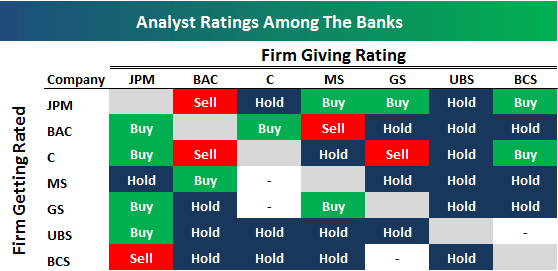
JP Morgan (JPM), Citi (C), Bank of America (BAC), Morgan Stanley (MS), Goldman (GS) and UBS. Analyst ratings on fellow banks as at 28 January 2009. Knowing analysts' ratings, a SELL is a big sell, a HOLD means its a SELL as well.

This will not just be in the US but will affect a few of the top banks in Europe as well. The idea of a bad bank is basically an alarm bell to all that TARP as it is will be insufficient to bailout the big banks. We now cringe at the size of the TARP and Obama's stimulus package, well how about another $1.5 trillion for the bad bank - while that is good for the markets, it should be the death knell for USD.


p/s photos: Chen Run Xi


Friday, November 14, 2008

FDIC Insures GE Capital's Debt


A follow up to the auto sector and hedge funds write up:

General Electric said Wednesday that the federal government had agreed to insure as much as $139 billion in debt for its lending subsidiary, GE Capital. This is the second time in a month that G.E. has turned to a federal program aimed at helping companies during the global credit crisis.

Until September, GE relied on selling commercial paper to obtain more than 15% of the funding of the finance unit. But investors began shying away from commercial paper after Lehman Brothers Holdings Inc. filed for bankruptcy protection and several other big financial players struggled. GE has said it would reduce its reliance on commercial paper, but it wasn't clear how the company would replace that funding.

GE Capital is not a bank, but granting it access to a new program from the Federal Deposit Insurance Corporation may reassure investors and help the lender compete with banks that already have government-protected debt, a G.E. spokesman, Russell Wilkerson, told Bloomberg News.

“Inclusion in this program will allow us to source our debt competitively with other participating financial institutions,” Mr. Wilkerson said. Joining the program could make it easier for GE to issue new debt in coming months. In recent months, investors have worried about GE's liquidity, and the price it has to pay to borrow money.

The F.D.I.C. program covers about $139 billion of G.E.’s debt, or 125 percent of total senior unsecured debt outstanding as of Sept. 30 and maturing by June 30. GE said Wednesday that under the program, the government will guarantee as much as $139 billion in long- and short-term debt through next June. But, Mr. Wilkerson added, "This does not mean that GE intends to issue this amount of debt."

With roughly $600 billion in assets, GE Capital is as big as some large banks. The finance unit last year supplied almost half of GE's profit. But GE Chairman Jeffrey Immelt this September said he would shrink the unit in response to the credit crisis. GE Capital issues loans for everything from aircraft engines to commercial real estate and restaurant equipment.

G.E.’s finance businesses are able to seek F.D.I.C. debt coverage because its GE Capital subsidiary also owns a federal savings bank and an industrial loan company, both of which already qualify. Last month, G.E. started using a new Federal Reserve program aimed at reviving demand for the commercial paper for a wide variety of companies.

Looks like the Treasury and Fed are making all the right moves and pushing the right buttons so far.

p/s photo: Nancy Wu Ding Yan & Sharon Chan Mun Chi


Thursday, November 13, 2008

An Improved Plan By Paulson


Nov 12, Paulson on TARP priorities going forward: "First, Although the financial system has stabilized, both banks and non-banks may well need more capital given their troubled asset holdings, projections for continued high rates of foreclosures and stagnant U.S. and world economic conditions. Second, the important markets for securitizing credit outside of the banking system also need support. Approximately 40 percent of U.S. consumer credit is provided through securitization of credit card receivables, auto loans and student loans and similar products. This market, which is vital for lending and growth, has for all practical purposes ground to a halt. Third, we continue to explore ways to reduce the risk of foreclosure. " Treasury Secretary Henry Paulson said Wednesday the $700 billion government rescue program will not be used to purchase troubled assets as originally planned. (Finally, some sensibility because buying the troubled assets will not help. If you buy at the market prices, it just means the banks will have to write down the losses with no hope of recouping them. This does not help shore up capital, which is what they need. To shore up capital the Treasury will have to buy them at a premium, which is no good also as it will lock the government into owning toxic assets, or the taxpayers actually owning them at a premium, whereby they could end up with huge losses.)

Paulson said the administration will continue to use $250 billion of the program to purchase stock in banks as a way to bolster their balance sheets and encourage them to resume more normal lending. (That is a more sensible way. By owning stocks and maybe even sit on management committees of banks, they can hasten the lending part.)

He announced a new goal for the program to support financial markets, which supply consumer credit in such areas as credit card debt, auto loans and student loans. Paulson said that 40 percent of U.S. consumer credit is provided through selling securities that are backed by pools of auto loans and other such debt. He said these markets need support. "This market, which is vital for lending and growth, has for all practical purposes ground to a halt," Paulson said.

The administration decided that using billions of dollars to buy troubled assets of financial institutions at the current time was "not the most effective way" to use the $700 billion bailout package, he said.

The announcement marked a major shift for the administration which had talked only about purchasing troubled assets as it lobbied Congress to pass the massive bailout bill.

Paulson said the administration is exploring other options, including injecting more capital into banks on a matching basis, in which government funds would be supplied to banks that were able to raise capital on their own. (This is smart. By voicing this out, it would theorectically DOUBLE the amount of capital injection, putting some onus on the banks to look for funding elsewhere as well. Instead of just $500bn of capital, suddenly it becomes $1 trillion. If banks are desperate, they will act fast. The source of capital will have to be largely from sovereign wealth funds. The fact that its on a matching basis should be an easier pill to swallow with the Treasury riding alongside them.)

p/s photos: Nozomi Sasaki

Wednesday, October 01, 2008

Roach's Take On TARP / The Revised Package


Finance Asia: Stephen Roach, chairman of Morgan Stanley Asia, says the US government’s Troubled Asset Recovery Plan (Tarp), aka the Paulson Plan to bail-out the finance sector to the tune of $700 billion, deserves a grade of B-.Roach’s take: a package needs to deliver the Three S’s: speed, scale and simplicity. In terms of speed, he gives the plan an A- or B+, noting it was churned out very quickly by Washington standards. [It had been; the Republican revolt is a stunning turn against President Bush and Congressional GOP leaders - Ed.]

For scale, he gives Tarp a B- or C+, noting that $700 billion is plenty big, but Congress has decided to dole out funds in tranches, with the first pool only $250 billion. Roach doesn’t think this is going to be welcomed by the market. He is also concerned about some of the red tape and procedures involved in prying out further tranches from Congress.
Lastly, for simplicity, he says the original three-page Paulson Plan deserved an A+, but the Congressional bill, at 110 pages over 42 sections, gets a C- or a D+. It includes four new government bureaucracies, including oversight panels, an Office of Financial Stability, an inspector and a schemes administrator. Roach calls this evidence of a “significant regulatory backlash”. “The best grade I can give this is a B+,” Roach says. “The plan does deal with the issues, but in a sub-optimal way.”

Thus, with the fiscal strategy now set forth, attention will turn back to the Federal Reserve Bank, where governor Ben Bernanke will be under pressure to augment Tarp if market confidence doesn’t improve.
Roach reckons that Tarp means we are more than halfway through the financial stage of the credit crisis. The real economy in the United States is only partway through. “Most adjustments are yet to come,” Roach warns, “particularly in consumption.”

More ominously, he thinks this crisis will extend to the real economies of Asia – a process that has only just begun. “Asian economies have been the beneficiary of the US consumption boom,” he notes.
In 2007, the US consumer accounted for 72% of US GDP growth, thanks to bubbles in property markets, which in turn fuelled bubbles in credit (using home equity loans to borrow, for example). As Americans spend less, it will keep the US economy wobbling at very low growth for a prolonged period of time – and it will hurt Asia.

The US consumer spent $9.7 trillion in 2007, versus only $3 trillion among consumers in China and India combined – and much of that Asian wealth was based on exports. Granted, the US only accounted for perhaps 20% of those exports, but Europe and Japan are also experiencing economic declines as a result of the credit crunch, so Asian export markets worldwide are losing steam.
This threatens Chinese GDP growth rates, which have already fallen from around 12% in 2007 to an expected 10% for 2008. A further cut in exports threatens to move Chinese GDP growth to 8%. The government can’t afford to see growth fall beyond that, so it is now cutting interest rates, loosening bank credit rules, and may introduce fiscal stimuli or act against further renminbi appreciation, Roach says.

(MarketWatch) -- The U.S. Senate is scheduled to vote Wednesday on its version of the historic $700 billion Wall Street rescue package, two days after the House of Representatives' stunning rejection of the original legislation.
The move capped a day of behind-the-scenes negotiations to try to salvage some version of the package that the House, defying President Bush and its own party leaders, rejected on a 228-205 vote.
The package before the Senate will be similar to the House version, with these additions, the New York Times reported in its online edition:
  • The higher limit for insured bank deposits sought by the Federal Deposit Insurance Corp., which asked to raise the cap to $250,000 from $100,000, to quell opposition by individual and small-business depositors.
  • Tax breaks for businesses and alternative energy, part of a package that has been caught in a stalemate in the House of Representatives. The Senate version of the gridlocked tax legislation would cost more than $100 billion and extend and expand many individual and business tax breaks, including tax credits for the production and use of renewable energy sources, like solar energy and wind power, the Times said. It would also extend the business tax credit for research and development, expand the child tax credit, protect millions of families from the alternative minimum tax and provide tax relief to victims of recent floods, tornadoes and severe storms, according to the Times.


p/s photo: Fiona Sit Hoi Kei

Tuesday, September 30, 2008

TARPaulining All Over


I think they got the name wrong in the first place, that's why it did not get passed. TARP or Troubled Asset Relief Program, it sounded like tarpaulin, the heavy duty netting for lifting heavy goods onto the ships ... no wonder la, the safety net has too many gaping holes in them.

1) Seriously, this will bring back a tighter plan, one that is more accountable and responsible - so, gotta be good right.


2) The original plan did not specify at what price levels will the fund buy the distressed assets at. If they are buying at market, its no use to the banks and financials because it does not add to their capital base. Its the capital that needs to be enlarged. Hence they have to buy at higher than market prices for the whole thing to make sense, or don't buy the assets but give insurance for the assets as a major comfort factor.


3) The biggest obstacle has to be that the naysayers do not want the fund to buy these assets.


4) The release in batches is good to maintain a sense of integrity to the whole process. Shows that the team is managing the lending/injection well before given new parcels of fund. $250bn first, then another $100bn if results are positive. Plus the government will have the option to block the remaining $350m. This will send the message of more accountability at all levels.


5) The other message to the markets is that the US government will NOT just roll over in any future financial crisis. The major financial firms will now know that they cannot simply knock on the doors of Fed or Treasury to help them get rid of the mess they may create in the future. That is very clear.


6) There probably will be structured equity exposure to companies that take money from the fund as the fund is likely to be paying higher than market prices for the assets.


7) The mark to market accounting may be the pink elephant in the room. The rule may be suspended for the time being so that financials which sell those assets may not need to write down the full amount, which would have reduced their capital availability. The rule may be suspended till 2010 (when the fund expires) but only for those instruments affected and taken up by the fund. This seemingly inane accounting move actually may lift the gloom and difficulty of rescuing the affected companies brilliantly by just the stroke of an accounting entry.


All in, its actually not that bad that the bailout fund was voted down, although I did not expect that at all. A tighter second plan will send the right message and drill down on proper and responsible restructuring plans and ramifications. The fact that major equity markets may have lost 5%-8% may actually be good. When the second plan is approved, regaining just 3%-4% of what was lost may then be a big sigh of relief.
Still, its a very long road for equities in general. Not yet to get back in.

p/s photos: Mami Yamasaki