Showing posts with label Haruna Yabuki. Show all posts

Tuesday, December 27, 2011

The Debt Crisis In 2012

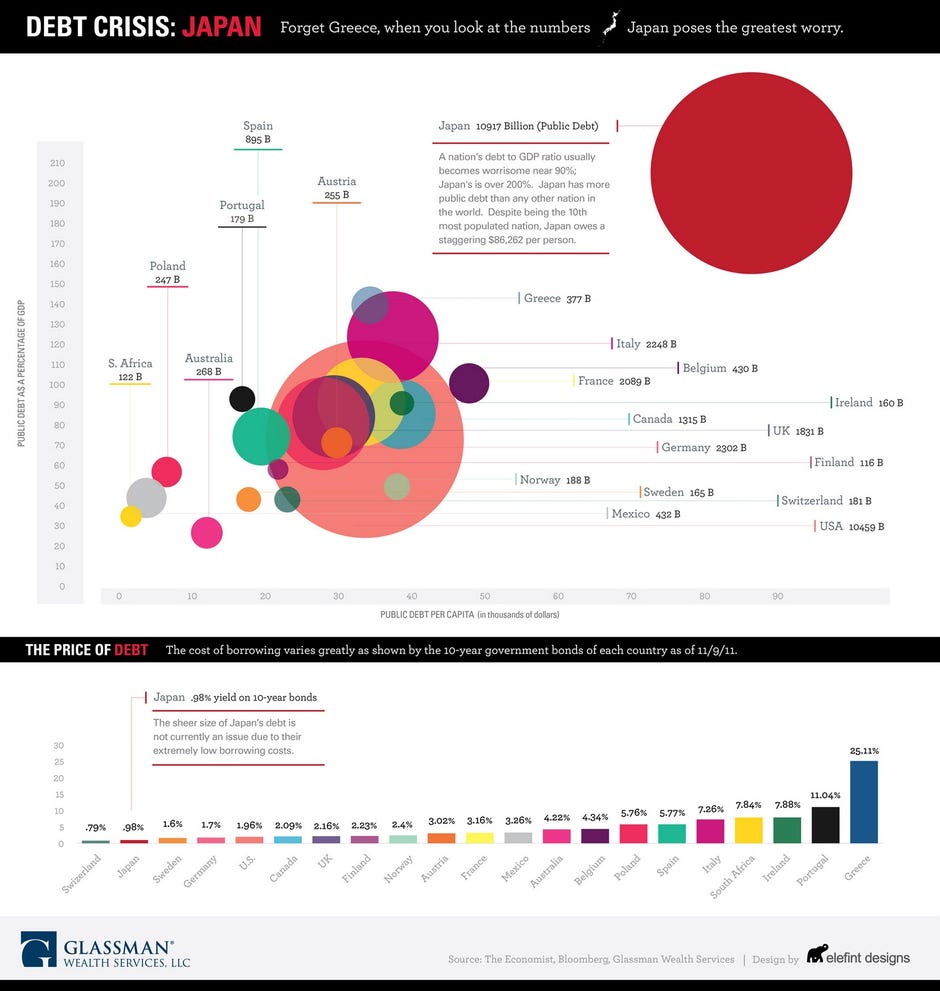
Japan has long been mired by an aging population, sluggish growth and deflation since an asset bubble popped in the early 1990s.  The country already has the highest debt-to-GDP ratio in the world--about 220% according to the OECD -- and a debt load projected at a record 1 quadrillion yen this fiscal year.

Image Detail 

Based on a plan approved by the Cabinet in Tokyo on 23 Dec, the country is now looking to sell 44.2 trillion yen ($566 billion) of new bonds to fund 90.3 trillion yen ($1.16 trillion) of spending in fiscal year 2012 starting 1 April.  That will raise Japan budget’s dependence on debt to an unprecedented 49%.

According to Bloomberg, the government projects new bond issuance will surpass tax revenue for a fourth year. Receipts from levies have shrunk about a third this year after peaking at 60.1 trillion yen in 1990.  Non-tax revenues including surplus from foreign exchange reserves also halved to 3.7 trillion yen. Social-security expenses, now at 250% of the level two decades ago, will account for 52% of general spending next year

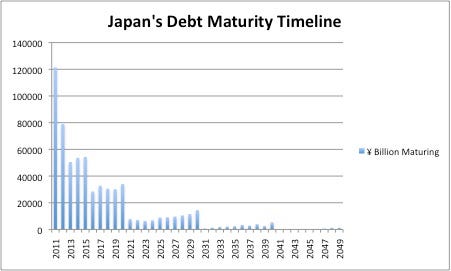
Moreover, an April 2011 analysis by CQCA Business Research showed that "Japan has an extremely near-future tilted debt maturity timeline" (see chart below).  CQCA estimated that in 2010, Japan was able to push 105 trillion yen into the future, but concluded it is doubtful that Japan will be able to continue this.
chart 
Chart Source: CQCAbusinessresearch.com, April 2011
Indeed, as one of the major and relatively stable economies in the world, and since almost all of its debt are held internally by the Japanese citizens or business, Japan has been able to still borrow at low rates (10-year bond yield at 0.98% as of Dec. 26, 2011), partly thanks to the Euro debt crisis going on for more than two years.

So as long as Japan could keep financing a majority of its debt internally without going through the real test of the brutal bond market, the country most likely would not experience a debt crisis like the one currently festering in Europe.
Image Detail 

But the chips seem to have stacked against Japan now.  On top of the new and re-financing needs, the Japanese government estimated that the economy will shrink 0.1% this fiscal year citing supply-chain disruptions from the earthquake and tsunami disaster in March, the strengthening of the yen and the European debt crisis.  Moreover, S&P said in November that Japan might be close to a downgrade.  After a sovereign debt downgrade to Aa3 by Moody's in August, 2011, it'd be hard pressed to think Japanese bond buyers would shrug off yet another credit downgrade.

Burgeoning debt, coupled with the global and domestic economic slowdown, and continuing political turmoil (Japan has had three Prime Ministers in the last two years, and the current PM Noda’s popularity has fallen since he took office in September), would suggest it is unlikely that Japan could continue to self-contain its debt.

It looks like its massive debt could finally catch up with Japan in the midst the sovereign debt crisis that's making a world tour right now.  While some investors might see Japan as a bargain, it remains to be seen whether the country will continue beating the odds of a debt crisis.


Read more: http://feedproxy.google.com/~r/EconForecastFullFeed/~3/TIJNwGPhjtA/debt-crisis-2012-forget-europe-check.html#ixzz1hjsHdRg9


chart


Comment: Funnily, the decision to sell $566bn worth of bonds by the Japanese is uncannily close to the 460bn euro long term funding facility by ECB. While we all should know why Japan's debt problem may not be as devastating as the other sovereign types - in that the bulk of the buyers are NOT foreign funds, the buyers are Japanese, private and institutions, Private as in via their massive postal savings scheme. Even I think its not a severe problem for Japan but the one development which seems critical is that this would mark the fourth year whereby the dependency on bond sales is higher than tax revenues.


It also seems that BOJ is unable to reverse the strength of the yen at all, further crippling spending. The E.U. crisis has caused a lot more funds to be repatriated back as well. The tsunami/quake early in the also caused many institutions (insurance) to bring back funds to yen. The yen is causing untold problems to the Japanese economy.


Image Detail


The twin problems of stronger yen and dwindling economy is very hard to stomach. Even a recent downgrade of JGBs by S&P failed to push local buyers away from JGBs. So, while we see a huge problem mounting, I do not yet see anything that would trigger a major debt crisis in Japan. For that to happen, you have to see local private, businesses and institution shrivelling from buying JGBs, how???


The other related problem is deflation, with slowing consumption and strengthening yen, we have the very silly situation whereby seemingly positives become huge negatives: DEFLATION, STRONG CURRENCY. Unemployment is getting out of hand as the strong currency is exporting plenty of mid-level jobs away from the country at a time when the economy is not growing.


Endgame: Disenchantment by the young and those caught by the nasty shift in economic paradigm..


Will this end horribly?I don't see it, what I see is a slow, long and painful decline for the welfare of Japanese. 

Wednesday, May 12, 2010

Let's Take A Walk With The New "Apek" On The Block


I will go through the entire exercise of reading the prospectus and noting the important points of this China-company listing on Bursa, K-Star Sports. This way, we all can discuss on how we should be evaluating the whole thing.

Yes, you guessed it correctly, its another shoe maker. Why is it that shoe making industry is the only industry being keen to list on Bursa? That's another question for another time.


K-Star will offer 15.32 million new shares at an issue price of RM2.15 per share with 3.4 million shares allocated for the Malaysian public and the rest of 11.92m for selected investors. OK, the size of the offering is not too big at all. The thing to watch out for is the placement to selected investors - if its a huge allocation to selected investors compared to the public, then maybe the promoters and lead underwriters are NOT THAT CONFIDENT on the issue at all. A large sized placement to selected investors may be negative as well, remember MultiSports and Mr. Quek.


Some may think that its a good thing that its all new shares issued. I think if its an ACE company, then that is OK, but for an established company churning decent profits, that is myopic and naive. You should have some sort of moratorium but you should also be upfront with shares that owners might want to sell. I would rather that they sell 20% of their shares to the public and 5% to selected investors - and then the rest of the shares be placed on a moratorium for 6 months, and only sell another 10% from 7-24 months. That way, they can go and concentrate on running the business but with some sort of buffer on being listed. You cannot and should not deny entrepreneurs from some cashing out after having growing the company to a listing.

The IPO exercise is expected to raise RM32.94mil out of which RM9mil will be used for raising the company's production capacity, RM5mil for sales and marketing network expansion, RM4.5mil to enhance product design and development capabilities, RM3mil on branding and advertising efforts and the rest for working capital and listing expenses.

http://ima.dada.net/image/9586062.jpg

The company, scheduled for listing this May 31, recorded a revenue of RM294.4mil and a pre-tax profit of RM45.54mil last year (StarBiz made an error in taking the RMB figures for RM). Here is the key, it makes RM45.54m a year, and yet it is only raising RM32.94m??? There is absolutely no need to get listed, is there? Generally, a company should be making much less than what it is trying to raise - that way, it is to channel additional capital to fund growth. When you already make more than what you are trying to raise, you MUST HAVE OTHER BIGGER OBJECTIVES on your agenda.

Hence, the bullshit about increasing capacity, marketing network expansion, enhancing product design, branding and working capital are all plain bullshit (and it smells too).

I am not saying you cannot list when the amount you are raising is a lot less than your annual profit but you got to be more upfront-la, not so many idiots running around. I would be a lot happier if the company says that its also to allow for some early investors to cash out - there is nothing wrong with that at all, but don't try to pull a fast one. We all need entry and exit strategies, and its an accepted process for capital to invest and divest, so that the process can be repeated, its the whole mantra of investing and capitalism.ol

K-Star has been in the apparel industry for twenty years and its product range include athletic footwear and leisure wear. They are also the original design manufacturer (ODM) and original equipment manufacturer (OEM) for international brands including Umbro, Diadora, Kappa, Le Coq Sportif, Die Wilden Kerle, Canguro Cosby and Bridgestones, as well as PRC footwear brand, Double Star. This is good stuff, proven deliverables across a wide section of reputable clients. It has four production lines and produces four million pairs of shoes in-house annually.

http://ima.dada.net/image/9586585.jpg

Back to valuations, RM45.54m based on 89m shares is a net EPS of 51 sen. At IPO price of RM2.15 thats a remarkably cheap PER of 4.2x. However, we should do a comparison:
Xinquan, for year ending June 2010 should be making 35.7 sen, at RM1.17 it is trading at 3.27x PER. Why do you want to list on Bursa when you get PER valuations between 2x-5x???

Look at the 2010 PER valuations for similar China sports apparel companies: Anta in HKSE 17x; Dongxiang in HKSE 15x; Li Ning in HKSE 19x; Hongxing in Singapore at 8x.
The key difference besides the different exchanges is the size of the companies. Anta, Dongxiang and Li Ning all have a market cap of above $3bn. Even Hongxing in Singapore has a credible market cap of $338m. Xinquan's market cap is just $103m. As for K-Sports, its market cap on listing 89m x 2.15 =RM191.4m / 3.2 = $60m.

Realistically, I think Xinquan is more interesting because if you ascribe an 8x PER (like in Singapore) for Xinquan, its market cap would be close to Hongxing. But even at 3.2x PER Xinquan only paid out 5.3 sen in dividend, presenting a yield of just 4.7%. If you are really generating so much cash flow and you are concerned on your share price, then maintain a strong dividend policy. Xinquan should make RM109m for year ending June 2010 and is only likely to pay out 5.3 sen gross dividend. They have 307.3m shares but they are paying only RM16.3m in dividends. Do this, declare that you will pay 50% of net profits as annual dividends. RM109m x 0.5 = RM54.5m = 17.7 sen. At RM1.17, thats a gross dividend yield of 15%. Once you declare a firm dividend policy, watch your share fly. I am sure using 50% of net profits is more than sufficient to grow the business.


K-Star directors said in the prospectus that they intend to pay 10%-20% of profits in dividend. At RM45.54, assume 20% = RM9.1m / 89m = 10.2 sen. At RM2.15 thats a yield of 4.7%. So tell me what K-Star is doing that is any different from Xinquan???
The controlling shareholder will retain 58.4% of shares upon listing, the key again is who holds the rest?

One hint, the conversion of a S$6.105m loan into 13.32m K-Star shares. This amount may be fluid and could be early sellers, maybe.


Sales to two major customers, namely Xiamen-Waitu Import Export and Qingdao Double Star Celebrity Industrial accounts for 40% of sales. I need not tell you that that is a significant risk, but still acceptable.
Other financial metrics such as inventory turnover period of 13 days and receivables turnover period of 80 days are quite positive.

http://ima.dada.net/image/9586293.jpg

Overall, its valuations are attractive but will suffer the same fate as the rest. Initially you probably have to clear 15.32m + 13.32m shares = 28.64m shares. After that, maybe the share price can find some traction.


I would strongly advise that these companies come out and declare 50% profits payout as dividends; and Bursa put in my recommended moratorium on the owners and promoters. Only then will confidence be back in these shares, and you need confidence to be back if we are to be a viable alternative. You can have hundreds of meetings and brain storming sessions - these will be your best weapons.

Let's be honest here, even if we do all the right things, these shares will probably get between 7x-10x PER valuation max because:
- they will always be benchmarked to those listed in Singapore and HK
- the discounts for smaller China companies listed overseas are justified judging from the "shenanigans" concocted by some of the red chips in Singapore
- they list in Malaysia usually because someone had the bright idea of either cleaning up the books and/or inject fresh capital to dress up the company and/or hammering together a few smaller companies to make it listable and/or ... you get the drift ... when that's the case, usually the ideas man would want to cash out quick


Saturday, November 28, 2009

Important View On Dubai World Factor In Equity Strategy


Well, just as swiftly foreign money came into emerging markets, just as swiftly will they leave, and not even on something direct. An indirect scare out of Dubai seems to be enough reason to take the chips from the table. On Wednesday, Dubai World, the government investment company behind some of the emirate's most ambitious projects, said it was seeking to delay repayment on a tranche of its debt. The company has $60bn of liabilities from its various companies including Nakheel, the property firm behind the Palm Jumeirah, the world's biggest artificial island, and the Nakheel Tower, the world's tallest building at 1km high. It also owns DP World, the ports operator that bought P&O Ferries. Nakheel is due to make a $3.52bn Islamic bond repayment, plus charges, on December 14.

Traders feared that the request for a six-month standstill was a sign that the Dubai Government was struggling with its other debts – and that the full impact of the financial crisis globally may not yet be over. British bank stocks, that are among the most exposed in the world to the Middle East, were hard-hit. Royal Bank of Scotland slumped 7.75pc, Lloyds Banking Group lost 5.75pc and HSBC fell 4.4pc – all three are among nine banks who were book runners on an outstanding $5.5bn syndicated loan to Dubai World in June 2008. HSBC's interim accounts showed that the bank had a $15.9bn exposure to the whole of the United Arab Emirates.

The concerns for UK banks also hit sterling, which fell to its weakest point in a month against the euro and a basket of currencies, while gilt futures leapt to a six-week high, propelled by renewed fears about credit quality. Property shares fell sharply amid concerns of a fire sale of Dubai's UK assets, which include the Grand Buildings in London. Dubai has also been a major buyer of UK property.

The risk of corporate default in Dubai clearly shows that contagion risks have not disappeared and that perhaps the market has turned a little complacent about risk. Foreign money flew out of emerging markets yesterday and the cost of borrowing shot up as investors sweated over the prospect of a state-owned Dubai company defaulting and sending another round of shock waves through the global banking system.

Banks in Europe and North America are heavily exposed to the Middle East, and Dubai in particular, with its $80 billion of debt. The cost of borrowing money increased sharply with the increased risk in financial markets. Credit default swap rates (CDS) rising on debt issued out of the Middle East and emerging markets rose, and borrowing costs on Dubai's five-year loan jumped to 5.4 per cent, up 2.24 per cent in two days.

If you look at the emerging nations' stock market performances it gives you a feel of how quickly Western capital will flow out of these nations on default fears. That said, we have to acknowledge that this is largely not long term funds anyway. These funds will find some obscure reasons to get out, if it wasn't this Dubai World situation, it will be some other obscure factor. Thats part and parcel of the high risk of having carry trades into your system. You can complain when they exit, but somehow the same people never seem to complain when they arrive??!! (ala Mahathir).

If nothing is resolved for Dubai World in the next few days you could expect more of the same next week. Uncertainty will breed fear, in other words. However methinks the risk of contagion is relatively low this time around - plus it came at a time when most equity markets were quite robust, and were actually looking for a reason to correct. This would be a good reason to correct - but I would have to say that its a buy on weakness this time around, rather than a "go for a few months holiday" kind of correction. I think markets should have a few more days of weakness, and a good strategy would be to slowly build up positions.

One big thing which most of the Western media have neglected is the role of Abu Dhabi/UAE in this - many seemed to just gloss over this. Abu Dhabi won't allow Dubai's state-owned companies default on debt payments as the global banking crisis limits their access to funds. Dubai and Abu Dhabi are interdependent and one can't be isolated from the other. Abu Dhabi Investment Authority is the world's largest sovereign wealth fund with assets of between $250 billion and $850 billion, according to the International Monetary Fund. The emirate owns more than 90 percent of the U.A.E.'s oil reserves, nearly 8 percent of the world's proven total.

Take all that into account, the risk of contagion and another credit crunch was low. Because seriously, the Middle East is not the engine of growth or a crucial part of the recovery we are seeing in the global economy. The sums that the affected banks will have to bear are not overly large, they can be written down safely, yes these banks' share prices will take a hit, but its nowhere as bad as the subprime situation.


p/s photo: Haruna Yabuki

Wednesday, April 22, 2009

Yale University Endowment Fund Beats Harvard


University endowment funds are widely tracked and followed. Yale, Harvard, Virginia, etc... have high profile managers and there is a strong fascination to follow how these supposedly top business universities manage their own funds. The fact that these universities can attract the best professors and teaches the best management practices and finance courses, puts additional pressure on themselves in that regard. Can they apply what they supposedly know best?

Yale and Harvard led the pack, and their most significant move was to diversify their portfolio into private equity and hedge funds. Harvard went as far as buying tracts of timber concessions. The rationale is quite good. If all your funds are in equity, you are tracking listed companies' fortunes. The best you can do is to continually beating the index, which is very difficult over the longer term. It can be argued that funds that seek out alpha returns are usually hedge funds and private equity funds, owing to the fact that they have specialised knowledge. The key is of course, being able to pick the right managers in private equity and hedge funds.

Even so, one can argue that these investments have a similar danger: they all tend to look good during a bull run, and not sufficient clarity is available on how they perform during extended bear markets like the ones you have currently. The danger is more pronounced in hedge funds because many hedge funds tend to close shop when they have a couple of negative years (not worthwhile to stick around, as you need to claw back the losses before you get your 20% profits on gains).

Endowment funds are not like other funds in that there is no "massive withdrawal by investors" or panicked runs on funds. In that sense, they are better off in holding out till the markets return. They only need to budget for annual fund requirements by the university to fund their operations. Nevertheless the article in portfolio.com did a good job singing the praises of David Swensen.

-----------------------------

University endowment managers followed Yale investment guru David Swensen into private equity and hedge funds, eager for the same 16 percent annual returns he got. Now with the crash, they’re short on cash. Luckily for Yale, Swensen didn’t always follow his own advice.Swensen’s idea, implemented at Yale and copied nationwide, was that universities should shift their endowment money out of traditional investments such as stocks and bonds and into higher-yielding ones like private equity, hedge funds, and real estate. The Yale model, as it came to be known, perennially outperformed stodgier strategies, gaining Swensen gurulike adulation. Since June, though, endowments on average have given up 22.5 percent of their value. Moreover, the economic crisis would seem to have exposed a major flaw in the Yale model: Alternative investments like private equity and real estate are very difficult to convert to cash without significant loss, leaving universities with a dearth of ready money. As a result, many schools have slashed operating budgets and sold off stocks at depressed values.

Swensen is unrepentant. Walking me through his offices on the fifth floor of a brick building a couple of blocks from campus, he shows me a slip of paper documenting the Yale endowment’s performance in the decade ending June 30, 2008: up 16.3 percent annually, compared with 6.5 percent for the average college endowment and 2.9 percent for Standard & Poor’s 500-stock index. The value added to Yale’s coffers was $14.9 billion.

Since Swensen took over in 1985, Yale’s endowment has led all universities in average returns and leapfrogged Princeton and the University of Texas to become the second largest, behind Harvard. In the spring of 2008, alumni mounted a campaign to name a new residential college after him. His insights into the markets landed him a spot on President Barack Obama’s economic-recovery advisory board.

Tributes clutter the walls and shelves of Swensen’s office: a 2006 fan letter from Warren Buffett (“Yale and the investment world owe you a great deal”); the Mory’s Cup for distinguished service to Yale, an award whose other recipients include former president George H.W. Bush (“Bush one, not Bush two,” Swensen notes); and a limerick in his honor by the economist and Nobel laureate James Tobin, celebrating the endowment’s reaching $10 billion in 2000. Called “Son of Sven,” it neatly summarizes the biography of Swensen, a Wisconsin native with a doctorate in economics from Yale: “A young Viking, a badger called Dave / Determined poor Eli to save / First he’d be / A PhD / And then make those markets behave.” Mugs illustrated by the children’s book author Sandra Boynton commemorate several endowment milestones: “I actually drink out of the $6 billion coffee mug every morning,” Swensen says.

He earned these plaudits with a bold strategy that increased Yale’s stake in private equity from 3.2 to 20.2 percent; in real assets—timber, real estate, and the like—from 8.5 to 29.3 percent; and in hedge funds, from zero to 25.1 percent. During his tenure, the share of Yale’s endowment invested in domestic stocks and bonds has dropped from 71.9 to 14.1 percent.

In his 2000 book, Pioneering Portfolio Management: An Unconventional Approach to Institutional Investment, and in numerous speeches, Swensen championed such alternative investments. He argued that while beating the stock market is almost impossible because so much information is available about public companies and shares are accurately priced, shrewd managers can exploit inefficiencies in the pricing of less familiar private assets. Diversification into alternatives, he added, reduces risk.

He contended that keeping funds in investments that are more liquid—that is, easily converted into cash—is more valuable to short-term players than to endowments, which can afford to wait until private assets are sold or go public. He brushed aside concerns that most alternative investments are tied up for years and therefore illiquid. “Investors should pursue success, not liquidity,” he wrote. “Portfolio managers should fear failure, not illiquidity.” And again: “Accepting illiquidity pays outsize dividends to the patient long-term investor.”

For endowment managers, the Yale model appeared to solve a constant dilemma: how to generate returns high enough to support their operating budgets and simultaneously preserve capital for the future by allowing growth to keep up with inflation. Princeton, the Massachusetts Institute of Technology, and Bowdoin College hired Swensen protégés to run their endowments. By the 2007 fiscal year, colleges were devoting 42 percent of their endowments to alternative investments, up from 23 percent in fiscal 2000, according to Commonfund, a money manager for nonprofit institutions. Endowments grew so fast that many schools, including Yale, hiked their payouts—the percentage allocated to the operating budget. Private equity was particularly rewarding, averaging a 16.9 percent annual return to university endowments.Now, the recession that has already undone the reputations of Alan Greenspan, Robert Rubin, and other economic sages threatens Swensen’s too. Nearly every sort of alternative investment has been slammed, undermining Swensen’s diversification rationale, and his advice to downplay liquidity has backfired. With private donations dwindling and students clamoring for aid, universities that followed the Yale model find themselves in a plight that could be called cash-22. The publicly traded stocks they still own have plummeted in value, leaving the schools overdependent on illiquid alternatives—and constrained by contractual obligations to invest even more. The Yale model assumes returns when private holdings go public, but no initial public offerings are taking place.

From the best and brightest on down, most universities failed to anticipate this quandary. Harvard, Duke, Columbia, and the University of Virginia are looking to unload private equity at a loss by trading it on a secondary market that has emerged as a last resort during the cash crunch. Many schools are also trying to redeem shares in hedge funds—generally considered the most liquid alternative investment—only to encounter “gates” or “lockup clauses” in their contracts that prevent them from getting their money back. Brandeis University, which boosted its allocation to alternative investments from 29 percent of its endowment in 2003 to 65 percent in 2008, has seen its endowment drop 23 percent since June, and several of its big donors have been hit by losses in the Bernie Madoff fraud. To raise cash, Brandeis has considered closing its art museum and selling its renowned collection of contemporary art. Other schools are imposing salary and hiring freezes and delaying building projects. Like many investors who bet on mortgage-backed derivatives and similarly novel strategies during the boom, the Yale model’s adherents have painfully learned the old lesson that greater returns carry greater risk.

“Institutions were attempting to emulate the Yale model because it seemed to make sense,” says the chief investment officer for a university with a billion-dollar endowment. “Now this is the squeeze that everybody’s in. Were we wrong to go into this asset class? Is the asset class dead forever? Do we have to change the model going forward? These are all questions people are grappling with.”

Nevertheless, Yale doesn’t seem to be hurting as much as some of its imitators. That’s because Swensen, it turns out, hasn’t always followed his book’s advice. He pursued success and liquidity, employing lessons he had learned from prior bubbles and crashes to ensure ready access to cash. Now, with his counterparts at other top colleges dumping private equity investments in a panic, Swensen, ever the contrarian, is looking to buy more. Those who know him would expect nothing less.


Swensen tells me that Yale is about to break precedent and announce endowment results before the end of the fiscal year. They aren’t good: down 25 percent, to $17 billion from $22.9 billion. He concedes that the economic crisis has identified “real weaknesses” among some of Yale’s outside managers, including one who put together a land-development fund without enough capital. On the other hand, Swensen points out, he’s still beating the stock market, which has slid by an even greater amount. When critics deride the performance of alternative investments, “they aren’t asking, ‘Relative to what?’ Hedge fund returns are negative. That’s very disappointing, but they’re still far superior to equity returns,” he insists, spinning the numbers like a campaign manager. Although it’s too early to evaluate how private equity has done, he adds, “I’d bet, two or three years from now, when we look back, high-quality private equity managers will produce superior returns” to public equities.

Swensen disavows any responsibility for the troubles of other endowments that adopted the Yale model. He’s heard the attacks, he says: “Sometimes it’s me personally, or Yale. They put my name on it, or Yale’s name on it, and criticize the approach.”


p/s photos: Haruna Yabuki

Thursday, October 30, 2008

The Asian Response


  • 10 ASEAN nations planning for a crisis fund to tap from if they face severe liquidity crunch due to global financial crisis; Fund can also be used to purchase bad assets, recapitalize troubled financial institutions and private companies; ASEAN+3, ADB, IMF will contribute to the fund while World Bank has contributed $10bn; also include plans for stand-by liquidity facilities
  • In spite of limited exposure to US bank losses, risks from external funding crunch, higher borrowing costs, bank panics and deposit withdrawals are growing for banks and corporates in Korea, HK and Taiwan
  • Asian central banks had been injecting liquidity into banking system and cutting rates (discount/policy rate) and/or bank reserve requirements to ease liquidity squeeze and spike in short-term rates (swap, overnight, inter-bank rates and spreads) since Sep; Some banned short-selling, guaranteeing deposits, considering fiscal stimulus; following global central bank intervention, these rates have somewhat eased in recent days
  • Australia: $7.3bn stimulus for pensioners, middle and low-income groups, first-time home buyers; additional stimulus may follow; deposit guarantees; cut overnight cash rate to 6% from 7%, offering 6-mo/1-yr repos; Term Deposit lending facility, expanded types of collateral, loan maturity under bank lending facility as difference b/w inter-bank and overnight indexed swap rate surged; doubled swap agreement with Fed from $10bn to $20bn; banned short selling; to purchase $3.2 bn in residential-backed mortgage securities to help small lenders offer home loans
  • Japan: supplementary budget for fiscal stimulus; providing unlimited dollar funds to banks at a fixed rate against pooled collateral until Jan-09 under swap agreement with Fed; eased rates under lending facility, expanded range of bonds under repos, suspended program of selling bank shares; Injecting liquidity amid spike in Yen overnight LIBOR; banks' exposure to Lehman had led to decline in stock prices and short halt in trading on Sep 15
  • India: Raised cap and credit cost on external borrowing of firms; cut interest rate 100pbs to 8%; conducting 14 day Repos to help banks provide credit to MFs; allowed banks to lend to MFs against CDs; Allowed Savings bond holders to borrow from banks against govt paper; to infuse capital into commercial banks to raise CAR up to 12%; cut bank reserve ratio thrice in Oct from 9% to 6.5% (first time in 5 yrs); raised FII limit in corporate bonds; raised interest rate on non-resident deposits by 50bps following similar move in Sep; eased limits on banks to raise foreign capital, restrictions on FII equity investment; eased Liquidity Adjustment Facility; continues to sell FX reserves
  • HK: to use forex reserves to guarantee bank deposits, set up a fund for banks to access capital; Cut base rate by 150bps to 2% twice in Oct to contain jump in HIBOR; providing additional liquidity to banks via 3-mo repo window, expanded acceptable collateral
  • Korea: cut 7-day repo rate 75bps to 4.25% and lowered the base rate 75bps on loans to SMEs amid high commercial paper and loan refinancing costs, household debt; up to $100 bn to guarantee maturing foreign currency debt; to use forex reserves to inject $30 bn liquidity in won-dollar swap market after an initial $10bn; might buy govt bonds from the market to reduce USD shortage; temporary ban on short selling
  • Taiwan: Guaranteed bank deposits; Cut discount rate on 10-day loans to 3.25% on Oct 9 (second time in 2 weeks following first cut since 2003), cut reserve ratio (first time in 8 yrs) and ratio for passbook deposits; injecting liquidity into foreign-currency interbank market; lending via repos to insurance companies w/ extended maturity up to 180 days; banned short selling; instructed 4 major funds and state-owned banks to buy shares after stock market fell to 3-yr low on Sep 15
  • Indonesia: allowed commercial banks to use central bank debt and govt bonds as secondary reserves; extended FX Swap tenor to 1 month; passage of foreign currency via banks for firms; abolished limit of daily balance position; eased foreign currency min reserve req; Cut bank reserve ratio 1.58bps to 7.5%; exempted banks from mark-to-market rule, eased rules/cap for firms to buy back shares; Suspended trading on Oct 8/9 following 10% slide in stock market; banned short selling for Oct; injected over 3bn via 6-day repo; lowered overnight repo rate, adjusted rate of liquidity facility; might increase infrastructure spending, fiscal stimulus for exporting firms, households
  • New Zealand: overnight Cash Rate cut 100bps to 6.5%; introduced opt-in deposit guarantee scheme; accepting (longer term) bank paper in daily market operations, ABSs from local banks for swapping foreign cash into NZ dollars
  • China: Chinese banks reluctant to extend loans to foreign banks in the interbank market; reduced 1-yr lending rate (second time in 3 weeks, first since 2002) by 27bp to 6.93% and 10yr deposit rate to 3.87% and cut bank reserve requirements by 50bp to 17%; eliminated stamp duty on stock purchases with plans to buy shares in state-owned banks; to introduce short selling and margin trading to ease pressure on share prices
  • Singapore: guaranteed deposits; Injecting liquidity via market operations; prepared to provide further liquidity if necessary and also to individual banks amid spike in 1-mo and 3-mo SIBOR, BEA bank run, CDS also rising; but rates have eased somewhat following central bank measures
  • Malaysia: guaranteed deposits; Might inject liquidity, move interest rates if necessary; planning for an economic stabilization stimulus
  • Pakistan: declining capital inflows/outflows in inter-bank and open market causing currency depreciation; central bank injected $100-200 bn, raised limit on investment bonds and term finance certificates under banks' statutory requirement
  • Easing commodity prices, peaking of inflation, growing risks to exports, economic growth might also shift central banks' bias towards monetary easing; Taiwan, Pakistan, Vietnam had earlier intervened in stock market by narrowing trading band, introducing stabilization fund to contain volatility; India, S.Korea, Thailand, Philippines, Indonesian intervening in forex market to contain downward pressure on currency (led by capital outflows, decline in external balances)
Comments: Malaysia and Singapore are still the last to act. Hinting that their fundamentals are more solid than the rest. Safe to say that there is "no attack" on the currency so far. The difference is that Singapore was adamant in defending the strength of the Sing dollar - which could very well bite them in the back as their property side is headed for a substantive fall.

p/s photos: Haruna Yabuki