Monday, July 31, 2023

Malaysian REITs ... Beauty Contest


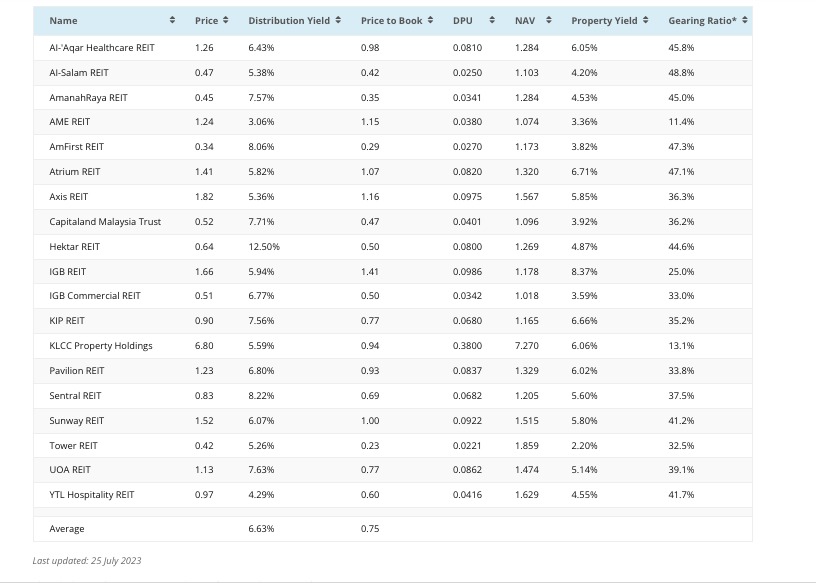
A friend asked me about Malaysian REITs... they all look so cheap. What gives. Looking at the above table there are only 5 REITS that trades at its NAV or higher: AME, Atrium, Axis, IGB, and Sunway.

If you look at Price to Book, i.e. discount to NAV, many trade between 40%-70% discount to NAV. How should we view such investments?

Discount Trap/Value Trap

Most REITs do trade at a discount, that's a given, but an acceptable discount should only be between 5%-15%, anything more implies there's something more that we have missed out.

Potential Factors Driving Discounts:

a) an environment of higher interest rates, which eats into net yield as rentals are not so agile at moving in tandem with real interest rates... not to mention the higher cost of refinancing;

b) economic activity outlook depressing: if we are looking at a depression over the horizon, there will be more breaking of leases and rentals, and subsequent downward pressure on yields;

c) owing to the age/design of properties under management, investors may be looking at lower rentals going forward, thus exacerbating the discount;

d) diversification or non-diversification can and will affect the discount, and so too is the "Grading" of the said property;

e) vacancy rates, the existence of newer competing projects in surrounding areas, the deterioration of infra-supporting business activity;

f) the aging aspect and requirements for repairs and upgrades;

g) the liquidity being traded, as usual, a bigger REIT would always win over a smaller capitalized REIT, the ability to get in and out, the ability to get a sizable position;

h) more importantly:  access to more capital sources, transparency, and a good management team;

Locally, investors are most gloomy with Hotels and Resorts type REITs. Will take a few more years before we need to look at them. Investors are most keen on Healthcare related REITs. The other sub-sector that is slightly optimistic is the Office REITs, while the Industrial REITs are not that exciting, although nowhere as gloomy as Hotels/Resorts REITs.


Using Discounts Smartly


When you based on just an absolute discount figure to NAV, you are likely to be caught in the value trap, even if the yield looks attractive. The best way to utilize a discount to NAV is to use the historical discount line over time. Each REIT has its nuances and timeline. If the yield is "good in your view", buy only when the discount is BELOW the average discount to NAV figure. Use a 5 percentage points basis before acting. That means when it is at least 5 percentage points below the average. You can use that also when selling, sell when it's 5 percentage points above the average line.

REITs Rosetta Stone

Local REITs taxation (or rather the non-taxation aspect) is the key. If the government even starts to consider any policy change to tax them, it will be more than disastrous. However, if we follow the regional policy to stay competitive, that is not likely to happen anytime soon.


What Do I Prefer

Well, good management first of all. I also like to look at family-owned REITs. There are family-owned ones that have good and solid professional management and some that don't. Do they do arm-length transactions?

The other aspect I look at is how "dependent" they are on the yearly dividends. To that end, I mean that the shares and other equity instruments are "not sold" or held in trust, and the rest of the family relies on the dividends more so than others.

I prefer UOA, IGB and KIP. But that's just me.

Thursday, July 27, 2023

Fed, Interest Rate Differentials, The De-Dollarisation - What Gives


The Federal Reserve finally bit the bullet and hiked rates to a target range of 5.25-5.5%, the highest in 22 years. What does that mean?

Firstly, we are all lucky that there's Jerome Powell, has the political will, intellect, and the balls to do that. If it was a Trump presidency, he would have sacked him and appointed a stooge who would have stopped raising the rate at 4.5% and wouldn't have been "allowed" to raise rates further.

The rate hike saw the bulls for stocks emerge from the ruins as they see this as the final hike necessary. Hope they are right.

The inflationary cycle has to be curtailed this time around because it all stemmed from the over-exuberance printing by the USA when they haven't even rectified the bastardization of US currency since 2008.


All currencies in Southeast Asia depreciated in 2022 and 2023 but to varying degrees. Many Malaysian are concerned over the weakness of the ringgit, in particular, over the last 6 months. 

Local companies have been shouldering higher import costs since H2 2022. Higher import costs will exacerbate existing cost pressures, driven by surging commodity and shipping costs. Firms are seeing a high-cost environment through the rest of 2022. They should find ways to cut costs where possible, for example, by reducing supply chain inefficiencies and reducing channel costs.

Why Asian Currencies Are Weak In 2022 and 2023

Surging commodity prices – Rising commodity prices are causing trade deficits across Southeast Asia to widen, as most of these countries are net commodity importers (except Indonesia). 

Global volatility – Global volatility has triggered a rush of foreign portfolio investment toward safe-haven currencies, leading to massive outflows from the emerging markets of Southeast Asia.

Monetary policy differences – The interest rate differentials as can be seen by the chart below, amplifies the interest rate differentials. Some countries may have a harder time hiking rates alongside the Federal Reserve owing to the already "depressive nature of their local economies".

Have you seen the Japanese yen??!! Even our ringgit is better than the yen. Japan really cannot raise rates as their own domestic economy is so unenergised.

Malaysia tends to feel the effects more because countries like Thailand, Vietnam, and Indonesia have a better than critical mass in their domestic economies. A "critical mass" implies a country's population of more than 50-60m in my view. This is why it is so much harder to launch a startup or a business in Malaysia as it's harder to get to critical mass.

It is more than likely that Malaysia's situation has been exacerbated by large outflows of money since the results of the last election. For reasons I need not elucidate here, it is only logical to expect dubiously gotten gains to leave the country in anticipation of a higher chance of crackdowns on illicit and illegal activities of the past. One should really go through the transactions since the last elections and pinpoint their source of wealth... but do we have the political will, even with a new, more transparent government?

The Demise Of USD Is Near

At every juncture, whenever the US economy goes into a crisis, the smaller countries all get whacked. Everybody's pretty pissed about this. The internet implosion in 2000, the 2008 financial crisis... even the Covid pandemic ... the American solution is to print and print. It goes back to the rest of us while the USD maintains its parity.

But let's solve the inflationary spiral first. Already if you look at the countries that are already doing a de-dollarization campaign. 

China and Russia are trading in their own currencies. Beijing and Brazil have also dropped the dollar in bilateral trade. The UAE is selling China its gas in yuan, through a French company. Southeast Asian nations in ASEAN are de-dollarizing their trade, and promoting local payment systems. Kenya is buying Persian Gulf oil with its own currency. Even the Financial Times newspaper has acknowledged that a “multipolar currency world” is emerging.


For all the central banks' talk that gold is useless... well most central banks have been buying gold in a big way for the past 15 years. China was the biggest since 2008 crisis. Now all the smaller countries have been accumulating as well.

While I do not think the USD will lose its wheels, its reserve currency status will be severely dented over the next few years. Less global transactions will involve USD, where possible.

The biggest Treasury bonds and USD holders will continue to reduce their position in favor of gold holdings. 

For all the talk by central bankers and economists about gold being a poor investment, and not viable as part of a standard global currency system ... these countries sure have been buying a lot of gold. You have to ask, what's that for?

Russia has been among the top buyers of gold in the last ten years pushing its gold reserves from 882.96 tons at the end of 2011 to 2,301.64 tons at the end of 2021. Turkey’s central bank has added around 278.55 tons of gold reserves since 2017. During 2017, 2018, and 2019, Turkey was the second largest purchaser of gold and continued with its buying as the fourth highest buyer in 2020. The country’s gold reserves at the end of 2021 stood at 394.2 tons, equivalent to 24.37% of its total reserves. 

India’s gold reserve levels are the ninth highest in the world. One of the biggest purchases of gold was in 2009 when the Reserve Bank of India purchased 200 metric tons of gold from the International Monetary Fund (IMF), under the IMF’s limited gold sales program. This took its reserves to 537 tons. In the last five years, India has continued to add gold to its reserves, which have swelled its gold holdings from 557.77 tons at the end of 2016 to 754.1 tons at the end of 2021 with 77.45 tons bought alone in 2021. During Q1 2022, India added 6.31 tons, taking its total gold reserve holdings to 760.4 tons. Gold currently constitutes around 6.86% of its total reserves.

China holds the world’s sixth-highest gold reserves at 1,948.31 tons, which constitutes 3.3% of its official reserves. However, many experts believe China's total is closer to 4,000 tons (making it the 4th highest in reality) with a lot of secretive buying - judging by surreptitious transactions over the past few years.


Look at the Gold Reserves, final column... if Gold is so useless why were 3 out of 4 central banks buying so aggressively for the last 5 years? For a no-yield instrument, that's a lot of gold.


The Finale ..

What will happen is the USD will see a gradual devaluation at first, followed by a big one, which they themselves will initiate. Calamity will ensue ... they will all gather around and discuss the global monetary system not working ... in the end the countries with gold will lead the talks as the USA does not have the means to pay down their debt, and even their gold holdings will not make a dent ... those with higher ratios of gold as per net GDP will have a louder voice ... IMF will restructure the SDRs (Special Drawing Rights) which will be a new mixture of gold, and other major currencies as per their ratios of gold to net GDP.

Tuesday, July 25, 2023

If I Were Elon ...


A better strategy would have been to buy 3 top clubs and 3 middling clubs, you take the supply out ... there will always be billionaires with nowhere to spend the money... eventually, you cash out one top club and 2 middling clubs and you get 3 big clubs for free

Caring Healthcare, BIG, Apex Healthcare


7-11 sold 75% stake in Caring Pharmacy Group to BIG Pharmacy Healthcare for RM637.5m last Friday.


Conclusion:

a) the deal is a bit rich ... net net good for 7-11. 

b) seriously, its so much more expensive that Apex Healthcare, which should be in everyone's core portfolio, as Apex Healthcare still has a very juicy subsidiary within the company (orthopedics/prosthetics), Apex Healthcare is an interesting stock to follow.

c) while its good for 7-11, other than paying down debt I see no cohesive deployment of capital for future earnings growth platform, so call on 7-11.


d) the partial sale by Straits Apex looks right a necessary step rather than a fantastic corporate decision. On its own, SA probably cannot list owing to its high potential contribution to Apex Healthcare. The only way forward is to sell down the stake so that the listing will come via another entity. You cannot get exposure to SA directly, so Apex Healthcare is the only option. 

Apex Healthcare's QTRs


Disclaimer:  this is not a call to buy or sell, just an opinion from a market watcher, please consult your dealer or remisier before any action.


Friday, April 14, 2023

Why We Need Testosterone (a message from this site's sponsor)

Why do we need testosterone?

Last updated Wed 6 February 2019 By Markus MacGill Reviewed by Daniel Murrell, MD


What is testosterone? Imbalances Testosterone levels and aging Treatment Outlook

Testosterone is the key male sex hormone that regulates fertility, muscle mass, fat distribution, and red blood cell production.
When levels of testosterone drop below levels that are healthy, they can lead to conditions like hypogonadism or infertility. There are, however, sources from which people with low testosterone can boost their levels.

Low testosterone is becoming more and more common. The number of prescriptions for testosterone supplements has increased fivefold since 2012.

This article will explore what testosterone does and whether men should worry about decreasing levels of the hormone as they grow older.

Fast facts on testosterone
- Testosterone regulates a number of processes in the male body.
- Levels of testosterone tend to drop as men age.
- Prohormone supplements do not have any effect on testosterone levels.
- Testosterone replacement therapy (TRT) is also available. However, this can carry side effects and risks.


What is testosterone?
Testosterone is the male sex hormone.
Testosterone is the hormone responsible for the development of male sexual characteristics. Hormones are chemical messengers that trigger necessary changes in the body. Females also produce testosterone, usually in smaller amounts.

It is a type of androgen produced primarily by the testicles in cells called the Leydig cells.

In men, testosterone is thought to regulate a number of functions alongside sperm production. These include:

- sex drive
- bone mass
- fat distribution
- muscle size and strength
- red blood cell production

Without adequate amounts of testosterone, men become infertile. This is because testosterone assists the development of mature sperm.

Despite being a male sex hormone, testosterone also contributes to sex drive, bone density, and muscle strength in women. However, an excess of testosterone can also cause women to experience male pattern baldness and infertility.

The brain and pituitary gland control testosterone levels. Once produced, the hormone moves through the blood to carry out its various important functions.


Testosterone imbalances
Testosterone test
Testosterone decreases naturally with age. It is important to receive tests to determine whether any imbalances are due to an active condition.
High or low levels of testosterone can lead to dysfunction in the parts of the body normally regulated by the hormone.

When a man has low testosterone, or hypogonadism, he may experience:

reduced sex drive
erectile dysfunction
low sperm count
enlarged or swollen breast tissue
Over time, these symptoms may develop in the following ways:

loss of body hair
loss of muscle bulk
loss of strength
increased body fat

Chronic, or ongoing, low testosterone may lead to osteoporosis, mood swings, reduced energy, and testicular shrinkage.

Causes can include:

- testicular injury, such as castrationi
- infection of the testicles
- medications, such as opiate analgesics
- disorders that affect the hormones, such as pituitary tumors or high prolactin levels
- chronic diseases, including type 2 diabetes, kidney and liver disease, obesity, and HIV/AIDS
- genetic diseases, such as Klinefelter syndrome, Prader-Willi syndrome, - hemochromatosis, Kallman syndrome, and myotonic dystrophy

Too much testosterone, on the other hand, can lead to the triggering of puberty before the age of 9 years. This condition would mainly affect younger men and is much rarer.

In women, however, high testosterone levels can lead to male pattern baldness, a deep voice, and menstrual irregularities, as well as:

- growth and swelling of the clitoris
- changes in body shape
- reduction in breast size
- oily skin
- acne
- facial hair growth around the body, lips, and chin

Recent studies have also linked high testosterone levels in women to the risk of uterine fibroids.

Testosterone imbalances can be detected with a blood test and treated accordingly.


https://andropausesuccor.com


Testosterone levels and aging
Testosterone levels naturally decrease as a man ages.

The effects of gradually lowering testosterone levels as men age have received increasing attention in recent years. It is known as late-onset hypogonadism.

After the age of 40, the concentration of circulating testosterone falls by about 1.6 percent every year for most men. By the age of 60, the low levels of testosterone would lead to a diagnosis of hypogonadism in younger men.

About 4 in 10 men have hypogonadism by the time they reach 45 years old. The number of cases in which older men have been diagnosed as having low testosterone increased 170 percent since 2012.

Low testosterone has been associated with increased mortality in male veterans. Late-onset hypogonadism has become a recognized medical condition, although many of the symptoms are associated with normal aging.

The following are symptoms of late-onset hypogonadism:

- diminished erectile quality, particularly at night
- decreased libido
- mood changes
- reduced cognitive function
- fatigue, depression, and anger
- a decrease in muscle mass and strength
- decreased body hair
- skin changes
- decreased bone mass and bone mineral density
- increase in abdominal fat mass

As well as sexual dysfunction, late-onset hypogonadism has also been associated with metabolic disease and cardiovascular disease.

The degree to which testosterone levels decline varies between men, but a growing number of men experience the effects of reduced testosterone levels. Life expectancy has increased, and many men now live beyond the age of 60 years.

As a result, a higher number of men see the effects of age-related testosterone depletion.

Treatment
Administering treatment for hypogonadism as the result of a disease differs from treating late-onset hypogonadism in older men.

Testosterone supplements
One proposed treatment for low testosterone comes in the form of testosterone supplements.

One type of testosterone supplement, methyltestosterone, has received approval from the United States Food and Drug Administration (FDA). However, guidelines advise doctors not to prescribe this supplement due to the speed with which the liver metabolizes testosterone.

This can lead to liver toxicity. While doctors can legally prescribe the supplement, they generally try to avoid this.

Until stronger evidence is available to support the benefits and safety of testosterone supplementation, only older adults with severe clinical symptoms of low testosterone should be candidates for these supplements.

The FDA have advised that testosterone supplements are not suitable to treat late-onset hypogonadism, and a doctor should only prescribe them for an identifiable cause.

Testosterone replacement therapy
Testosterone replacement therapy (TRT) can help restore some affected functions of low testosterone.


Current research is conflicting. Additional studies into testosterone replacement are necessary for physicians to fully understand its potential risks and benefits, and to identify the individuals that may see the most benefit.


Outlook
For men, testosterone levels are important to maintain, but they naturally decrease over time. If symptoms of severe or chronic low testosterone are showing, the hormone deficiency may be caused by an active disease or condition.

Treatment can lead to unwanted side effects, so it can be crucial to balance the expected benefits of testosterone supplementation with the risks of the treatment. Often, low testosterone levels come without harmful physical effects and do not require treatment.

Speak to a medical professional, and confirm if treatment is required.