Thursday, June 10, 2010

The 20 Swear Words Rooney Cannot Say

The big hoo-hah over the World Cup now is the amount of incessant swearing by players. Rooney has been made the poster boy. In fact, newswires now report that the referees for the match between England and USA have been given 20 English swear words so that they can familiarise themselves for that match between England and USA. Trouble is NONE of the swear words were released or published by the media. Only at Malaysia Finance do we try to analyse which 20 words they were. Please read at the latter part of article.

The Daily Telegraph:

Carlos Simon, who has a reputation as a no-nonsense, if also controversial, official is a fluent English speaker but he and his assistants, Roberto Braatz and Altemir Hausmann, have been given a list of 20 English swear words to prepare themselves for England's Group C match against the United States.

With Rooney cautioned in Monday's practice match against the Platinum Stars for using foul and abusive language against referee Jeff Selogilwe - who warned that if the striker behaved the same during the tournament he could get sent off - it will intensify the focus on his behaviour.

Fabio Capello is likely to speak, informally, to Rooney ahead of Saturday's game to remind him of his importance to the team and also the need to keep his discipline especially if he is provoked by the Americans who have already questioned his, sometimes, volatile temperament.

Given a list of English swear words ...  controversial referee Carlos Simon

Given a list of English swear words ... controversial referee Carlos Simon Photo: Getty Images

Hausmann, Simon's first assistant, said: "We have to learn what kind of words the players say. All players swear and we know we will hear a few 'son of a ..... '."

His fellow assistant, Braatz, added: "We can't do this in 11 different languages but at least we have to know the swear-words in English."

Simon, 44, is officiating in his third World Cup finals, but has been criticised in Brazil for a series of decisions which led to one of the country's biggest clubs, Flamengo, petitioning Fifa to get him thrown out of the tournament.

Wayne Rooney .... cautioned for swearing in England's friendly match

Wayne Rooney .... cautioned for swearing in England's friendly match

Capello is acutely aware of the different referees and styles the England players will encounter during the World Cup which is why he selected officials from a series of different countries during the warm-up games and friendlies over the past two years.

It is all part of his meticulous preparation which stepped up on Wednesday with the Italian starting his in-depth analysis of how the Americans will play on Saturday. He will examine DVDs and scouting reports which may influence the selection of the team he puts out although the XI is, according to sources, starting to take shape.

One of the key decisions is who will play in goal and Joe Hart is, as has been apparent since the squad arrived in South Africa, putting increasingly severe pressure on Robert Green to be selected and may even, now, have edged ahead. Indeed it is understood that so close is the call between the two that Capello is not likely to make up his mind until after his usual post-breakfast walk on Saturday morning.

The England manager had indicated he would decide who would play on Friday but Hart's impressive performances in training and his self-assurance is putting Green's selection in doubt. David James, who is still recovering from a sore knee, is unlikely to be risked by Capello.

The decision will come down to who does best in the last two days of training with Hart understood to be that little bit "sharper" than Green right now, although the West Ham goalkeeper does have the advantage of greater experience.

It is likely that Capello will partner either Emile Heskey - who appears the favourite as things stand - or Peter Crouch with Rooney in what is expected to be a 4-4-2 formation. One of the other big selection issues is whether James Milner - who will return to training today after missing the last two days due to a temperature - or Joe Cole plays on the left of midfield. The likelihood is that Capello may favour Milner but, again, it will be an extremely close call and may depend on how he feels the Americans will line up.

The Daily Telegraph, London

--------------------------

The 20 swear words will have an English/UK bent to it. To that end, Anorak has cited a survey of swear words: Swearing and offensive language – severity rating - Source: Delete Expletives? Researched by NOP for the ASA, BBC, BSC and ITC

Cunt

83

13

3

1*

1

1

Motherfucker

79

15

4

2*

2

2

Fuck

71

22

6

1*

3

3

Wanker

37

37

22

4

4

4

Nigger

42

26

14

18

5

11

Bastard

33

33

25

8

6

5

Prick

26

36

29

8

7

7

Bollocks

25

32

34

8

8

6

Arsehole

22

34

36

7

9

9

Paki

34

26

16

24

10

17

Shag

27

28

32

12

11

8

Whore

26

33

25

15

12

13

Twat

26

27

27

19

13

10

Piss off

18

32

42

7

14

12

Spastic

32

24

16

28

15

14

Slag

19

31

33

17

16

18

Shit

16

26

49

9

17

15

Dickhead

16

24

44

16

18

19

Pissed off

14

24

47

14

19

16

Arse

10

21

47

21

20

20

Bugger

9

22

48

21

21

21

Balls

11

19

44

25

22

22

Jew

20

15

14

51

23

24

Sodding

7

18

45

30

24

23

Jesus Christ

14

13

27

46

25

26

Crap

5

15

48

32

26

25

Bloody

3

11

56

29

27

27

God

10

8

23

60

28

28

*Fewer than 25 correspondents


There are more than 20, so to cut the list down, here is what I think the 20 swear words were, in order of popularity:

1. FUCK / FUCK OFF
2. PRICK
3. PISS OFF
4. SHIT
5. ARSEHOLE
6. BUGGER
7. JESUS / JESUS CHRIST / CHRIST
8. BOLLOCKS
9. DICKHEAD
10. WANKER
11. GOD
12. BALLS
13. MOTHERFUCKER
14. BASTARD
15. CUNT
16. SODDING / SOD OFF
17. TWAT
18. CRAP
19. SPAZ / SPASTIC
20. ANY PAIRINGS OR COMBINATIONS OF THE ABOVE

The Most Likely Golden Boot Winner

The injuries to key players so near to the start of the World Cup were disheartening. Though many of them are fabulously rich already, many of them would have dreamed of being in the World Cup from the very start. That was what drove their passion, money kind of got in the way. You cannot buy a position to be playing in a World Cup tournament.

http://www.wallpapers-football.net/player-wallpapers/Gonzalo-Higuain/Gonzalo-Higuain-wallpaper3.jpg

One of the more interesting betting schemes would be predicting the likely Golden Boot winner.


2010 World Cup Top Goal Scorer Odds


Visit Paddypower Visit Ladbrokes Visit Boylesports Visit Bet365 Visit Betfair Visit Williamhill Visit VCBet
Villa, D 9 8 9 8 9.8 8 15/2
Messi, L 10 9 10 9 11 10 9
Rooney, W 11 8 10 10 12 10 10
Fabiano, L 12 11 12 12 15 12 10
Torres, F 12 12 12 12 16 12 12
Higuain, G 18 16 16 16 23 16 16
Ronaldo, C 18 16 16 18 19 14 16
Van Persie, R - 25 22 20 23 20 25
Drogba, D 25 25 28 22 38 33 25
Nilmar 25 - 28 25 - - -
Milito, D 28 33 20 33 40 33 28
Klose, M 25 25 28 25 46 33 25
Negredo, A - - 33 - - - -
Aguero, S 25 33 22 25 65 40 25
Benzema, K - - - - 450 - 40
Pato, A - - - - 370 - 40
Kaka 33 40 33 33 55 40 33
Tevez, C 40 33 33 33 44 33 33
Robinho 33 40 40 40 60 40 40
Podolski, L 50 40 50 50 80 50 40
Akale, K - - - - 590 - 50
Adriano - - - - - - -
Mueller, T - - - 50 - - -
Huntelaar, K 40 50 50 40 85 50 40
Gilardino, A 33 50 40 33 50 40 40
di Natale, A 50 66 66 50 60 50 50
Defoe, J 33 33 33 33 90 50 33
Eto`o, S 40 40 40 33 95 50 40
Guiza, D - - 66 25 1000 - -
Robben, A 66 66 50 50 70 40 -
Pedro León, S - - - - - - -
Henry, T 33 40 33 25 85 50 33


I totally agree with the odds as I do think David Villa is way under-rated when compared to the more popular Messi and the over-hyped Rooney (even though he is a Red Devil). I think Torres is a bit of a prima donna and plays like a woman, in that he has his period days and can get moody. Messi is a near God, no doubt about that, but he will be heavily marked in every game and that might free up his team mates to do the scoring rather than seeing him on the score sheet. That is why Gonzalo Higuain might be a decent bet at good odds. However, the consideration is that the poorly qualified coach that is Maradona, only called up Higuain in the last 2 qualifying matches, and that was after a lot of pressure from the media. Maradona may only use him sparingly.

http://www.freewebs.com/nccrdog/david-villa1.jpg

To be a Golden Boot winner, we have to look at the teams they will be facing, and then how far down to the finals they will be playing. To that end, I still think Gonzalo Higuain is a good bet, with a smaller cover bet on Robin van Persie. Robin would have been more popular but Holland is likely to meet Brazil in the quarter finals, and that may limit the actual number of games one can play in the end.

What is your take?

http://www.1000goals.com/wallpapers/van-persie-holland-1.jpg

Tuesday, June 08, 2010

After Greece and Portugal, We Have Hungary and Spain

This is like a Euro Soccer Championship gone very bad. We have Greece and Portugal is teetering as well. The EMU stepped in and markets were calmed ... for a while, now the unthinkable is happening, Spain is treading murky waters. It used to be that Spain and Italy were considered much like AIG ... too big to fail. Now we are all not so sure. Spain may still have some time and size on its side, but Hungary looks doomed now and should see fresh funds from somewhere before the end of June.


Sovereign debt worries in Europe have been elevated for a couple of months now, and today Hungary moved into the crosshairs. Sovereign debt default risk as measured by 5-year CDS prices has spiked for Hungary and the countries surrounding it today, but default risk for this region still remains well below levels seen in late 2008 and early 2009.

The first two charts below of 5-year CDS for Austria and Hungary since 2008 highlights this. Greece and Portugal default risk remains elevated as well, but at the moment it is still down from its recent peaks. France also remains elevated, but it is still below highs seen in early 2009.

The same can't be said for Spain, however. Spain default risk reached a new crisis high today, taking out levels seen prior to the trillion Euro bailout. And Spain matters much more than Hungary.


Hungary's fiscal position has improved in recent years, but the public debt burden, at just under 80% of GDP, remains hefty by regional standards. Hungarians overwhelmingly voted for the center-right Fidesz party in April 2010 elections, but questions remain over the new government's fiscal policy agenda. In early June, Hungarian markets reeled amid comments from Fidesz officials that the budget deficit would be much wider than the current 3.8% of GDP target for 2010, leading some to draw parallels with the situation in Greece. However, officials later backtracked on the comments.

http://i671.photobucket.com/albums/vv80/sgdaily9/MayukoIwasa03.jpg

On June 3, markets in Hungary came under pressure after State Secretary Mihaly Varga said he expected a budget deficit of 7-7.5% of GDP in 2010. Meanwhile, Lajos Kosa, deputy head of the ruling Fidesz party, said public finances in Hungary were such that Hungary only had a slim chance of avoiding a Greek-style fiscal crisis. In 2009, Hungary narrowly missed meeting the 3.9% of GDP budget deficit target set out under the terms of its US$25.5 billion EU/IMF-led loan agreement. The 2010 budget deficit target is 3.8% of GDP, but it is expected to be renegotiated under the new government.

The European Commission notes that Hungary almost met its budget deficit target of 3.9% of GDP in 2009. Parliament adopted the 2010 budget on November 30, 2009 that complies with the 3.8% of GDP deficit target for 2010 under the country's EU/IMF-led loan program (although the Fidesz government plans to renegotiate this target). Specific measures in the 2010 budget include: "a freeze of the public sector wage bill, reform in the pension system, saving measures in the area of social benefits as well as reduction in the level of housing subsidies and gas- and district-heating supports."

On May 21, 2010, the newly-elected Fidesz government warned that the budget deficit will increase in 2010 due to the discovery of additional debts in the outgoing government's budget. Fidesz officials stated that debts of 170 billion forints (US$757 million) have been uncovered so far, which represent 0.7% of Hungary's GDP, and that additional "skeletons" are likely to be found.

Thursday, June 03, 2010

Wonderings

How do you view this? Goldman Sachs International now has a 11.5% stake in Berjaya Corp. No matter what your views are of Vincent Tan or his Berjaya group of companies, you have to salute him in getting GSI onboard. If you ask all the analysts covering Malaysian stocks to recommend 3 counters for GSI to take up substantial stakes in, I can safely say that Berjaya Corp would probably not make the list at all. Its a wonderment, its probably the only time you can shake your head in disbelief but had to clap at the same time.

http://clovetwo.com/pitstop/photogallery/thumbnails/41/Marion%20Caunter.jpg

Goldman Sachs International ("GSI")
Peterborough Court, 133 Fleet Street, London EC4A 2BB, United Kingdom
Indirect/deemed interest (%)
:
11.5
Total no of securities after change
:
464,685,800
Date of notice
:
28/05/2010

GSI is a subsidiary of Goldman Sachs Holdings (U.K.), which is a subsidiary of Goldman Sachs Group Holdings (U.K.), which is in turn a subsidiary of Goldman Sachs (UK) L.L.C. The Goldman Sachs Group, Inc. is the direct holding company of Goldman Sachs (UK) L.L.C. and the ultimate holding company of the other aforementioned entities.

As if thats not enough, he still managed to get Temasek to pour billions into U-Mobile ... another round of head shaking and you just had to clap some more.

http://mediamalaya.com/wp-content/uploads/2009/06/marion-caunter8.jpg

Next, lets look at Sime Darby's Annual Report 2009, in the first few lines of the Chairman's Message: "I am pleased to announce that the Group has reported a net profit after tax and minority interests of RM2.3 billion and a Return on Average Shareholders’ Funds (ROA SF) of 10.6 percent, exceeding our Key Performance Indicators (KPI) for FY 2008/09 of RM1.9 billion and ROA SF of 8.8 percent."

This was the headline of Ahmad Zubir's message as CEO: "On behalf of the Board of Directors, I am pleased to report that the Sime Darby Group has exceeded our Key Performance Indicators (KPI) for FY 2008/2009 despite the challenging operating environment during the year. The Group recorded RM2.3 billion in profit after tax and minority interests and Return on Average Shareholders’ Funds (ROA SF) of 10.6 percent, exceeding our Key Performance Indicators (KPI) for the year, of RM1.9 billion and 8.8 percent."

Just wondering whether KPIs are the best management tool we have, or are KPIs really effective after all??!! Don't shoot the messenger ....

IMG_7490_ed by dkbu5.

Wednesday, June 02, 2010

JZ8 Gets Solid Reviews

Taiwan's top hifi magazine Audio Art posted a wonderful review of JZ8's album:

Click on link for high resolution pdf version:

http://www.poppop-music.com/jz8review.pdf


Article in Oriental Daily:

http://www2.orientaldaily.com.my/read//2JS40bU418090D8l01i56lOd0nVd23M7

Article in Sin Chew:

http://ent.sinchew-i.com/node/20984

https://blogger.googleusercontent.com/img/b/R29vZ2xl/AVvXsEj2mIo7K4yqfxQNuAsYX626zoVPqrC18HYwxhmVdGud58zl5FUv-dFoKcVUDGuZ-hlnXBXqaFC9K0Gx_vURZOt0cPwUFYlqhuT9LEvfkC41hgicmqZLFqe9IfpL6rRPZOCdj4SV/s1600/jz8+team.JPG

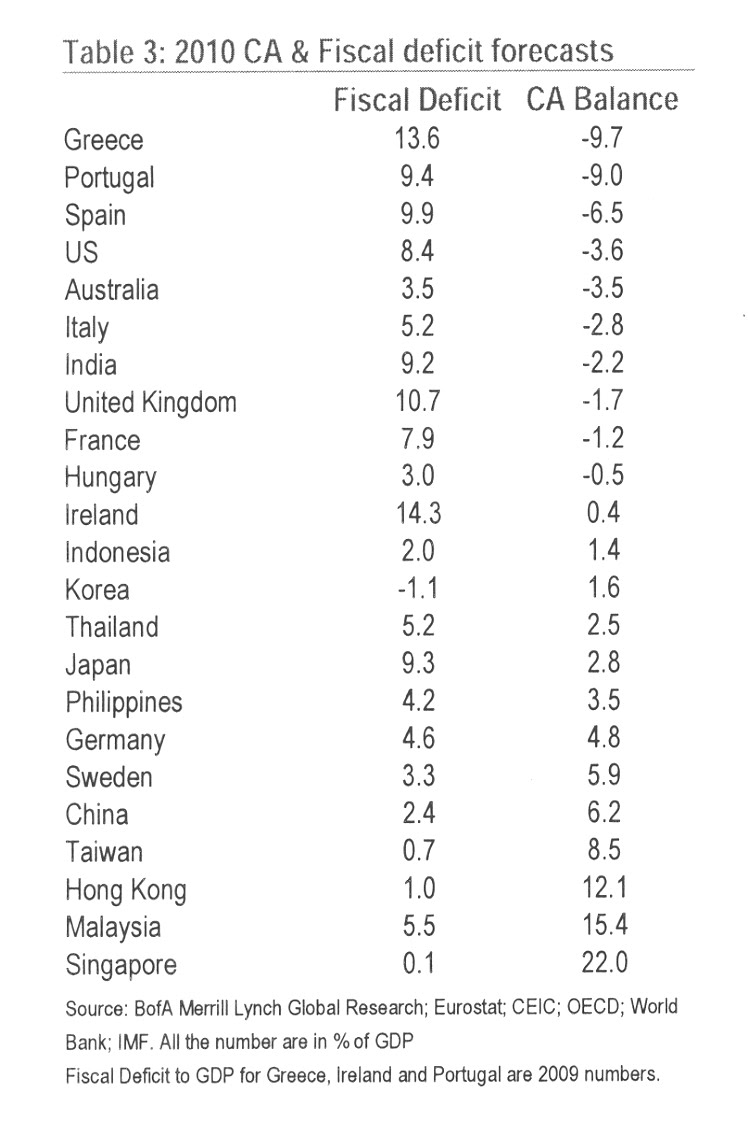
Fiscal Deficits, Current Account Surplus & Asset Class Returns As At May 31, 2010


Wow, May was THE month alright. Look at the returns for May. Everything were red except for US bonds. May was the worst month for the major asset classes since the dark days of February 2009. Virtually everything suffered with more than trivial losses. Treasuries were the exception, thanks to the revived rush to safety.

Stocks around the world led the decline, with foreign developed markets posting the biggest loss among the major asset classes. What changed the sentiment so sharply in May? A renewed fear of deflation was one catalyst. Investors are increasingly focusing on the growing burden of debt that weighs on the global economy, particularly in the mature countries of Europe, Japan and the U.S.

060110a.GIF

It was inevitable that the surge in asset prices across the board would come to an end. That doesn’t mean that expected risk premiums are nil or negative. But the investment landscape ahead is set to become more complicated. In the spring of 2009, as it became clear that the global economy wasn't going to implode after all, the markets repriced assets accordingly. Markets are no longer trading in anticipation of another Great Depression.

Olivia Ong - Girl Meets Bossa Nova 2 by Kian's Crazy Life.

We may have avoided another Great Depression but we now have the The Winter of Euro-Discontent. To a large extent, we can say that this is more localised than the subprime mess. In another angle, the Eurozone crisis is a different version of the US/UK subprime mess as well.

The US and UK governments acted swiftly to contain the mess, by rescuing dubious companies that cannot be allowed to fail. The US government can print money liberally and even with an enlarged debt, the US is still the US. Not so for many of the governments in the Eurozone. If Greece was the US, Greece would not have been under such a spotlight. It would have been able to print its way out of its troubles.

What is real is we are going to see a long period of deflation within Eurozone, with equally weighty weights on the Euro currency, and other independent European currencies. Public debt or sovereign debt inhibits movements in or grandiose monetary policies. While they have to placate foreign buyers of the attractiveness of their bonds, they are hamstrung by not being able to do deficit-stimulus. Unemployment and social unrest will only climb.


All this will mean that other countries may be wanting to delay tightening, such as the US, China and a host of more vibrant emerging markets. When investors compare the EU with the rest of the world, its obvious. Then you STILL have a low interest rate regime everywhere, in fact a prolonged low interest rate environment - that will cause funds (now on the sidelines) to pour into the US and other emerging markets. The more EU plays out the cards they were dealt with, the more optimistic I am of a strong equity market for the US and emerging markets in 3Q and 4Q.

Technically, Japan is in a more difficult position with a huge fiscal deficit but they still have a current account surplus, and that should be the key in estimating the probable recovery by EU countries in crisis. Watch their current account movements and signs of improvement will mean they are on the mend. Well, we all know that that is not going to happen till 4Q2010 if not later.

As a side note, Malaysia looks impressive with its strong current account surplus, and owing to our deficit-stimulus funding, our fiscal deficit is a bit high but not exceedingly so. Being an emerging market economy, it would be wise to bring the fiscal deficit down gradually over the next 3 years.

Strategists Still Bullish On Year End Targets

Despite the volatility in the markets, most market strategists are still bullish. In fact a number of them have upped their forecasts for year end targets. My view is still the same, we will end the year near the highs, but I still see the best time to re-enter is after the World Cup season. Call it topical or market timing, I don't think anyone in their right mind would want to be holding stocks in May and June.

http://123.30.54.34/c.uploadanh.com/upload/0/527/0.510498001247995429.jpg

Bespoke: Bloomberg surveys sell-side Wall Street strategists on a weekly basis for their year-end S&P 500 price targets. At the start of 2010, the average year-end S&P 500 price target was 1,225, which would have been a gain of just about 10%. As markets moved higher in the first quarter, strategists upped their year-end targets, and the current average target stands at 1,268. (In the table below, green shaded price targets are ones that have been increased so far this year. No strategists have lowered their targets since the start of the year.) A target of 1,268 translates into a gain of 13.68% for the year and 16.48% from current S&P 500 levels.

There are no strategists with year-end targets that are lower than the index's current levels. Deutsche Bank currently has the most bullish year-end price target at 1,375, followed by UBS at 1,350, and JP Morgan, Oppenheimer, HSBC, and Bank of America. Citigroup is the least bullish at 1,175, which would still be a gain of 7.97% from here.

http://123.30.54.34/c.uploadanh.com/upload/0/558/0.869309001248346145.jpg

Tuesday, June 01, 2010

PER – simple but limited


A simple article on "Buy & Hold" elicited so many readers' comments. There is a hunger for genuine debate on investing techniques, obviously. In this lackluster market, I have been staying away from focusing on stocks, why not go further to refine ideas on investing.

Too many investors would hold onto low PER as the main decision making trigger. It is an important indicator but we must have a strong appreciation of its powers. Only by realising its limitations, can we use PER effectively.

The price-earnings ratio (PER) is probably the most common financial indicator used by investors. However, there are a lot of shortcomings in relying on just the PER to make financial or investing decisions.

One should also note that the earnings per share is based on net profit and not gross. Plus, it should be fully diluted, that is, it should take into account probable conversions into stock. “Trailing PER” involves taking earnings from the last four quarters, while “forward PER” uses the estimated earnings going forward 12 months.

One of the simplest and safest ways to invest is to judge a stock by its absolute low PER. It is simple as you have the low figure as a buffer and cannot go wrong by very much.

If investing were that simple, there would be no need for data mining and earnings projections, or even analysts' reports. You just sort and search each sector according to historical and forward PERs, and then look at the bottom 10% in PER.

To add value, consider the sector and earnings outlooks. If these are good, then it's a safe investment. You may not get a big bang for your bucks from this investment, but it's safe and sure. If this works all the time, why bother doing anything else? That's because investing using low PER as your main yardstick will not give you market returns or better-than-market returns (alpha). If it did, all fund managers would use that exclusively and we would not need to spend billions on research.

Using low PER as a tool

You won't be the first to discover cheap PER stocks. Rule #1: There must be very good reasons why they trade at low PERs in the first place. One must fully be aware of the whys before going further. Try and locate all the negative reasons before jumping in. Reasons for low PER are aplenty. Some of the more common ones:

  • Sunset industry, enough said
  • Cyclical stocks
  • Capital-intensive industries tend to trade at low PERs
  • Erratic earnings
  • Earnings may have had a huge jump in recent years, making PER low but not likely to be sustainable
  • The PER is low because it is likely to go lower
  • Not liked by funds for good reasons
  • Third-class management with no vision or coherent strategy
  • Jumbled shareholders or management using vehicle as their dumping ground

    Steel stocks have outperformed enormously; cyclically, it still is a good time. It's the same with certain stocks in shipping services. Both are still cyclical stocks. This means their low PER may be upgraded but it won't run very far. Cyclical stocks do not have predictable growth in earnings further than three years. Get the timing correct, but also look for a time to exit. These are not for a buy-and-hold strategy.

    Low PERs usually mean “capital-intensive stocks = low returns on assets” as compared to those in the services industry. Low PER stocks also usually have very high NTA (net tangible assets) per share relative to their share prices. Conversely, high PER stocks usually have low NTA per share relative to their share prices.

    This is because from an investing point of view, NTA only comes into consideration upon liquidation. Certainly, you don't invest in a stock hoping for the company to be liquidated in the foreseeable future. Take Maxis Communications Bhd. Its NTA is less than a quarter of its share price. If you liquidate Maxis today, it would be hell for bondholders and shareholders.

  • Paying for higher PER

    A stock will command a high PER if its business model is scalable without the same proportion of capital investment. If you have a cement plant, you will have to fork out a huge amount of capital to expand elsewhere. If you are N2N Connect Bhd, you can scale up your business into the Middle East bourses with relatively low capital investments.


  • It is highly unlikely that if you were to find a stock at 6x forward PER, you would be the first and only one to have done so. When the timing and conditions are right (like in the last few months), low PER stocks will have their day in the sun.

    Hence, PER is only a minor guide and should not be given undue weighting. Many a times, when a low PER stock is moving, it is not because of the low PER, but rather, because of a confluence of other factors, such as a sector or earnings upgrade, or that cyclically, it's time has come. It just so happens that the stock has a low PER.

    There are many who religiously find comfort in low PER, when in fact they have carved out a universe of stocks for their selection that are largely capital-intensive industries. You might as well say that you would only invest in capital-intensive and/or cyclical industries if you were to embrace only low PER stocks.

    It's not rocket science. An 8x PER stock could still go to 4x PER in a bear market, trust me. A higher PER stock does not mean that it will fall by a higher percentage. Some will cite that artificially manipulated stocks may also have high PERs. But that should not scare people away from them. Just do your homework.

    The best way to use PER in investing is by marking them to their historical PER bands. It is more meaningful to use them within the same-sector PER trading bands.

    It's pretty useless and shortsighted to buy steel stocks at 7x PER and tout them as great buys compared to the market PER of 14x. On the other hand, it's okay to buy a steel stock at 7x PER when its historical PER is 10x and because you like the market sentiment, sector outlook and the stock's fundamentals.

  • http://i426.photobucket.com/albums/pp345/bongban/zhangzilin5-1.jpg

  • An alternative gauge

    Owing to the shortcomings of the bland PER, professional investors tend to favour using the EV/EBITDA ratio. It's very similar to PER. EV is enterprise value and EBITDA is earnings before interest, tax, depreciation and amortisation.

    (Enterprise value = Common equity at equity value + debt at market value + minority interest at market value, if any – associate company at market value, if any + preferred equity at market value – cash and cash-equivalents.)

    Basically, EV is one way of trying to arrive at the net present value of the company. If a company has a lot of cash, the EV can even be negative. EV looks at the company as a going concern. It indicates how much the business is worth after paying off all claims. That's why cash in bank does not count.

    Hence EV/EBITDA is a cashflow measurement or a payback period measurement, while PER is an earnings multiple ratio (or payback period in terms of earnings).

    The former measure is superior because it takes into account the capital structure of the company. One can better compare using EV/EBITDA as it can be adjusted for risk per capital structure of a company to get at the proper returns.

    Interest and tax are external to real earnings, while depreciation and amortisation are not real cashflow items.

    Hence, you would get a better gauge on real earnings minus the peripherals. Still, even though it is a more sophisticated measure, EV/EBITDA also suffers from most of the shortcomings of PER as explained above.