Friday, July 24, 2009

HKMA Should Sit On A Screw & Turn Itself Round & Around


I really hate it when smart people suddenly caved in and kowtow to big companies. They are all idiots at HKMA, including the politicians who are supporting the newest resolution. The resolution on the Lehman bond investors sage in HK - those who have invested more than HK8m in these bonds are deemed as "professional investors", and would not get a cent back. The rest will get 70% back.

What a fucking stupid idea. If a person bought HK$40m worth of bonds, is he/she a professional investor? Why??? By the sheer size of the investment???

What if I am an idiot who puts up all my HK$8m in that one investment??? What if I am that idiot who puts in HK$8m in the fucking bonds, because it SAYS THERE ITS "BONDS", not stocks, not derivatives, not futures, not land banking, not ATM investments, not even gold coins... because its FUCKING BONDS, and its issued and "guaranteed" by Lehman Brothers, ... because its FUCKING TRIPLE AAA rated ... because HKMA also thought it was triple AAA rated and because HKMA also thought its Lehman Brothers.


Sue the shit out of the banks and HKMA, ... that is an inequitable resolution. A person who invested HK$8m, ends up losing every cent, and is now worth less than HK$1m ... compare that to someone who invested HK3m and now has HK$2m in net worth ... who is the professional investor?


A professional investor knows the risk involved, the bonds were sold by assholes who did not even know what the bonds were based on and how the money would be used. The banks selling the products themselves didn't know the full extent of the risk, or else they would have TOLD THE CLIENTS already.

People were buying them because they were BONDS. If the sales, the banks and even HKMA did not know the full extent of the risk... how do you expect the people who bought to know? Its misrepresentation.


-------------------------------------------

Friday, July 24, 2009


Celebrity investors of Lehman Brothers minibonds yesterday voiced their outrage that they may not see a cent in compensation as they are being classified as "professional investors."

Actress Meg Lam Kin-ming is likely to be one of the unlucky ones.

She bought about HK$10 million worth of Lehman-related products, including minibonds. "You are a professional investor once you've invested HK$8 million? How to assess?" she asked. "They [the bank] asked me to buy this and that back then. Yes, I bought a lot. But am I a professional investor?"

A professional investor is assessed on whether or not an individual's portfolio is more or less than HK$8 million, including securities holdings, according to the Securities and Futures Ordinance.

Some 29,000 Hong Kong minibond investors will be refunded about 70 percent of their original investments by banks, financial regulators announced on Wednesday.

About 2,000 investors are not qualified under the repurchase scheme as they are either "professional" or "experienced," Secretary for Financial Services and the Treasury Ceajer Chan Ka-keung said yesterday.

Other big-name entertainers caught up in the investment nightmare include superstar Jacky Cheung Hok-yau, funny man Eric Tsang Chi- wai and former actress Maria Chung Wai-bing. The media speculated that Cheung invested as much as HK$40 million in the high-risk product, while Tsang and Chung were estimated to have invested more than HK$10 million each.

Tsang said he invested in minibonds, but he could accept it even if he is not able to get his money back. He believes the most important thing is that the elderly can get their money refunded.

Banks will not compensate customers who have, in the three years preceding their first purchase of minibonds, executed five or more transactions in leveraged products, structured products, or a combination of these products, according to the Securities and Futures Commission.

Lawmaker Kam Nai-wai also said the arrangement was unfair as some purchases made by professional investors could involve misselling by banks.

Ceajer Chan said the arrangement was reached by banks and regulators, and investors should make inquiries to banks for details. "If investors who have not benefited from the program complain, the regulators will handle it," he said.

p/s photo: Jeanette Aw

Thursday, July 23, 2009

How To Hire Well by Temasek


Temasek should really come out with a guidebook on "How To Hire Well", a follow up on "How To Maintain Your Ego While Losing Tons Of Money", completing the trilogy of books aka Lord of The Sing$ was "How To Buy Mega Companies Without Ever Visiting Them". I don't know what to say. Firing a CEO after hiring him, without him even officially starting is poor form. Wtf was the interview or interviews like??? Wasn't Chip even asked about his strategic mindset. I am certain Chip would have asked Temasek what their objectives were, short and long term. I am certain the interviewees would have asked Chip how he would go about achieving that, what his management style was, etc...

Suddenly, Chip is not the guy after all after just 4 months, but somebody who was supposed to be leaving ... is still hanging around. I am sure Chip would be fuming if not for the probably "excellent severance package" for just 4 months of work. Probably the package would need to be excellent enough in order to remind Chip not to speak "off the cuff" about his experience at Temasek over the last 4 months.

Is the culture clash so bad at Temasek? I didn't know Temasek is so inbred!!! Either somebody is not acting professionally, I am loathed to guess who. I mean Chip has run BHP Billiton, so I think Chip would know the decorum and "best global practices" on Senior Management 101.

Obviously, Chip did not really get to call the shots. Chip does not need the aggravation or somebody looking over his shoulder. Chip has made his money. Chip is outta here. Chips Ahoy!

----------------
Finance Asia:

Charles (Chip) Goodyear will not, after all, become the first foreigner to run Temasek Holdings, the Singapore government investment company. The surprise announcement comes just four months into the leadership transition period, which should have ended with Goodyear taking over the reins from Ho Ching on October 1.

According to a statement released by Temasek late yesterday afternoon, the board of directors and Goodyear have "concluded and accepted that there are differences regarding certain strategic issues that could not be resolved". Hence they both decided that "it is in their mutual interests" to end the leadership transition process from August 15, at which time Goodyear will also step down from the board. Goodyear was appointed a member of the Temasek board on February 1 and CEO-designate exactly a month later.

"It is with much regret that both Chip and the board have accepted that it is best not to proceed with the leadership transition. We wish Chip all the best in his future endeavours, and are happy that Ho Ching has agreed to continue as executive director and CEO," Temasek's chairman S Dhanabalan said.

Goodyear added that he too was sorry that we are unable to continue with the leadership transition. "Temasek has a fantastic platform and I wish the board, Ho Ching and the team all the best," he said. Temasek was unable to comment on any compensation package agreed with Goodyear.

Meanwhile, Ho Ching praised Goodyear's albeit brief contribution, but left open what those "strategic issues" might be, saying that, "in the short time with us, Chip has started a number of initiatives which I believe will help strengthen the Temasek platform. I am sorry he is unable to continue with the leadership transition, and hope to complete the initiatives that he has started".

Goodyear is the former boss of leading Anglo-Australian mining group BHP Billiton, and would have been the first foreigner to run Temasek, the smaller of Singapore's government investment companies. He left BHP Billiton in early 2008, having started as chief financial officer in 1999 after a career as an investment banker at Kidder Peabody.

His appointment to head Temasek had indicated that a redirection of the firm's investment policy towards the natural resources and energy sectors was likely. But Temasek said yesterday that any inference of a change in focus had merely been a rumour, and that the fund would continue to invest in several sectors, and seek various opportunities.

But it looks as if it's back to square one for Temasek in terms of the search for a new boss. In a further statement yesterday, chairman Dhanabalan said the board, including Ho Ching, has been engaged on the issue of CEO succession since early 2005. "This involves an annual review of both external and internal candidates over various time horizons [and] Temasek will continue with this annual succession planning process," he said.

Ho, who is married to Singapore Prime Minister Lee Hsien Loong took the helm at Temasek in 2004, and had aimed to diversify the fund's portfolio with about one-third invested in Singapore, one-third elsewhere in Asia, and the rest in developed economies. A clear investment philosophy was to invest in industries which should grow in tandem with an expansion of the region's middle class, such as healthcare and education providers. Banking and telecoms also entered the fund's radar.

In the financial sector, Temasek bought a 19% stake in Standard Chartered since 2006, but it was its combined $5.3 billion investment in Merrill Lynch in December 2007 and July last year, and its £1.2 billion ($1.9 billion) investment in Barclays in 2007 that attracted most attention and which have caused the most pain. The fund made losses of more than $4 billion when it sold these stakes earlier this year.

The release of the fund's fiscal 2009 results in August will show how badly it was damaged by the collapse in stockmarkets last year. Temasek's portfolio lost $58 billion in value in the eight months to November 2008, leaving it with total assets of $84 billion, Singapore finance minister Tharman Shanmugaratnam said in May.


p/s photo: Suparksorn Chaimongkol


The Asia Pacific Property Market Overview


Industry Profile — Key Points

• The Asia-Pacific is the third largest real estate market, after Europe and North America, but has the highest amount of listed real estate, €515 trillion (US$683.25 trillion) as of January 30, 2009, compared with €228.1 trillion (US$302.62 trillion) in Europe and €393 trillion (US$521.39 trillion) in North America.
• The overall fundamentals of the Asia-Pacific office and retail property markets have weakened over the last year, with many existing tenants adopting a cautious view regarding expansion, causing rents to fall.
• A lack of credit meant the Asia-Pacific REIT markets suffered their deepest falls in the second half of 2008, with their total market capitalization down almost a third.
• Tight credit requirements for property acquisition led to slowing Asia-Pacific investment activity in the second half of 2008.
• After years of tight constraints, most countries implemented a range of more liberal policies and measures to boost their sluggish property markets.


Market Trends and Outlook — Key Points

• Most Asian REITs are finding that a lack of available credit is affecting investors’ decisions about finalizing deals, with the value of the top ten transactions by Asian REITs down almost 40% in the second half of 2008.
• Building development is becoming more environmentally friendly with companies and households applying cost effective measures to reduce greenhouse gas emissions.
• The global economic recession is likely to slow Asia-Pacific property market growth in 2009, with further room for property price adjustment in many markets and with investor and household confidence still low.
• More fiscal stimulus measures, apart from interest rates cuts, may be needed to aid property market growth.


Current Environment — Key Points

• The poor economic environment and the onset of the US subprime mortgage crisis caused a housing market downturn in the Asia-Pacific during the six months ended April 30, 2009.
• Central banks across the region cut interest rates to historic lows, while governments unveiled economic stimulus packages worth trillions of dollars to boost their economies and property demand.
• Investor confidence picked up in mid-March, with the average share price of 14 leading Asia-Pacific property companies up 17.19% over the six months ended April 15, 2009.
• Weak equity sentiment caused companies to either lower their IPO prices or delay listing, leading to few IPOs across the region over the six months to April 15.
• The property market downturn caused most leading Asia-Pacific property companies to report net losses in the quarter ended December 31, 2008, with few mergers and acquisitions (M&A) recorded.


Industry Focus - Residential Segment


Rapid residential property growth in most Asia-Pacific countries ended in 2008, as the weakening economy hit household income. In China, the massive residential property boom slowed, after the Government introduced a series of anti-speculative measures to curb growth. The People’s Bank of China (PBC) reported that outstanding loans in the property sector totaled RMB5.28 trillion (US$774.63 billion), down 20% from the previous year, including RMB1.93 trillion (US$283.15 billion) of property development loans and RMB2.98 trillion (US$437 billion) of individual mortgage loans.

In Australia, demand for residential property declined, as the weakening economy started to affect employment. Australian Bureau of Statistics (ABS) data shows the approval of 98,709 private dwelling permits in 2008, down 7,282 from 105,991 in 2007. As property prices fell, the value of private dwelling approvals declined by 2.62% to A$41.88 million (US$30.53 million) in 2008, from A$43 million (US$31.35 million) the year earlier.

The poor economic environment also reduced demand for residential property in Hong Kong. Land Registry figures show that residential property sales in the first three months of 2009 totaled 16,464, down 55.4% from 36,917 in the same period of 2008. Property sales were worth HK$55.19 billion (US$7.12 billion), compared with HK$137.73 billion (US$17.77 billion) the year earlier. Residential properties at prices ranging from HK$1 million (US$129,030) to less than HK$2 million (US$258,060) were the most saleable in Hong Kong, accounting for 40.54% of the total.

In 2008, the number of residential property starts in Japan picked up slightly, despite the weakening economy, which started in mid-2008. Ministry of Land, Infrastructure and Transport (MLIT) data shows that the number of new residential starts picked up to 1.09 million in 2008, up 3.09% from 1.06 million in 2007, but down 15.26% from the record high of 1.29 million in 2000. About 42.5% of the total was rented property, while 29.13% was individually owned.


Real Estate Investment Trusts

A lack of credit caused the Asia-Pacific REIT market to suffer its deepest fall in the second half of 2008. EPRA figures show the market capitalization of REITs in Asia shrank by almost a third over the last six months of 2008, to around US$48 billion, with nearly all REIT equity prices down more than 30%. Seven new REITs were listed, bringing the total number in Asia to 115 as at the end of December 31, 2008.

Australia is the world’s second largest REITs market, with more than 60 Australian REITs (A-REITs) listed on the Australian Securities Exchange (ASX) and a market capitalization of more than A$100 billion (US$72.9 billion). Australia was the first country in the region to adopt REIT legislation in 1985. Known as Listed Property Trusts (LPT) until March 2008, they were then renamed Australian REITs (A-REITs) in line with international practice. GPT Group (ASX: GPT) was the first LPT listed on the ASX.

Japan has the second largest REITs market in the region, established in December 2001. As of December 30, 2008, there were 41 REITs listed on the Tokyo Stock Exchange (TSE), with a market capitalization of ¥2.66 trillion (US$28.65 billion), which dropped 34.1% over the previous six months, due to falling property values and lack of credit.

Other two large REITs markets in the region are Hong Kong and Singapore, the main hubs for cross-border REITs listing from China and India. Cross-border listings have boosted their growth, with the number of listed REITs in Hong Kong and Singapore increasing to seven and 21 in 2008, respectively, from four and 13 two years earlier.


p/s photos: Wang Rou Yi

Wednesday, July 22, 2009

Sigh .......


Saw this this morning in NST, see if you can spot the flaw:

-------------------------------

The number of Middle Eastern tourists visiting Malaysia this month and next could plunge by half based on initial data obtained from travel agencies.


Traditionally, more Arab tourists reach Malaysia in the third quarter alone than in the first half of the year. They also spend three times more than the average tourist. Based on the RM6,070 spending per person, a 50 per cent drop in arrivals could result in potential revenue loss of RM300 million for the country. While the tourism industry had expected a decline in arrivals given the shorter summer prior to the fasting month of Ramadan, they did not expect the number to be halved. Factors cited for the decline, apart from the global economic crisis and influenza A(H1N1), included the lack of advertisements in the Arab world this year.

In July-September last year, Middle East tourist arrivals fell 6.3 per cent to 108,665 from the comparable period in 2007.Travel agents are bracing for worse this year. Asia Overland Services Tour And Travels group managing director Anthony Wong said its inbound market from the Middle East had dropped 40-50 per cent.

"We used to bring in 18,000 to 22,000 in July and August. Now, we are not busy at all," he told Business Times. "This time around, we have been told by our agents in the Middle East that there has been a lack of advertisements compared to previous years," Wong said.

World Express Tours group president Tunku Iskandar Tunku Abdullah said that business at his agency had fallen 70 per cent in terms of tourist arrivals as well as value. "Currently, even forward booking is down due to the lack of advertisements in the Middle East," Tunku Iskandar said. He said that agents in the Middle East had told him that there had been a significant drop in advertisements on Malaysia compared to previous years. "They tell me that there is very little promotion that consumers can see compared to previously and to advertisements to other destinations like Thailand, Singapore and Australia."


Asia Experience Tours, touted as the largest agency for inbound travel from the Middle East, is expecting a more than 40 per cent drop in business in terms of tourist numbers and value. Its chief executive officer Ngiam Foon described this year as a "disaster", citing the economic crisis, H1N1 outbreak and other, better, deals offered by regional competitors. This year, they are not coming in big numbers," he said.

Calls to the secretary-general of the Ministry of Tourism went unanswered. It is understood that the advertisement and promotion budget alone for Middle East countries in 2007 and last year was around RM20 million. In reality, the amount is far more when the cost of its officers' fees, mega familiarisation programme, agent incentives and contributions from airlines are taken into account.

Last week, the Minister of Tourism revised downwards the projection for tourist arrivals this year to 19 million from 20 million.

--------------------

Who edited the piece? The headline was "Absent Ads Blamed For Fewer Arab Arrivals". Just because the tour agents said that ads were to be blamed for the drop in 2Q 2009 compared to 1Q 2009 arrivals, does not mean BT can absolve itself by making that as the headline. You can quote the agents but you must also have the journalistic integrity to comment that that is a flawed conclusion.

Any decent journalist or reader with average intelligence will be able to tell that there is this thing called the seasonal effect (maybe less holidays, better weather in Middle East, no bonuses in 2Q, etc.). It is wrong to say that a reduction in ads caused the 2Q figure to be lower than 1Q. In fact the 2Q 2009 figure was the higher compared to 2Q 2008 and 2Q 2007, which is better for comparison. If anything, the H1N1 is a major factor, and taking that into account, the arrivals figure in 2Q has been nothing short of amazing. The arrival figures should be lauded not derided.

Sigh.....


p/s photo: Zhou Wei Tong


CLSA Strategy Report


Its been some time since I have read Chris Wood's strategy pieces. I like him quite a bit and his views are worth following. He is surprisingly bullish on Malaysia, Indonesia, the Philippines and China. I don't know enough about the Philippines, but I would rank my bullishness: 1) Indonesia 2) China 3) Malaysia 4) Thailand. Unlike Wood, I do like Thailand as well as I believe political uncertainty is the norm in Thailand.

Indonesia because of the Susilo's factor and the continued restructuring of its economy which will be a strong point in luring in long and short term foreign funds. China because of its deliberate liquidity pump priming, although I do see liquidity traps in second half of next year, it should first reveal itself in higher stocks and property prices. Malaysia because of its resource based, low rates, and this round of financial crisis did not hit private pockets that extensively (do read my piece on the stock market effects for Malaysia and how it has differed from the 90s experience).

I disagree with Wood when he said that deflation is a higher risk.

-------------------------------------

Rally will fail - The relief rally in Wall Street-correlated world stock markets should have one push higher. But it will fail in coming months amid renewed deflationary market action, as it becomes clear to investors that the Western world faces an extended period of structurally lower growth.

Deflation risk - Deflation, not inflation, remains the predominant risk in the West, as it follows the same mix of monetarist and Keynesian policies which have caused Japan to suffer 20 years of anaemic growth. But it will take time for these “orthodox” policies to be completely discredited.

Southeast Asia's emerging markets — Malaysia, Indonesia and the Philippines — should offer investors some of the best returns this year, given their strong corporate earnings and low interest rates, CLSA's equity strategist said in an interview yesterday.

Investors should steer clear of Thailand and Taiwan, which are riddled with political uncertainty, Christopher Wood told Reuters. He has a "zero" weighting on Thailand for his relative return portfolio, even though the index is at a five-month high.

"I'll get more bullish on Thailand if I see more local investors buying the market. Right now, all you see are locals selling," he said. "But if local confidence comes back, then there'll be a huge buying opportunity."

Wood, who joined CLSA in 2002, was top-ranked Asian strategist in financial publication Institutional Investor's annual survey in 2005 and ranked second last year.

Wood expects China's booming stock market, which has more than trebled since the start of last year, to rise further, even though it trades at an expensive price-earnings ratio of about 50.

"A full-scale mania in China shares is inevitable unless the government becomes a lot more aggressive, more than what it's been so far," Wood said, referring to the Chinese central bank's monetary tightening measures announced on Friday.

But Wood, in Singapore for a CLSA conference, said China should instead accelerate the listing of A-shares - off-limits to all but a few foreign institutional investors - and increase the supply of listed companies.

Wood prefers stocks that cater to domestic demand, such as consumer stocks, banks and real estate, but warned that commodity stocks could falter, if the US economy slows.

In other asset classes, Wood said investors are best off buying Singapore hotels , "the biggest no-brainer in Asian real estate" as average room rates are still lower than those of international hotels.

He said investors should also buy the Singapore dollar amid a private banking boom in the city-state, adding these customers might use the Singapore dollar as a reference currency on their accounts, if they lose confidence in the US dollar.

"The Singapore dollar is a fantastic long-term currency story. It's basically cheap," Wood said. "It makes no sense for the government to try and artificially hold it down."

Investors who want to hedge risk should "short" US securitised consumer and corporate debt, as this is cheap, Wood said.Asian stocks are not overvalued, despite their recent record-breaking rallies, but could face a downturn if credit spreads rise, Wood said.

"What's overvalued to me is credit spreads, not stock markets," he said. "To me, the risk in the world is credit spreads rising, in which case, there will be collateral damage in stock markets."

His views contrast with some fund managers and strategists who have voiced concern that record-setting Asian markets, particularly China, Singapore, South Korea and Indonesia, have climbed far beyond their proper valuations. MSCI's measure of Asia Pacific stocks excluding Japan has risen about 12% so far this year, compared with an 8.4% rise in the MSCI World index over the same period.

Gold remains essential insurance for those investors who want to hedge the systemic risks caused by the increasingly panicky responses of Western policymakers to growing deflationary pressures in their debt-burdened economies. Such longer term risks include the discrediting of fiat currencies and hyperinflation.

— Reuters


p/s photos: Fasha Sandha

Monday, July 20, 2009

Most Expensive Places To Park Your Cars


Colliers International, a property company, has come out with an interesting survey on global parking rates. European cities have some of the highest daily parking rates, with Amsterdam and London coming out on top. Tokyo is the most expensive place to leave your car outside Europe. Honolulu is second behind New York among America's cities. Drivers in London fork out the most for a monthly unreserved space. The cheapest parking in the survey is in India, where a spot in Chennai costs 96 cents a day.

I should really not complain about my RM150 ($41) monthly parking fee. Parking can be a major cost factor in determining whether people drive to work or not. In HK, its very easy to own a car, it costs a lot more to park it.

Parking is one thing, the other is toll rates. While we bitch about our tolls, many cities have "restricted zones" that charges according to the time of entry. The thing to bear in mind is that if you are going to make it prohibitive to own and drive a car to work, make bloody sure the infrastructure and alternative modes of (affordable) transportation are available.

Saturday, July 18, 2009

Latest US Economic Outlook By Roubini


July 16, 2009

STATEMENT ON U.S. ECONOMIC OUTLOOK BY DR. NOURIEL ROUBINI


The following is a statement from Dr. Nouriel Roubini, Chairman of RGE Monitor and Professor, New York University, Stern School of Business:


“It has been widely reported today that I have stated that the recession will be over “this year” and that I have “improved” my economic outlook. Despite those reports - however – my views expressed today are no different than the views I have expressed previously. If anything my views were taken out of context.

“I have said on numerous occasions that the recession would last roughly 24 months. Therefore, we are 19 months into that recession. If as I predicted the recession is over by year end, it will have lasted 24 months with a recovery only beginning in 2010. Simply put I am not forecasting economic growth before year's end.

“Indeed, last year I argued that this will be a long and deep and protracted U-shaped recession that would last 24 months. Meanwhile, the consensus argued that this would be a short and shallow V-shaped 8 months long recession (like those in 1990-91 and 2001). That debate is over today as we are in the 19th month of a severe recession; so the V is out of the window and we are in a deep U-shaped recession. If that recession were to be over by year end – as I have consistently predicted – it would have lasted 24 months and thus been three times longer than the previous two and five times deeper – in terms of cumulative GDP contraction – than the previous two. So, there is nothing new in my remarks today about the recession being over at the end of this year.

“I have also consistently argued – including in my remarks today - that while the consensus predicts that the US economy will go back close to potential growth by next year, I see instead a shallow, below-par and below-trend recovery where growth will average about 1% in the next couple of years when potential is probably closer to 2.75%.

“I have also consistently argued that there is a risk of a double-dip W-shaped recession toward the end of 2010, as a tough policy dilemma will emerge next year: on one side, early exit from monetary and fiscal easing would tip the economy into a new recession as the recovery is anemic and deflationary pressures are dominant. On the other side, maintaining large budget deficits and continued monetization of such deficits would eventually increase long term interest rates (because of concerns about medium term fiscal sustainability and because of an increase in expected inflation) and thus would lead to a crowding out of private demand.

“While the recession will be over by the end of the year the recovery will be weak given the debt overhang in the household sector, the financial system and the corporate sector; and now there is also a massive re-leveraging of the public sector with unsustainable fiscal deficits and public debt accumulation.

“Also, as I fleshed out in detail in recent remarks the labor markets is still very weak: I predict a peak unemployment rate of close to 11% in 2010. Such large unemployment rate will have negative effects on labor income and consumption growth; will postpone the bottoming out of the housing sector; will lead to larger defaults and losses on bank loans (residential and commercial mortgages, credit cards, auto loans, leveraged loans); will increase the size of the budget deficit (even before any additional stimulus is implemented); and will increase protectionist pressures.

“So, yes there is light at the end of the tunnel for the US and the global economy; but as I have consistently argued the recession will continue through the end of the year, and the recovery will be weak and at risk of a double dip, as the challenge of getting right the timing and size of the exit strategy for monetary and fiscal policy easing will be daunting.


p/s photos: Kristy Yeung Kung Yu

Friday, July 17, 2009

Which Is Worse?


I hate it a lot when I come across corrupt cops, but what if you get stupid cops? If you have to choose, always choose the corrupt ones because the stupid ones can kill you accidentally with just an "... oops".

Earlier in the week in HK, a few police officers were trying to stop 14 cars which were racing furiously with each other in Kwun Tong at around 2am ... I guess , much like the Federal Highway after 11pm (oh, btw, don't ever drive on the extreme right lane after 11pm on Federal Highway ... its meant for mini-Protons and Peroduas trying to turn Federal Highway into an autobahn). Anyway back to the story, these police officers stopped 5 cars (3 taxis, a truck and a private car) to help create a roadblock to stop the racing cars. That is still alright, the stupid thing was that the police asked the drivers of the 5 cars to remain in their cars!!! According to The Standard, it was more like the drivers were forced to remain in their cars. Mind you, its supposed to be a roadblock and you were going to be watching and waiting for 14 cars coming at you ...

End result, 6 out of the 14 cars that were racing each other plowed into the roadblock. Surprisingly, only 5 drivers were arrested, one even managed to run away while the other 8 cars made a u-turn and zoomed away to freedom. One of the 3 taxi drivers reported that one cop told him that he was just following orders and the driver should complain with his commander.

The Police Commissioner has not reprimanded anyone or sacked anyone yet. The rule of law is that cars being used by the police or under police direction is not covered by insurance, and will have to be claimed from the police. The Police Force in HK is lucky in that none of the 5 decent members of the public died acting as roadblocks. If they did, the insurance company will surely not pay for "accidental death". The policemen will be sued for manslaughter. The Police Force will be sued for compensation and derided as callous idiots.

The case could have greater ramifications if people had died as part of the roadblock. Do you charge the drivers that were racing? Do you charge the police officers? I guess both, and I wouldn't want to be the presiding judge here as attributing blame and cause would be extremely tricky.

Naturally the public were outraged, while at the same time making deserving sarcastic comments about those police officers. Its mind numbingly stupid. Would the officers had asked their own children or parents to remain in the cars in the roadblock???

Police Commissioner Tang King-shing made a public apology following public outcry over the crackdown on illegal road racing early on Monday morning which had was said to endanger the safety of other motorists. Tang said preliminary investigation showed police had made mistakes when they planned the operation. The commissioner said police thoroughly considered the personal safety of the public before they conducted any operation. But he made an apology to those who were injured during the impromptu action against illegal racers on the Kwun Tong bypass which had resulted in pile-up and chase on the highway, leading to six people being injured including a taxi driver and two police officers. In the incident, five racers, aged between 23 and 26, were arrested for furious driving.


p/s photos: Fiona Xie

Thursday, July 16, 2009

Some Dirty Tricks By (Unscrupulous) Real Estate Agents


In every profession, there will be bad hats. The following article was found in Sydney Morning Herald which looked at some dirty tricks employed by certain bad hats real estate agents.

Dirty little secret #1

There is an old adage among real-estate agents, ''quote 'em low and watch 'em go. Quote 'em high and watch 'em die". The practice of under quoting is widespread and has surged again in recent months. It is when potential buyers are told a price much lower than a property's true market value and the owner's reserve. Unfortunately, under quoting is rife because it works. Every weekend hopeful buyers are lured to an auction thinking they can afford, for example, $850,000-plus for a four bedroom house in Templestowe, Melbourne, only to be broken hearted when sells for $1.51m, as happened at 45 Taparoo Road last month.

Dirty little secret #2
The reverse of under quoting is over quoting, a ploy some agents use to win business. In this case, agents promise a vendor their house will fetch a price well above its market value, whether to convince them to sell or to beat others for the right to sell it. Once the contract is signed, the agent begins to groom the owner to accept a lower price. Adding even more insult to injury is the fact that many times property is actually sold for less than it is worth. This happens when the agent can not be bothered with the hard yakka to get, for example, an extra 5 per cent for their vendor. Such agents have a churn mentality, simply finding a price the owner will accept, selling the house and moving on to the next campaign.

Dirty little secret #3
Vendors can be cheated in another way too. Very naughty agents have been known to withhold good offers made before auction, even those well above the reserve, for several reasons. Sometimes, the offer comes through another agent at the firm and the original agent doesn't want to share commission. So, the bid is never put to the vendor or is put to them but at less than the real offer to be knocked back. Other times the agency wants to promote its brand by pushing ahead with the auction no matter what. It wants the vendor to spend the full amount on advertising because it is a lighthouse to attract other buyers and sellers to the business.

Dirty little secret #4
Now we get to the dummy tricks, used by agents who never outgrew their imaginary friends. Dummy offers are when agents claim to the vendor or buyer they have an offer that is purely fabrication. This tactic is used to make buyers increase their bid in a private sale or expression of interest campaign. It can also be used to groom vendors into accepting a lower price than they want. Remember, the agent wants to sell more than anything, to get their commission. If the agent has promised an unrealistic $1m for a property, a common trick is come back with a fake offer, say $800,000. The vendor will reject it but the process of talking down from their original expectation has started.

Dirty little secret #5
Dummy bidding is another old trick in the magic bag. While in the past it was normal for auctioneers to accept bids cast by street trees and passing pigeons when action was slow, these days it has become more sophisticated. Some very sneaky agents and vendors now enlist friends to cast fake bids that push prices up. Like under quoting, dummy bidding is popular because it works. And, it is almost impossible to prove, making it still very much a part of the real estate landscape.

Now the Top Five is done, but there is one last secret worth mentioning, possibly the worst kept secret of all. The visual trickery used in advertising photos is so endemic consumers are wise to it, in a big way. Lounge rooms are stretched, power lines removed and artificial sunlight beamed in, all thanks to some serious Photoshopping. A relatively new trick is the use of flashy display furniture that is actually made on a smaller scale than real furniture to tizz up an ordinary house and make the room look bigger.

Having revealed all of that, it is easy to see why real-estate agents have a collective reputation only slightly less murky than journalists. For what it is worth, I have dealt with many agents in the course of my duties and found most to be upstanding. Whether you can trust a journalist on that is up to you.


p/s photos: Joanne Peh (really like her a lot, gonna be a great actress in Singapore)

Global Economic Recovery - Are We There Yet?


    Analysts are now revising upward their growth estimates, suggesting that the contraction of growth will be slightly less severe than was expected in February and March. However, they remain divided about whether the recovery will begin in the latter half of 2009 or be delayed until 2010. Consensus now suggests that the U.S. economy might bottom in H2 2009 and that Chinese acceleration in H2 2009 could be more pronounced. The outlook remains weak for Europe and Japan. However growth may be well below potential in 2010.

  • IMF (July): The global economy is beginning to emerge from the recession "but stabilization is uneven and the recovery is expected to be sluggish." Economic growth may be 0.5 percentage points higher than projected in April 2009 or a 1.4% contraction in 2009 and 2.5% growth in 2010. Advanced economies will contract by 3.8% in 2009 - the U.S. by 2.4% (slightly less than in April), eurozone by 4.8%, Japan by 6%, UK by 4.3%, Canada by 2.3%. Eurozone will continue to contract in 2010 (0.3) while U.S. (0.6%) Canada (1.4), Japan (1.7%) and UK (0.2%) have below potential growth
  • IMF: Emerging markets will slow sharply, growing by only 1.5% in 2009 before rebounding to 4.7% in 2010 (lower than the 6% in 2008). China to grow 7.5% in 2009 (8.5% in 2010) India 5.4% (6.5%). Asean to contract by 0.3% in 2009 before growing 3.7%) Latin America (-2.6), Eastern Europe (-5) and CIS (-5.8) to all face contractions in 2009 and sluggish growth in 2010 while the Middle east grows only 2%
  • OECD (June): now expects a 4.1% contraction in the OECD area for 2009 (from the 4.3% expected in March) followed by a 0.7% growth in 2010. Thanks to a strong economic policy effort, OECD activity now looks to be approaching its nadir but the ensuing recovery is likely to be both weak and fragile. Recovery will take hold in a staggered manner across countries, reflecting differential policy stimulus and the force of headwinds from balance sheet vulnerabilities. A recovery appears to be in motion in most large non-OECD countries. The U.S. may bottom in H2 2009 and show marginally positive growth (as will Japan). Signs of impending recovery in the euro area are not yet as clearly visible and recovery may be sluggish.
  • World Bank (June): Global GDP, after falling by a record 2.9% in 2009, is expected to recover by a modest 2.0% 2010 and by 3.2% in 2011 as banking sector consolidation, continuing negative wealth effects, elevated unemployment rates, and risk aversion are expected to weigh on demand throughout the forecast period. Despite higher growth rates in developing countries (given stronger underlying productivity and population growth), output will remain subdued. Given output losses to date—and because GDP will reach its potential growth rate only by 2011—the output gap (the gap between actual GDP and its potential), unemployment, and disinflationary pressures are projected to build over 2009 to 2011.
  • UN (May): The world economy (World Global Product) is expected to shrink by 2.6% in 2009 after a nearly 4% annual increase in 2004-2007. Despite an expected recovery (1.2% growth) in 2010, risks are on the downside in 2010. World income per capita is expected to decline by 3.7% in 2009. In a more optimistic scenario, in which the financial and credit markets are healed in 2009, world GDP could rise 2.3% in 2010.
  • In April's World Economic Outlook, the IMF forecasts that real global economic activity will contract by 1.3% in 2009 (1.8ppts lower than January's 0.5% growth prediction and 3ppts lower than in November 2008) before staging a modest recovery in 2010. In June (Reuters) it reportedly raised its forecast, suggesting global growth of 2.4% (up from 1.9% in 2010).
  • Citigroup: Recessions — in terms of declining GDP — are ending, or soon should, in many countries, and our growth forecasts have edged up in recent months in many regions. with low inflation, most major countries can afford to keep low interest rates and extensive unconventional stimulus in place for an extended period with the RBA being among the first to hike rates. Global growth is likely to contract by 2% in 2009 before increasing by 2.9% in 2010 (based on PPP weights)
  • Signs of stabilization―though scattered and sometimes contradictory―have begun to emerge. However, it is still too early to say that a sustained recovery is imminent. Global industrial production is currently down about 13% over last year, and while it may rise in the coming months due to inventory correction, the future remains murky. GDP forecasts for 2009 are still being marked down to reflect a weaker-than-expected start to the year.
  • BNP: A deeper and sharper inventory reduction, stabilization of financial confidence and policy actions may have helped bring about green shoots earlier than expected, but they may be transitory given that the countries that have had a mercantilist growth strategy have not sufficiently stimulated domestic demand to offset the hurt from falling exports.
  • RGE Monitor (April): Global economic activity is expected to contract by 1.9% in 2009. Advanced economies are expected to contract 4% in 2009. Japan and the eurozone will suffer the sharpest downturns. U.S. GDP will continue to contract, albeit at a slower pace throughout 2009, with negative growth in every quarter. Emerging markets will slow down sharply from the stellar growth rates of the past few years, with the BRIC economies growing less than half their 2008 pace of 7.5%.
  • Morgan Stanley: Massive global policy action has moved us further away from a Great Depression-type scenario, and the risks of contracting output and structural deflation have waned. Global output will probably start growing in 3Q09, with G10 output growth turning positive in 4Q. Growth for 2009 as a whole will stay firmly in negative territory for all regions except Asia excluding Japan (AXJ) (where China and India will keep growth in positive territory).
  • The global economy remains weak across the board, with no significant signs of improvement. Moreover, growth in 2010 is not a foregone conclusion.
  • Goldman: Growth in the emerging world may likely keep the global economy from contracting in 2009, but risks are tilted to the downside. The global economy may expand by about 1% y/y in 2009, down from about 3.2% in 2008. Most of that growth will come from Brazil, Russia, India and China as domestic demand growth will offset declining exports. China alone may contribute more than 60% to global growth in 2009
  • Citi: The nadir for growth in most regions remains late this year with 1.7% global growth expected, with shallow recoveries expected in 2010. The deepening global recession is creating greater challenges to policy making. Markets will face more challenges to growth after the recession due to a rise in the cost of financial inter-mediation and the potential to draw the wrong lessons from the crisis.
  • The global financial crisis is bringing an end to the vendor financing model, whereby excess consumption in the US was financed by a savings glut in the emerging world. The market will ensure this adjustment finally happens.


p/s photos: Michelle Yip Shuen

Wednesday, July 15, 2009

Can China's Demand Strength Stir Global Demand?


# Signs that extensive government investment and credit extension are contributing to a soft landing for China are giving rise to hopes that Chinese demand might support other emerging economies. Chinese commodity imports, which have surged in volume terms, may be supporting commodity exporters in Latin America and Asia in particular, yet other imports continue to be weak.

What Countries Might Benefit From Chinese Demand?

# Singapore, Taiwan and South Korea have been more dependent on exports to China, while several South East Asian economies like Indonesia, Malaysia, the Philippines and Thailand have lower dependency.
# The composition of Chinese imports has also shifted. Fewer intermediate goods are being sourced for the processing trade given weak demand in the G3, the ultimate recipient of such goods. This shift, if persistent, could hurt traditional exporters in East Asia like South Korea, Taiwan, Singapore and Japan which have tended to be reliant on Chinese demand.
# China’s imports of commodities such as iron ore, coal and crude oil have been extraordinarily strong, increasing speculation that China is building strategic inventories of the most important commodities - boosting Latin America (especially Brazil and Chile) the ASEAN countries and Australia.
# With Latin American trade with China having increased, a Chinese slowdown would have a more significant role than one in the U.S. or the EU.
# While strong US retail sales previously pushed up exports from China, in turn boosting China’s imports, the engine for China’s economic recovery is now likely to be public works spending. Thus, China's imports from Japan may be lower than expected.

Will Chinese Recovery Lead to Import Growth?

# China seems to be sourcing an increased share of parts and intermediate goods domestically. Despite an increase in car sales, auto parts imports and autos have not increased. China has been implementing a Buy China policy for its stimulus projects which might continue to hold down China's goods and services imports.
# Over time, as China's growth shifts to more domestic sources, its demand will boost the rest of Asia. In the short-term, however, a sustainable recovery in developing Asia depends on positive developments in advanced economies. While Chinese government investment has boosted its outlook in the short-term, such efforts may provide little support in 2010 if global demand continues to be weak. A reduction in Chinese exports and export related capex could lead to weaker potential GDP over the next three to five years.
# Overall, Chinese imports continue to seem weaker than would be anticipated during an investment boom. Land purchases may account for a significant share of the reported Fixed asset increase.
# There is a risk that Chinese investment might be contributing to further overcapacities and domestic imbalances. If China (and other export economies) continue to export capacity rather than boost consumption in the face of global demand, it could weaken the prospects of global economic recovery.
# The rebound in China’s exports since early in 2009 has been weaker than in most other Asian countries, suggesting that China has been a major driver in Asian countries’ export recovery.
# China can lead but that will not be enough to save the world or the other Asian economies.
# China generates only 7% of global output, at market prices; moreover, real imports are likely to fall 5% in 2009 . China's net stimulus to the rest of the world will only be around 0.1% of global output.
# A slowdown to 6% or less in China’s growth rate would have significant impact on the already weak global economy.
# Even if it escapes a hard landing and achieves 7-8% growth, subpar GDP growth in China over the next two years at least will weigh on global growth.
# Income increases in East Asian countries and currency appreciation would cause large increases in consumption imports (those that are consumed at home). In 2006, in addition, U.S. consumption goods imports in 2006 equaled $430 billion while East Asian consumption goods imports equaled $220 billion.


p/s photos: Zhang Xin Yu

Tuesday, July 14, 2009

State Of Play - Internet Access Markets In Asia-Pacific


I managed to get my hands on a few reports on Internet Access markets in Asia-Pacific, which I think is a very important indicator for the future of the region. I shall try to consolidate the salient points. The Internet access market consists of the total revenues generated by Internet Service Providers (ISPs) from the provision of narrow band and broadband Internet connections to Internet subscribers. Asia-Pacific comprises Australia, China, Japan, India, Singapore, South Korea and Taiwan.

The Asia-Pacific internet access market generated total revenues of $69.4 billion in 2008, representing a compound annual growth rate (CAGR) of 21.7% for the period spanning 2004-2008. The number of internet subscribers increased with a CAGR of 14% between 2004-2008, to reach a total of 151.9 million in 2008. The performance of the market is forecast to decelerate, with an anticipated CAGR of 14.2% for the five-year period 2008-2013, which is expected to drive the market to a value of $135 billion by the end of 2013.

The Asia-Pacific internet access market generated total revenues of $69.4 billion in 2008, representing a compound annual growth rate (CAGR) of 21.7% for the period spanning 2004-2008. In comparison, the Americas and European markets grew with CAGRs of 10.7% and 12.8%, respectively, over the same period, to reach respective values of $64 billion and $51.4 billion in 2008. The number of internet subscribers increased with a CAGR of 14% between 2004- 2008, to reach a total of 151.9 million in 2008. The number of subscribers is expected to rise to 253.9 million by the end of 2013, representing a CAGR of 10.8% for the 2008-2013 period.

The performance of the market is forecast to decelerate, with an anticipated CAGR of 14.2% for the five-year period 2008-2013, which is expected to drive the market to a value of $135 billion by the end of 2013. Comparatively, the Americas and European markets will grow with CAGRs of 8% and 6.4%, respectively, over the same period, to reach respective values of $93.8 billion and $70 billion in 2013.

The 3 biggest and leading players for Internet Access in Asia-Pacific are:

1) China Telecom - China Telecom has a single operating segment: wireline. It provides wireline telecommunication services, wireline internet, value added services, managed data services, and leased line services to residential, government and business customers. The company primarily operates in China. The company is headquartered in Beijing, China and has around 285,105 employees. The company provides telecommunications services in 20 provinces of China including Shanghai municipality, Guangdong, Jiangsu, Zhejiang, Anhui, Fujian, Jiangxi, Chongqing municipality, Sichuan, Hubei, Hunan, Hainan, Shaanxi, Gansu, Qinghai, Ningxia, Hui autonomous region, and Xinjiang.

The wireline telephone services of the company include local, long distance, and interconnection services. China Telecom had 220 million local telephone subscribers towards the end of 2007. China Telecom offers primary internet access services to residential and medium enterprise customers. It provides broadband services to business and residential customers through fiber optic networks. The company had about 35 million broadband subscribers at the end of FY2007.

China Telecom offers managed data services such as digital data network services, which enable data transmission at 64 Kbps to 2 Mbps and serves small and medium enterprise customers. It also offers frame relay or Asynchronous Transfer Mode (ATM) services. ATM technology supports high speed data transfers.

2) KT Freetel - KT Freetel Co. (KTF) is a mobile communication company. The company's activities include the provision of code division multiple access (CDMA) engineering consulting services, wireless data telecommunication solutions, technology-related training and consulting services. The company also provides wideband CDMA (WCDMA) services under the brand name 'SHOW'. The company operates in South Korea where it is headquartered in Songpa Gu, Seoul, and employs about 2,555 people. The company is involved in various activities that include: the provision of code division multiple access (CDMA) engineering consulting services, including the planning and design of wired and wireless networks, network installation and testing, and network maintenance and optimization; the provision of wireless data telecommunication solutions, such as mobile data services based on short message service (SMS), wired and wireless integrated telecommunication services and multipack services based on CDMA, and the provision of technology-related training and consulting services. The company also provides WCDMA (wideband code division multiple access CDMA) services under the brand name 'SHOW'.

3) NTT - Nippon Telegraph and Telephone Corporation (NTT) is a Japan-based telecommunications provider. The company operates through wholly owned subsidiaries, Nippon Telegraph and Telephone East Corporation (NTT East), and Nippon Telegraph and Telephone West Corporation (NTT West), which have monopolies in their markets; the long distance carrier NTT Communications Corporation (NTT Communications); mobile carrier NTT DoCoMo; NTT Data and various other subsidiaries. The company primarily operates in Japan. It is headquartered in Tokyo, Japan and employs about 193,831 people.

The company's long distance and international communications segment offers international communications services and related ancillary services. IP/packet communications services handled by the long distance and international communications business include OCN, IP-VPN and frame relay. Under the mobile communications segment, the company operates thorough NTT DoCoMo Group in Japan. NTT DoCoMo is 65.3% owned by NTT.

The company offers its third generation (3G) services through FOMA (Freedom of Mobile multimedia Access) over Wide Code Division Multiple Access (W-CDMA standard). IP/packet communications services handled by the mobile communications business segment include i-mode. i-mode service is a wireless, packet-based Internet-access service using a system that transmits information that has been divided into blocks called packets.

The Future

By the year 2013, the Asia-Pacific internet access market is forecast to have a value of $135 billion, an increase of 94.6% from 2008. The compound annual growth rate of the market in the period 2008-2013 is predicted to be 14.2%.

In terms of subscribers, by the year 2013, the Asia-Pacific internet access market is forecast to have 253.9 million internet subscribers, an increase of 67.2% from 2008. The compound annual growth rate of the market volume in the period 2008-2013 is predicted to be 10.8%.


p/s photos: Sheila Majid (over the years)

Modified Loans Plan By Obama's Administration Not Working


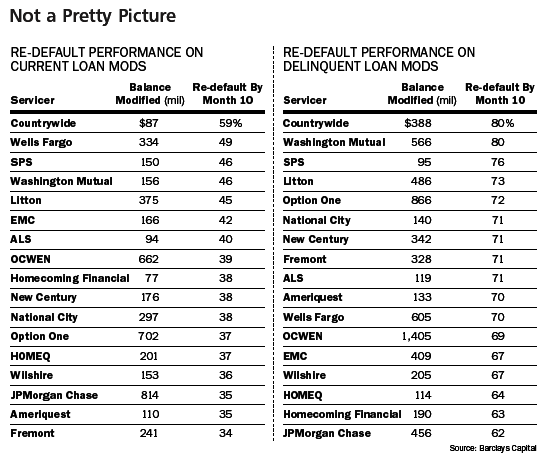
As the tables below show, loan mods seem to lead to subsequent default with distressing regularity. They illustrate the fundamental flaw in the notion, widely embraced, not least by the Obama administration, that loan modification is salvation for troubled homeowners, beleaguered builders and lenders. Loan mods are designed to keep the unpaid principal balances of the lender’s loans intact while re-levering the borrower. Mortgage modifications turn homeowners into underwater, over levered renters for life, unable to sell, re-buy, refinance, shop or save. They turn homeowners into economic zombies. On the left we see the re-default rates of homeowners who were current on their loans when they first defaulted (sounds odd, I know, but these tend to be people who can afford their homes but who subsequently ran into economic problems). The data tells us how many of them have defaulted again 10 months after their loans were modified.

The adjacent table (at right) shows the same thing, only this time with homeowers who were seriously delinquent prior to loan mods. As you would imagine, their re-default rates 10 months after their loans were modified are considerably higher. These are often the people who could barely afford their home (or not at all).

What was significant was those who were not in default (i.e. current) prior to the rush to modify loans, whereby they then took up the offer to modify their loans to either lower their monthly payments or take advantage of lower rates - their subsequent default rates were exceptionally high as well.

The other point to note is that while the default rates are high, they are so because unemployment continued to rise over the last 9 months, and while there has been some recovery in house prices of late, for most of the year house prices has been dwindling down as well. Thus the default rates are understandable to a large extent.

What this shows is that as well intended as Obama's plans were to start with, it needs to be accompanied by a a substantive recovery in economic activity and employment for the plans to work well.

>

Loan Mods Default Rates

loan_-mods-20090710

>


p/s photos: Kim Hee Sun