Showing posts with label bear market rally. Show all posts

Wednesday, October 28, 2009

Where Are We Again In This Financial Crisis & Recovery?


I have posted this chart before from Paul Kedrosky's excellent site. As the chart only looks at the recovery from the aligned lows of each crisis, the first year's recovery was most pronounced, and as usual when it recovers the naysayers during each of these periods were vocal. What is more significant is that the recovery carried on into the second year just by looking at the various charts - and that to the naysayers would be unthinkable at the moment. Markets have a nice way of shocking us - are we all drilled to look at the wrong indicators? I am still thinking 10,800 to 11,000 is easy for the Dow by year end. I would term the most appropriate indicators for each of these crisis were:

a) how much cash was thrown into the system - this crisis wins it hands down
b) how widespread / global were the effects - looks about the same for all except the depression
c) how concerted was the global effort - this crisis wins hands down again
d) how did interest rates behave or were managed - the tech crisis saw Greenspan dropping rates quicker than a bullet (and was the start of the financial mayhem in properties, packaged loans, and the leveraged derivatives on those assets); this time, most of the global central banks are still keeping rates very low coupled with massive stimulus left, right and center.

As argued before, its not that the central banks want rates to be low as that will fuel the property side for the less affected countries, and indirectly push liquidity into stocks when risk aversion mood drops - but its for the greater good because corporate spending, hiring, investments in R&D are not recovering fast enough. Hence they all will tolerate a seemingly higher and hard to justify stock market valuations for the sake of the real economy. The real economy is expected to catch up to equity valuations, maybe they will, maybe they won't. But when you keep rates low enough and you have glimmers of recovery, that will set the momentum.

Are we putting ourselves into another bubble, ... yes... but this one will last some time yet. Its the making of a bubble, we are nowhere near boiling point yet.

Tuesday, September 01, 2009

Bear Markets, Rebound Rallies, Follow Up Correction, Trading Range Bound

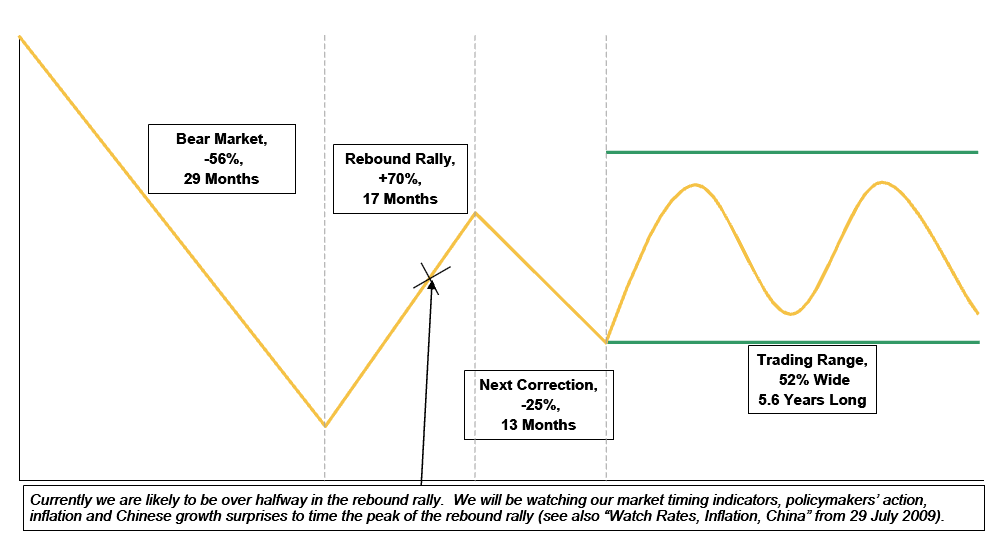
This fascinating composite chart below is courtesy of the Strategy desk of Morgan Stanley Europe. It shows what the average of the past 19 major Bear markets globally have looked like:

>

Typical Secular Bear Market and Its Aftermath

secular-bear-markets

>

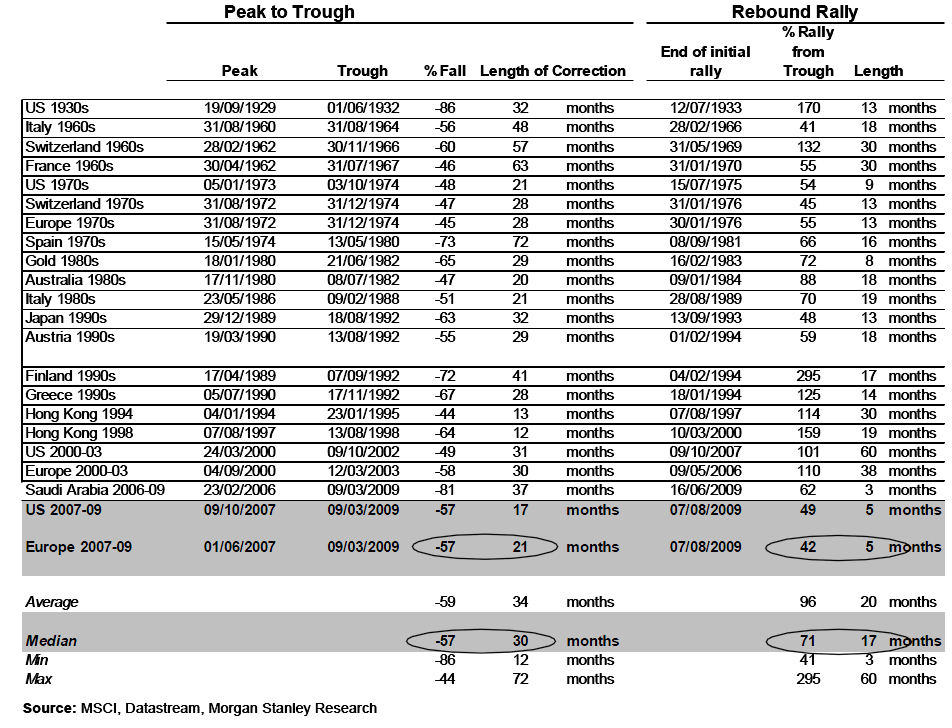
The Chart represents typical secular bear markets based on MS’s sample of 19 such bear markets as shown after the jump. Can we trust what is typical, or are all bear markets alike? The chart should serve as a benchmark to have an idea of where we are at this point in time, and to really seek out if and when there is a subsequent correction in the works.

This table shows Secular Bear Markets and Subsequent Rebound Rally:

>

secular-bear-rebound

Thursday, May 07, 2009

Highest Percentage Of Stocks Above 50 Day M.A. Since Mid-2006


The highly respected folks at Bespoke Investment Group has further evidence confirming the current market rally. It will take a lot to derail the current uptrend. According to the people at Bespoke Research, as the market continues to rally, the percentage of companies now trading above their 50-day moving averages also continues to rise. As shown below, 92% of the stocks in the S&P 500 are now trading above their 50-days. This is by far the highest reading since mid-2006, and it is indicative of extremely strong market breadth.

Spx50day505

Every sector except Health Care and Consumer Staples has a >50-DMA reading of more than 90%. The Consumer Staples sector is at 88%, and Health Care is at 75%. Telecom only has 9 stocks in the sector, and all of them are trading above their 50-days. The Industrials sector ranks second at 98%, followed by Energy and Utilities at 97%. While still high, Financials and Consumer Discretionary have actually seen a decline in the percentage of stocks above their 50-days over the last week. The indicator maxes out at 100%, so there isn't currently much upside room from a breadth perspective. A pullback in these extraordinary numbers would be neither surprising nor unhealthy.

Finlindu505

Inftenrs505

Condcons505

Hlthmatr505

Utiltels505


p/s photos: Deepika Padukone


Saturday, January 17, 2009

Its In The Price, Baby!


Things we know, some pretend experts will always say "its in the price". Is it really in the price already? Stock markets are forward discounting models, hence it would be silly to think that any known news would not be in the price already.

So when the banks started falling like bricks, markets fell. But when Lehman Brothers was allowed to fail (Paulson's gravest mistake), that was akin to saying all bets are off, that no one was big enough not to fail. That is why, in many ways, the collapse of Lehman Brothers paved the way for extreme risk aversion. Investors were calmed when AIG was rescued, followed by Fannie and Freddie. However when Lehman Brothers were allowed to fail, investors realised that other troubled entities might not be rescued.

Having realised his mistake, Paulson and Bernanke basically set about rescuing everything they could. Well, not everything, but every big thing. So, when something's in the price, it depends on the logical chain of events that follow - if that's the case, then its in the price. When something out of the ordinary pops out, then its not really in the price yet.

Markets globally collapsed by between 40%-60% over the last 13 months. One can say its in the price, right?! Well, yes and no. The fall is discounting the recession that will be pervasive. While earnings is expected to be bad, no one is certain how bad and for how long. While there have been extreme fiscal measures by most governments, investors will want to see the execution and implementation are done speedily and effectively (not drawn out over 2-4 years).

The markets was priming itself for a bear market rally stepping into the new year, but was halted by rumours of worse than expected losses by some major entities, e.g. Deutsche Bank, HSBC, Bank of America (having problems digesting Merrill Lynch) and Citigroup. The biggest factor has to be Citigroup as it was not just bad earnings but rather whether the entity will even exists. The losses for the latest quarter was not as bad as the rumoured $10bn. Still, steps have been taken to shrink itself down, so markets are calmed somewhat.

Of more importance was Bank of America. The company just received another $20bn to ease their absorption of Merrill Lynch. So far, they have received $138bn in government aid. What is more noteworthy is that their market cap is only approximately $50bn. Technically speaking, you might as well fold it and restart 5 new banks with the $138bn. However, its not as simple as it looks. Allowing Bank of America to fail is not just wiping out $50bn in market cap, it will also trigger a domino effect of counter party transactions failing. The ramifications which could erase more than ten or twenty times the $50bn Bank of America is worth. The confidence issue will take much longer to return should that happen.

Jim Rogers and those market purists will argue that the weak should be allowed to fail, and that no one should be too big to fail. But the reality does not allow for textbook style economics to be implemented. There is the bigger picture to consider - governments have to contend with the aftermath and flow on effects. You may be able to handle a10% unemployment rate, but what if it escalates to 20%, the social costs will be too great. You may even have to go to war to keep employment up.

Markets have fallen 40%-60%, so some of the recession and poor earnings have been factored in the price. Whether the markets have priced in all is debatable. I am of the minority group viewing that the markets have more than priced in the decimation in demand, poor earnings, company failings (look at the yields on non-prime corporate bonds) and jobs losses. To be sure, I think job losses will continue to worsen and may only peak in March/April, and till then I expect even a few more big companies failing ala Nortel and possibly Motorola. Though not publicised, already more than a few hundred small regional banks and mortgage firms have already closed sop in the US. My biggest argument why the markets have over-discounted the weakness is the absolute non-existence of confidence, and the extreme risk aversion to assets of almost all types. The de-leveraging basically just sped up the entire process. have you see how fast and hard commodity prices and shipping rates have collapsed. This is not a slow death, it is a swift reaction, anything seemingly left standing got its head chopped off, within or without reason.

The committment by the Treasury in the way it is treating Bank of America and the likes shows that they will not let another big entity fail. While many will be pooh-poohing Obama's $1 trillion stimulus, saying that its in the price... come to think of it, its not really in the price considering the markets were at the same level it was 2 months back when Obama wasn't even elected??!! Why do they say its in the price? Its the bear's normal reaction - give me anything, give me any news... I will say the good news will be in the price already, and the bad news that appears are not properly discounted yet. Give the bears any news, it will be considered as in the price already for sure.

I am not saying the bears are totally wrong, but one must view the developments with a proper view of developments. All it takes is just a minor improvement in risk aversion and confidence, and you will find things moving quite fast already. Looking at the markets for the last 2 days, even when the Dow flirted with the dubious 8,000 level... there was sellers' exhaustion. I am not trying to talk you all into believing all is right with the world, but that its not as bad as things seem.

p/s photos: Haruna Yabuki

Wednesday, January 07, 2009

Bad Data, Good Markets

As always, the most important indicator in my view, the yen rate. It has jumped again by a full yen to 94.5. Mark my words, the yen rate is big indicator of underlying market strength. As long as it keeps going up, more funds are actually being deployed back to equities of all types.

If we keep looking at latest released data, that would be pretty useless. The main reason why markets collapsed 6 months back was precisely forecasting the sluggish and depressing economic data we are seeing now and for at least the next 3-4 months. Bad data will not have the "negative impact" it had a few months back because the bad data 6 months ago was the trigger for a major re-evaluation of earnings and a down trending economy. The bad data now is largely playing itself out, hence much of it will not have the theoretical negative impact, or as bears call it "markets are ignoring the bad data at their own peril".


Stocks will have to be the first to move. Commodities will lag as the turnaround will take a bigger u-turn. As this is a risk aversion/confidence oversold market, substantive market gains will ease a lot of worried holders of corporate bonds. The other indicator to watch is the narrowing of corporate bonds and Treasuries spreads, which is also narrowing.
Of course all this will not be a one way traffic, there will be stop-start all along the way. But I am of the view that the markets are OK for the first quarter of 2009.

Looking at the table, we are well on the way to being in the longest recession since the Great Depression. I foresee the recession ending by end of 3Q2009, which would make the recession about 21 months. In fact I am optimistic that we could be out of jail by July 2009 even, thus making it around 19 months.
Considering the vast sums of liquidity and fiscal measures being handed out. The swiftness in response by almost all central bankers. The not-so-shy fiscal measures meted out. We are addressing the issues at a rapid rate. Fair to say that this credit crisis is a massive one as well. There is no playbook or textbook, but I do think the measures are already more than sufficient. We just need confidence to filter back to allow the liquidity to work its way.

BTW - More digging on the IJN-Sime Darby-EPU-MOF saga revealed that Sime Darby has finally called off the proposal. Interestingly, no one was really interested in running IJN, but rather it was attractive as it was sitting on about 12 hectares of reasonably prime and very flat land. Remember that IJN is on Jalan Tun Razak. Twelve hectares is very sizable. Hmmm...
Type
:
Announcement
Subject
:
Sime Darby Berhad’s interest in IJN Holdings Sdn Bhd (“IJN”)

Contents
:
We refer to Sime Darby Berhad's ("Company") announcements on 17, 18 and 23 December 2008 on the above matter.

The Company wishes to announce that it will not pursue its plan to acquire an equity stake in IJN.

The Company arrived at this decision after taking into consideration the public sentiment and feedback received since the Government announced that it had deferred its decision to allow Sime Darby to begin negotiations with the Ministry of Finance on taking a 51 per cent stake in IJN.

The Company, nevertheless, will continue to look for opportunities for expansion in the healthcare sector.

This announcement is dated 6 January 2009.


p/s photo: Fan Bing Bing


Tuesday, January 06, 2009

Ze Obama Rally Clarified


Back to the yen rate as a guide for risk aversion, the rate has literally jumped from 91 to be back above 93 in just a couple of days. We are headed in the right direction. The fact that many more still are more than willing to watch from the sidelines will mean there is some more legs to this bear market rally.

This is what I would term as an Obama rally. What we are dealing with is a market that is risk averse and a confidence crisis. The persistent tackling of the crisis by many governments is still not trickling through as banks are hoarding, companies are still guarded and cost cutting. You cannot undo something that is so intangible as risk aversion and confidence lacking with fundamental measures alone. The goodwill surrounding Obama is precisely the catalyst the markets need. You need to fight intangibles with intangibles - as nutty as that sounds, we all know that is what is happening.

My thesis on the oncoming mother of all bull markets will take time to play out. What we are seeing now is just a bear market rally, probably running for the first quarter. I see a flattish market for the second and third quarters. The genuine bull run will probably come about sometime in the fourth quarter. Hence it may be easy to dismiss this bear market rally, it is still a rally albeit a short term bull run at best.

My belief in this bear market rally is based on the fact that markets do tend to overshoot on the downside during a major correction. The bear market rally basically tries to establish a firmer platform, closer to logical valuation levels, bringing the market to a saner levels while waiting for the economy to improve.

Stockmarkets and the real economy normally would not jive together. Stockmarkets are forward discounting models. The carnage over the last 3 months was basically a reflection that the real economy would be in a difficult period for the 8-12 months down the road. So make no mistake that I am implying things are looking better over the next few months. The next few months will still see difficult periods. Markets always bottom 6-12 months before the economy bottoms out. By appreciating this, we may better embrace the notion that a genuine bull run would probably occur towards the final quarter of 2009.

In line with the yen rate surging past 93, investors has added $1bn to emerging market equity funds in the second week of December. The biggest positive jump over the last 5 months. Of course for the whole of 2008, the total amount of fund being pulled out of emerging market funds totaled was a bit more than $40bn. The willingness to put money back to work in December is thus even more significant in light of the risk aversion scenario enveloping all markets over the last 3 months.

p/s photo: Fiona Xie